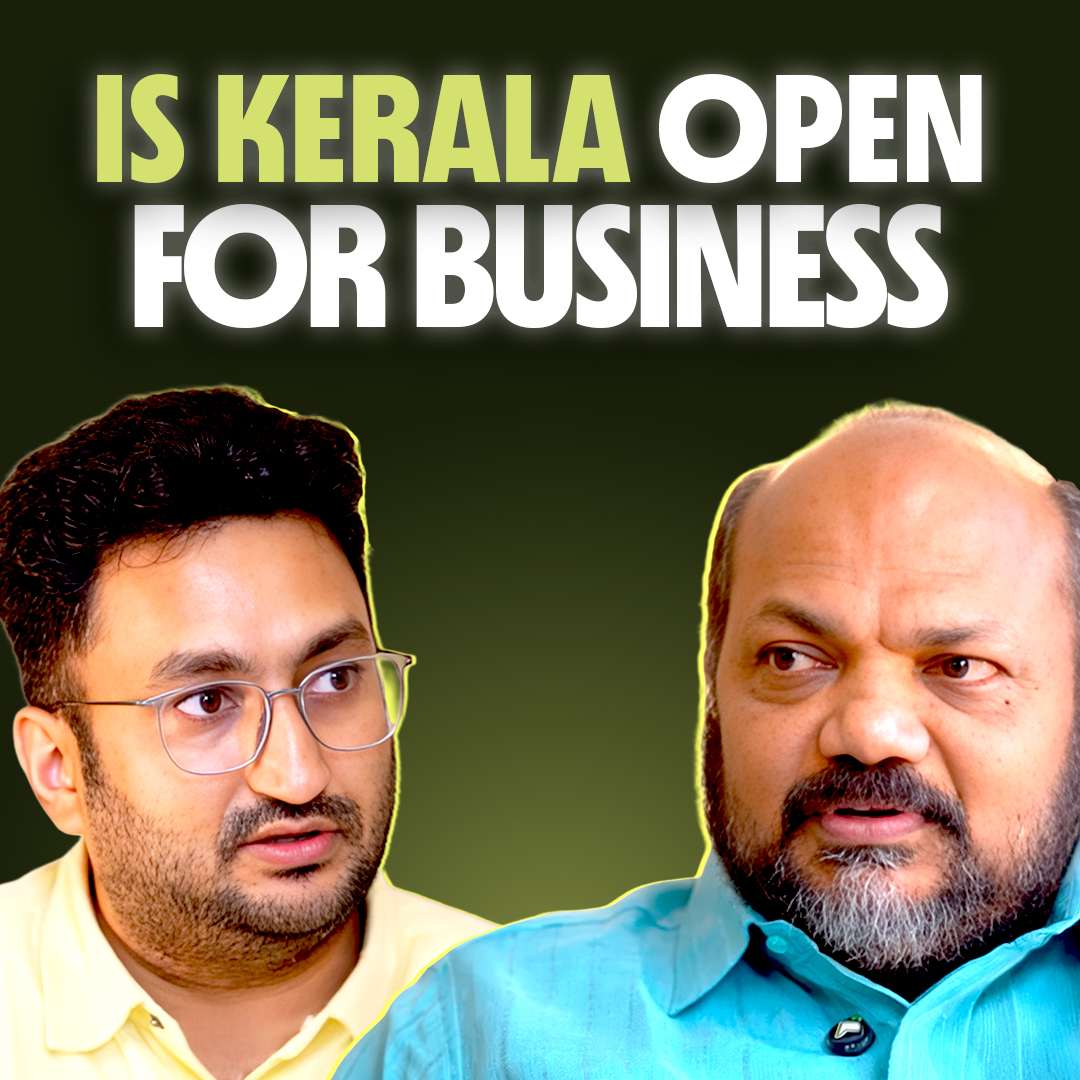




322 / July 28, 2025
Sanjeev Sanyal on Why India has No Big 4, Regulating AI & Ending Population Control
The global strategy consulting market stands at $39.5 billion, with Asia commanding $9.1 billion. India contributes just $1.09 billion. This is despite having the talent; Indians run global back-offices for McKinsey, BCG, Bain, Deloitte, and other consultancies. Yet, India continues to outsource strategy to the Big 4.
Sanjeev Sanyal, PM Modi’s Economic Advisor joins us to break this down.
We discuss the factors helping and hindering India’s growth opportunities. Sanjeev has long worked on improving the process reforms with the belief that this country needs small reforms that will bring huge impact.
We also discuss AI, with a policymaker who strongly believes unregulated AI will be catastrophic. Sanjeev shares his opinions on what could be the government’s approach to regulation, with acceptance of the limited predictability of the future with AI.
If you want to understand India from a policymaker’s eye this episode is for you.
Watch all other episodes on The Neon Podcast – Neon
Or view it on our YouTube Channel at The Neon Show – YouTube
Siddhartha Ahluwalia 0:58
Hi, this is Siddhartha Ahluwalia, your host at Neon Show and also a managing partner of Neon Fund, a fund that invests in the best of enterprise AI companies coming out of India. Today, I have one of the most special guests with me, Mr. Sanjeev Sanyal, part of the Economic Advisory Committee to the PM Modi in India. Welcome, sir, again for the fourth time on the Neon Show. So grateful to have you back again.
Sanjeev Sanyal 1:20
Pleasure to be here.
Siddhartha Ahluwalia 1:21
So, you have been doing so much amount of work. Your work has impacted so much. For example, in the previous podcast, we talked about the patent system that you worked on.
And today’s episode, I want to start with your work on process reforms. What are the various process reforms you’re working inside the government? And you have mentioned a very specific thing that India doesn’t need small reforms, which have large impact.
India needs a large number of reforms, which have small, small impacts. So, let’s take example of three to four process reforms that you have been working in the last one year and the ones that you will be working on in the next.
Sanjeev Sanyal 1:57
So, let me tell you about some reforms I have done. You know, there’s this explosion of these GCCs, global companies are setting up their…
Siddhartha Ahluwalia 2:06
Global capability centers.
Sanjeev Sanyal 2:07
Global capability centers and they are booming. Now, of course, we began doing it from the 90s, we remember, starting literally with call centers. And they were usually the lowest end of the system.
Over time, we have worked up the system, but it’s really in the last five years where it’s really exploded out and we are doing cutting edge research, development, logistics, everything. Now, of course, there are many reasons where we have, of course, you know, some part of it is simply going from that call center, working our way up. But the reason it has boomed in the last five years is a reform that almost nobody knows about.
So, till the year 2000, did you know that essentially even work from home was actually technically illegal in India? We had certain telecom ministry regulations called other service providers, OSP regulations, where essentially anybody using telecom system for any commercial purpose was technically was supposed to get written permission from the telecom ministry. So, all those BPO’s that I was talking of that we had built, all of them had to go to telecom ministry and do Shashtang Pranam.
As you can imagine, there were all kinds of ridiculous restrictions. For example, you couldn’t combine your domestic and international businesses. Now, why?
You needed an EPABX machine at every location, every small chain. All of this not only added to huge amount of compliance, there was a whole lot of rent seeking. So, these telecom officials used to make this thing especially in Bangalore, any BPO you ask from that era, they had to basically pay off somebody, the lawyers had to be paid off.
It was a real mess. Now, when you had the, in 2000 when the COVID related lockdown was put, I discovered this set of problems by pure mistake because the telecom ministry came out with a notification saying the OSP regulations will not apply for the next six months because you have to work from home because of, so we will allow you to work from home. When I read this, I am a suspicious sort of chap.
I realized there was something very fishy about this. What do you mean you cannot work from home? So, I investigated it and I discovered this whole gamut of OSP regulations and telecom related compliance requirements that were there.
And they were absolutely outdated and useless and mostly used for harassment and rent seeking. So, working with a friend of mine who was a lawyer in Bangalore, I will name him Rahul Matthan and I had support and with the blessings of the Honorable Prime Minister and the Finance Minister, I began working on this. And the then telecom minister Ravi Shankar Prasad Ji also was very supportive and we began to unwind these regulations.
So, we undid it one round in November 20 and then in June 21 we undid. And it suddenly made doing these GCC type activities in India radically simpler.
Siddhartha Ahluwalia 5:22
So, I could not understand the relation how work from home help the regulation.
Sanjeev Sanyal 5:27
No, because now I could just take a building. You see work from home is the reason I found out about these rules because I discovered work from home thing was only one part of the OSP regulations. But because I discovered it that something you were not even technically allowed to work from home, I discovered this whole OSP regulation universe.
And once I discovered it, of course, then I went after the whole gamut of them. They are still there in some fashion, but they have been watered down to being basically meaningless. So, now that the OSP regulations had been removed, it is now simple.
Now anybody can set up a thing, you start doing a GCC business, you do not have to go to telecom ministry to get too many. I think there are a few things you need, but they are basically minimal. And if by the way anybody in the audience thinks that they are becoming onerous, please bring them to me, we will water them down even further.
But basically as a result of this, large numbers of companies which wanted to create GCCs but were finding the compliance burden just too much burden. They suddenly opened up and then we have had of course this explosion.
Siddhartha Ahluwalia 6:34
I think today India is a GCC capital of the world.
Sanjeev Sanyal 6:36
Absolutely, we have become the office to the world. But it would not have been possible if we did not remove this rather obscure OSP regulation, other service provider regulation, which I said nobody knows about, but its removal was an absolute catalyst in creating, turning us into a GCC capital. So, this thing was happening anyway, more people wanted to come, but the key thing that stopped them was this OSP regulation.
Siddhartha Ahluwalia 7:03
That is amazing. And what are some other small process reforms?
Sanjeev Sanyal 7:06
So, similarly for patents, that is something I talked about last time. So, when it came last time, we were easing it up. So, what was the problem?
The problem was till let us say 10 years ago, we used to get about 45,000 patent applications and we used to give only about 6-7,000 patents. So, this is the situation in 2015, 10 years ago. Now, just to put it in context, at that time already, China was already giving 3.5 lakh patents. So, filing was a multiple of that. And the US also gives 3.5 lakh patents. Now, China has reached almost 1 million patent grants.
So, you can imagine how many applications they get. Now, there is a quality issue in China. So, I know it is not quite that number, but still even you take the good grant, they are doing about 200-300,000 good patents are giving out.
So, if this is the context, 10 years ago, what were we doing? We were giving out 6,000 patents. And that 6,000 patents also was a huge pain because 45,000 patent applications were there, we are barely giving.
So, many Indian innovators either did not bother to patent or they went abroad to patent. Yeah. Now, I looked into the matter a few years ago and we discovered there were a lot of process problems.
There were all kinds of bizarre system by which you could go through the entire process, which took years. And then at the last minute, you could insert an objection. So, what was happening?
Those who wanted to, the rivals of the patent person would basically wait till he nearly got it. And so, he would never get his patent. And of course, lots of foreign companies were happily undermining Indian research work.
And there were a whole ecosystem of NGOs whose job it is to stop this and funded by these companies. And then if you question them, they say, no, no, you know, they will all give all kinds of goody-goody reasons why. But basically, they were basically fronts for business rivals.
Who will stop your patents from becoming? So, we have changed those regulations. Now, there is a limited time within which you can object.
Objections are needed. But you have to have limit the time, which is what is done worldwide. Similarly, we did not have enough patent officers.
So, we began to hire them. So, in fact, just in the beginning of this year, we have gotten in about 500 new patent officers and 50 to be precise. They are right now being deployed.
The IT systems are being upgraded. So, all of this is being done. So, the net result of this is in the last financial year, we did about a lakh patent grants.
This is more than the number of filings.
Siddhartha Ahluwalia 9:56
Yes, that happened in 2015.
Sanjeev Sanyal 9:58
Because, no, no, we gave a lakh of patent grants. By now, the number of patent applications have gone to about 90,000. So, they have also gone.
But you can imagine 6,000 to 1 lakh patent grants. And this is actually more than the number of patent applications we are getting. So, what has happened effectively, we have cleaned up the backlog.
The backlog is clean. So, now we have a different problem. You, India has now become much, much faster.
I do not know how fast it is compared to the global average. But we are comparable, if not better than the global average. But more importantly, now we are deploying even more people in anticipation of an increase in people patenting here.
So, here is an example where the government is actually ahead of the curve. We are creating the capacities ahead of the curve. We do not actually need this capacity.
And the idea is now the research and development people who used to complain that our patenting system is hopeless, now we can turn around and say, where are the filings? Where are your filings? So, the R&D network now needs to get up and go.
Of course, a lot of support from the government is coming in. We have simplified rules for government labs, so that they are not stuck with the gem portal problems. We are also creating a huge amount of government Anusandhan funds for research.
But really, we need to get our private sector to get out there and do R&D. So, we really need to get our private sector out of this. We also do make steel kind of, you get the impression from talking to a lot of our private sector that they are very guilty to do whatever they are doing.
They are actually in reality an NGO that also makes steel. We have got to get out of it. Our private sector has to be serious about what they do.
They have to be at the cutting edge of what they do. And a lot of that requires R&D. And now, I am sorry, the patenting system is not one of the constraints to the system.
Siddhartha Ahluwalia 12:05
And right now, India is producing 1% of the world global patents. China is producing 21%. So, is there hope that India will match up to China?
Sanjeev Sanyal 12:13
We can.
But that requires, the patenting system is no longer the constraint. The constraint now will be filings. So, the R&D effort has to go up.
Siddhartha Ahluwalia 12:24
And for our audience, if you have a…
Sanjeev Sanyal 12:26
By the way, I am not 100% sure of that statistic. I do not think that is true. I do not think it is 21% vis-a-vis 1%.
In the last financial year, we did 1 lakh patents. They did 9 lakh patents. So, it is not 1 is to 21.
But it is still a large gap.
Siddhartha Ahluwalia 12:43
And for our audience, can you tell what is the average time that a patent is granted right from the first step in filing? And what is the average…
Sanjeev Sanyal 12:50
That varies a lot. But it used to be 8-9 years, which is obviously pointless. I mean, in our technology world, we are now managing to do in within 2 years, I think, which is now roughly the global average for good.
Yeah, but I do not have this, do not hold me to it. I do not know the statistic off the top of my head.
Siddhartha Ahluwalia 13:06
Okay. And what is the average cost involved?
Sanjeev Sanyal 13:08
It is very cheap to do. So, patenting in India is not an expensive thing. It is much more expensive abroad.
Our problem was, it was slow. There were all this problem with this random last-minute opposition. There were problems with people stealing ideas.
So, we have dramatically improved all of this.
Siddhartha Ahluwalia 13:29
And what is the process of upholding a patent like after?
Sanjeev Sanyal 13:33
So, after that, the legal system has to do it. That is an issue we nearly need to work. So far, it was not a constraint because there were so many patents.
Now, the number of patents will dramatically go up. The legal system has to be upgraded to deal with it.
Siddhartha Ahluwalia 13:45
Got it. And these are great examples of how you have simplified, let us say, the pipelines in the government system. Another thing that I wanted to discuss a part of the process reforms that you have been working on is the big seven consulting firms that have been global and most of their talent is from India. But India has been able to produce a TCS Infosys, but not a McKinsey or a BCG.
Why is that?
Sanjeev Sanyal 14:12
So, you have brought up an issue that is, by the way, something that Honorable Prime Minister and the Commerce Minister and many others have also brought up, which is the peculiar situation where Indians are very big in audits and consultancy worldwide. You go anywhere in the world, you will find Indians do well in this space. And yet, there is no large Indian auditor consulting firm.
And I am going to focus on consulting because it is a much bigger business. So, worldwide, this whole business audit plus consulting is about a 280 billion dollar business. Of that about 80% plus is consulting.
So, this is the real business, unlike what people think. Now, this business is dominated by the big seven. These are the four audit firms, old audit firms, the big four.
And let me say that even in those audit firms, the consulting business is much, much, much bigger. So, just because they have made their name in audit does not mean that this is not their bread and butter is consulting. And then, of course, you have the three big consulting firms, which have been there as consulting, do not have the origins.
So, if you add the three up, they are the big seven. Now, the big seven have basically dominated not just the world, but they also dominate India. They dominate consulting, every nook and corner of it.
And it is Indians who run it. And yet, why are there no Indian companies in this space? So, this is an issue that I began to look into a few months ago.
And this is what I have discovered. And a large part of it is apni pair pe kulhari. So, the first and obvious problem, which even the consulting, the Indian smaller consulting firms, they raise, this is that India’s own tendering systems, when government gives contracts and even large private sector gives contracts, we tend to discriminate against our own.
So, we will rather give it to a large global than to give it to an Indian. And that happens because one, very often the tendering requirements are such. So, we will say, for example, there is a 3 crore contract we want to get.
But we will say, we will only give it to a company that has already got a 500 crore turnover. Now, how on earth is, there is no new company. Now, in every other sector, we want startups to boom.
Here is one here will actually stop a and the same point is true for how we think about track records. Let’s say there are three Indians who have done some project in the world, doesn’t even have to be in India, let’s say they did somewhere in the world in one of these top big sevens. But suppose they want to come out and create their own big startup, we don’t give their track record any credence.
Whereas we will give the big seven company the track record, even though these are the three guys who did it. Now again, which other places in the world, in other sectors, do you do this? If somebody has invented something or wants to set up a startup in that field, you give him the full support.
But supposing three young consultants from the big seven come here and they want to do something and they set up their own consultancy, then we ourselves don’t give their track record credence. So, the reason I’m mentioning is that this is one of the reasons we’ll never have our startups in this field. So, this is the second.
But this is about our tendering rules. This is where I started this investigation. But I discovered data.
In fact, while this is an issue, this tendering rules issue, this is actually not the big problem, biggest problem. There are two other problems which are probably even bigger and self-imposed. The first problem is that many of these activities have in them professions which are guided by professional bodies in India.
So, it can be the Bar Council of India, Chartered Accountants Institute, company secretaries, its cost account, various bodies are there, the engineers have something and so on and so forth. Now each one of these bodies basically wants to protect its little pond. Whereas, as I have told you, the real game is sailing the sea.
There’s no point in having these small things because most of these big seven are essentially multidisciplinary partnerships or multidisciplinary firms. That’s why they are able to bring the whole gamut of things, array of services to you and they all feed off each other. If I bring you some IT thing, I will also bring you some audit capability, some business management capability, finance capability, I bring you the full solution.
But in India, our own professional bodies stop you from doing this.
Siddhartha Ahluwalia 18:58
So, for example, for our audience, a person who has a legal firm, they cannot have a…
Sanjeev Sanyal 19:03
Chartered accountant being a full partner.
They will allow you as to being some sidey, but they will not allow you to be a proper partner. By the way, every other body also does the same thing. The architects also have the same problem.
So, let us say, for example, we want to hold the Olympics in India. Now, I’ll need a consultant to work out the thing. Fair enough.
I don’t have experience of doing Olympics. I’ll have to get somebody. Now, how will you do it?
You will need architect, you will need sports management company, you will need finance people, you will need all kinds of people to work logistics, this, that, event management people. Now, the Chartered Accountants Institute will not allow you to bring a sports management expert into the mix. In fact, I am mentioning the Chartered Accountants Institute.
They are actually the most open of the lot. The Bar Council, for example, Advocates Act doesn’t even allow you, anybody but a lawyer. Now, when I make this point, they will say, but you don’t allow an untrained doctor to do surgery.
How are you allowing this? I am saying, this is a ridiculous argument. When you go to a hospital, a hospital has many people working there.
It also has an accountant. By the way, a Chartered Accountant, the hospital also has lawyers in it. They have lawyers, they have doctors, they have surgeons, they have furniture wala also.
That doesn’t mean that when I go there for a surgery, the furniture wala is doing the surgery. So, by the same logic, if you have a multidisciplinary firm, the audits will be done by the auditors, the specialist in legal affairs, the advocate will do the legal work. So, in any case, this untrained professional fear is ridiculous.
Secondly, there are many, many cutting edge things which don’t have this old style thinking of medieval guilds way of doing things. For example, cyber security. There is no medieval guild maintaining professional body for cyber security.
But that doesn’t mean that you shouldn’t do this. This is a major activity of all these big seven companies. But our guys will not allow the cyber security expert into, say, a legal firm.
Same thing with architects. Where are our Indian architects? We are the people, now India has the largest construction sites in the world.
We are building, today we are building airports, railway stations, the iconic buildings of the future are today being built in Mumbai and Bangalore and all these places. But where are our, why are we getting excited about Zaha Hadid? Where is our Zaha Hadid?
Why? Because we don’t allow our own architecture. And here I am coming to the next issue, which also is a problem of branding.
Our professional bodies explicitly ban branding. So, I cannot create a KPMG. So, when you go to, if you go anywhere in the world, but even inside India, many of these conferences, you will see on the board, KPMG, McKinsey, etc sponsoring them.
Why is there no Indian company that does this? Because they are not allowed to. You are not allowed to create branding.
Siddhartha Ahluwalia 22:21
By the various councils.
Sanjeev Sanyal 22:23
Various councils. And of course, the foreign entities are happily able to do this because they have built their brand outside the country.
Inside India, they function through various proxies. So, technically they follow the rules, but their proxies are not the brand. These guys have built the brand abroad.
And now look at what happens. One is, our own consultancies remain midgets. Two, they cannot build a brand for themselves.
Now we are having all these free trade agreements with, now it will also be true of services. Why cannot an Indian consultancy going to operate in the UK, US, etc with which we have free trade agreements either in the process or already done? Because nobody knows who they are.
Even we don’t know who they are.
Siddhartha Ahluwalia 23:10
We can’t count beyond Big 7, any Indian.
Sanjeev Sanyal 23:13
Even Indian, we will not be able to count.
And even if you know the names of one or two, you will discover that they are proxies of those Big 7. So, this is an amazing act where we have, in the name of protection of our thing, we are not protecting anyone. The foreign guys are here.
Siddhartha Ahluwalia 23:29
It’s a kind of imposed imperialism.
Sanjeev Sanyal 23:33
Yeah, on ourselves. So, one of the bizarrest rules is that, like the Chartered Accountants Institute came into being after independence. So, when it came into being in imposed rules, it actually grandfathered the existing ones.
So, there are actually some foreign Big 7 guys who actually operate in India in their own name because they were grandfathered, because they had registered in India before ICA, ICaI existed. So, ironically, it’s worse than not allowing Indians. We actually allow some foreign companies to operate in India being grandfathered.
Siddhartha Ahluwalia 24:09
And why is that these Big 7 know these loopholes and are able to exploit it so thoroughly within India?
Sanjeev Sanyal 24:16
They are obviously going to do it. Question is why do we have these rules?
Siddhartha Ahluwalia 24:20
And what is the solution?
Sanjeev Sanyal 24:21
The solution is that we get serious about getting, first of all, let’s get rid of these archaic medieval rules. These are basically rules of medieval guilds to protect their little box. The game in the world is multidisciplinary.
Now, that doesn’t mean we throw the baby out of the bathwater. Some of these rules actually need to be there for good reason. I’ll give you one example.
For example, restrictions on advertising. Now, not having any rules on solicitation and advertising is a dangerous thing. You will end up with what happens in the US with ambulance chasing and solicitation.
You have advertisements coming out. If you watch television in the US, you’ll see, are you having an argument with your husband? Here is my number.
And we will not charge any fees. For divorce, you can give us a share of your alimony. You know, stuff like that happens in the US.
There are clear misuses. Similarly, they allow pharmaceutical advertisements. All leads to bad outcomes.
I agree. I am not asking you to get rid of advertising and solicitation in the way. You cannot advertise divorce lawyers in the way you advertise Coca-Cola.
Siddhartha Ahluwalia 25:34
And the most billboards in the US are of legal people saying, do you have an accident or do you want to claim an accident?
Sanjeev Sanyal 25:41
Yeah. So, we don’t want that culture. Totally agree.
We do not want that culture. So, that restriction has to be there. But we, that is different from allowing you to create a logo, create a brand, especially when you need to go abroad where those restrictions don’t agree.
So, if an Indian consultancy lawyer, etc. operates in the US, there the laws allow it. They should be allowed to do it.
Advertising there as well, not in India. There we will restrict our own market to our thing. But, you know, don’t throw the baby out with the bathwater.
That’s the point I mean.
Siddhartha Ahluwalia 26:14
And right now, are you working with these various councils to…
Sanjeev Sanyal 26:16
Well, I have gone and spoken to a few of them. I mean, in each one of them, there are pulls and pushes. Many of the younger members of these councils want change.
But many of the older ones obviously have incumbent systems where they benefit from the perpetuation of the system.
Siddhartha Ahluwalia 26:32
And does the government have any influence on a long-term plan?
Sanjeev Sanyal 26:35
Well, some of them, the government can change rules, regulations, but many of them as a, you know, I think, first thing I’m trying to do through, say, doing a podcast is get people to understand what is going on. You see, unless there is a general discussion, a public discussion about this, you will not get the change. So, one of the things you got to do is, you know, why isn’t there Well, I’m sorry, because in many cases, it’s not the government that is stopping it.
It’s the professional bodies themselves. And much of it is about protecting a little bit of turf. This is a classic example of trying to save your little pond when the game is about sailing the high seas.
That is, a lot of this is about that.
Siddhartha Ahluwalia 27:13
And it’s a very important reason to understand why the IT services industry in India got created is because there was no body controlling…
Sanjeev Sanyal 27:21
Absolutely. The government officials didn’t know anything about this because they hadn’t used computers and there was no medieval guild called the IT, Chartered IT Professionals Institute of India or the Bar Council of IT Professionals.
Siddhartha Ahluwalia 27:37
So, you need that kind of freedom initially to build an industry.
Sanjeev Sanyal 27:41
Absolutely. Now, this is not to suggest that there aren’t areas where you need restrictions. For example, in artificial intelligence, you will eventually need, in fact, we quite quickly will need some kind of regulation.
But, you know, so I’m not saying everything has to be laissez-faire. There has to be rules for ethics, there has to be rules for professional behavior. I’m in favor of all of this.
But I cannot understand why you need to have them in silos.
Siddhartha Ahluwalia 28:10
And is there a solution also be like China, where you can say the 50% of the consultancy contracts have to go to Indian companies if you’re operating in India?
Sanjeev Sanyal 28:18
Yes. But you see, even there you have to be careful. We first need Indian companies who can be a part of that.
Siddhartha Ahluwalia 28:23
Very interesting. I think it doesn’t have a short-term solution right now.
Sanjeev Sanyal 28:28
No, it will. You see, there are so many Indians in this space. The moment we open it up, large numbers of Indians, both based in India and many based abroad will start.
This is ripe for starting. We have to get out there. As I said, we have to know which bits we need to open.
There are places we need to maintain certain controls. I’m not saying no control. So, as I said, I have problems with advertising and solicitation, but that does not mean we can’t allow logo creation and branding, different things.
Similarly, you do need to have certain ethics and professionalism codes and so on and so forth.
Siddhartha Ahluwalia 29:07
And among all of these things that you discussed, which is the first thing that you think is the most important that we need to strike down for creation of new companies in consultancy from India?
Sanjeev Sanyal 29:17
No, no. This will have to be done simultaneously. Because you see, I can’t ask the chartered accountants, who by the way are the most forward-looking of the lot.
They will open up, but the others don’t then what’s the point.
Siddhartha Ahluwalia 29:30
And creation of multidisciplinary firms.
Sanjeev Sanyal 29:32
Basically, a multidisciplinary partnerships, multidisciplinary firms of various kinds. And then you have to have allow rules for them, allow them to raise money, do various things. For example, a consultancy can be a listed company, but it may be difficult to have an audit company having listed company because they in a sense, they cannot be driven by short-term profit share price things.
So, the certain areas you can create Chinese walls between different activities. So, you have to think it through. It’s not just a laser fair, do what you want. We have to have certain restrictions and controls.
But the old way of doing it as medieval guilds, I’m sorry, the game is over on that. We need to get away from that.
Siddhartha Ahluwalia 30:16
Which brings me to another interesting point, right? We now covered big seven, but the world has leapfrogged into AI. And one of the things that you have been pioneering is AI regulations.
Let’s talk more about that and why we need it now and not 10 years down the line.
Sanjeev Sanyal 30:30
So, actually people do not understand the extent to which everything they already do is run by AI. Social media is run on the back end, is run by AI algorithms, all kinds. You already are victim of it.
When you’re getting into your bank account, all your security systems, cyber security systems, and they are all talking to each other as well and evolving. Now, when you have this big integrated world where AI systems and they’re all integrating and talking to each other, the dangers of a major mishap are multifold. And you got a taste of that just last summer when one line of coding was there and I think it was a Microsoft some upgrade.
Siddhartha Ahluwalia 31:11
Cloud strike. And all the airports got shut down.
Sanjeev Sanyal 31:12
Airports got shut down, ATMs got shut down, all kinds. Now, remember that is not an AI breakdown. That was a static code.
Okay, now imagine AI code which black boxes, human beings don’t even quite know what’s going on and they’re all talking to each other. Imagine the major breakdowns that can happen. It will all function perfectly till it blows up and then it blows up.
On the same day, your IT systems won’t work, your power supply will break down, your financial systems will short circuit and nobody will know what on earth is happening. So, I am just saying that we are setting ourselves for catastrophic failure at some point in time. It may not happen for a long time and it may look like it’s working beautifully till it fails.
But when it fails, there will be catastrophic failure. So, AI systems need to be regulated. Not just me saying it, many people in that field, we are the cutting edge.
Elon Musk is of course talking about it. So, we have to think about this quite seriously. So, there are different people thinking of this.
I have of course written about it. There’s a working paper written about couple of years ago on AI regulation. So, look it up if you are interested in this topic where I have taken a complexity theory view of it.
So, what is this? You see, I am very much into complex. Those of you who don’t know this, many of what I am saying derives from a framework of thinking called complexity theory.
And one of the points about complexity theory is that systems are so complex and evolving, evolving complex adaptive systems that human beings cannot fundamentally predict where they are going. It’s not about how brilliant I am. You can’t predict it, I can’t predict it, Elon Musk also cannot predict it.
Siddhartha Ahluwalia 32:54
Yeah, he was part of Doge one day and now he’s not part of that.
Sanjeev Sanyal 32:56
So, therefore, this AI driven system is a complex adaptive system. It’s not about being an expert trying to figure it out. Now, if that is the way it is, how do you regulate a system where no expert knows how it is going to evolve?
So, there are different approaches to this. One is the US and also to some extent UK approach, which is less of it. Let it, let what will happen, let the people in that sector do it.
Now, their idea is that ex-post should it go wrong, they have a system of tort laws. So, if it goes wrong, you have skin in the game, you are going to put a billion dollar fine on you or class action suit and you can be destroyed. So, the break on their system is that.
Now, whether or not it will work in this case or we can debate, I mean, you can say that post facto thing, but at least there is that fear that is there. In India, there isn’t such a system. We don’t have these kinds of class action suits where you can be large companies were completely bankrupted by such a thing.
The European Union is trying to do it through bureaucratic thing. They are trying to create buckets where bureaucrats will decide is this artificial intelligence dangerous, not dangerous and so on. Now, let me tell you this is likely to fail even more spectacularly because how does this bureaucrat know whether some artificial intelligence thing is dangerous or not.
I mean, I understand artificial intelligence running your nuclear warheads system is a dangerous thing. But beyond that, let me tell you, you can’t tell because something that is innocuous today may turn out to be very dangerous later on. So, since we cannot quite tell what is going on, it is a waste of time trying to get, you know, it’s not about having the most brilliant bureaucrats running this.
They can’t do it because we don’t know how it’s evolving. So, this idea of trying to put you know, levels of risk badges on AI is in my view a waste of time and 100% going to fail. And the same reason why the Chinese system where, you know, where the Chinese state knows everything is also going to fail.
And one big area of failure we already, the world experienced is that they were messing around with COVID vaccines and they lost control of it. And we had the COVID outbreak. So, the Wuhan lab people at least presumably were taking some care about the kinds of messing around with the COVID viruses that they were doing.
But much of this AI is done even without the little or kinds of protection that they were doing. So, the dangers of AI being run and the hope that the Chinese know what they are doing, even assuming that they are being benign. Of course, in many cases, they may even be malefied.
But even assuming that they are being benign and they may lose control of it. So, my own view is all of these systems in the end are setting us up for a major AI blow up. So, I have put up a paper saying that look, whatever system we have, whatever AI thing we have should be agnostic to our ability to predict where it will go.
Now, you may ask how on earth do I do this kind of regulation? So, it turns out that we regulate other things like this also. After all, we regulate financial markets.
Do I need to know where a share price will go in the future in order to be able to regulate the stock market? I do not. Why?
Because the financial system is also a complex adaptive system. But we regulate it. How do we regulate it?
By doing the following thing. First of all, we are agnostic to where the system is going. So, the regulations are not related to trying to predict where it goes.
Two, we have certain built-in systems of circuit breakers. So, here we have to have systems of circuit breakers where you can circuit break and you have a system of manual overrides in the stock market. You have to have them here.
You force audits. We have to have force audits of AI systems for explainability. Just like you have to explain your account, how did you make that money?
We have to have audits where the AI system whoever is running it has to explain why the AI system is doing what it is doing. So, you have to have regular audits of explainability. Then, we have to create walls with compartmentalization.
Today, we think we should have one great internet of things, one great AI of things, I am sorry, cause all kinds of catastrophic failures. In financial systems, we create between subsidiaries, between group companies, we create all kinds of walls. We do not allow industries to own banks, for example.
So, we have to allow these kinds of walls, we have to create between different kinds of AI, so that all of them do not break down at the same time. So, all of this has a, each one of the things that I want AI to do has a parallel in financial regulation. So, we can take that experience and create these regulations.
It will mean, however, that we will have to be willing to give up certain kinds of AI integration. And not just for India, the world has to be willing to do it. But in India at least, let us begin to force certain kinds of explainability requirements.
And then you finance the development of it with these. You say, yes, you develop AI, we will give you funding, government will maybe give you funding somewhere private, but cannot be a blank box, you have to have explained. And this should be imposed even on other companies, foreign companies operating.
If you are selling a software here, you have to explain why your software is able, does it. At some level, we have to ask this, for example, social media companies to tell us your algorithm. What is the algorithm you use, explain it to us.
Why does it give a certain result, not some other result?
Siddhartha Ahluwalia 39:05
Are you proposing to build a new like body like SEBI for AI?
Sanjeev Sanyal 39:09
You may need it eventually. And I think other countries in the world, I know that the big tech will resist this. But I think next year, we are going to have this big conference in India on AI.
And I think this conversation needs to be had. It’s something that humanity needs to think about.
Siddhartha Ahluwalia 39:27
And because now we are stepping into self-driving cars, US has already like proven a pilot works, right? It’s controlled entirely by AI.
Sanjeev Sanyal 39:35
Yes. Now the question is, to what extent is the car autonomous? And to what extent is sharing information to our centralized system?
If there is a centralized system that controls all the cars, let’s say we end up with, then you know, then do they also control the Prime Minister’s cavalcade?
Siddhartha Ahluwalia 39:51
And among the steps that you suggested, is anything about to get implemented in the next few years?
Sanjeev Sanyal 39:59
In this, no, we need a global debate on this. I think AI regulation, oddly enough, has got completely sidelined to all these developments and LLMs, etc. The world is getting dazzled by the AI capabilities, not realizing that we need to restrict them.
And so the debate on regulating AI has completely got sidelined. To the extent it happens at all, maybe it is ironically paid for by the tech companies themselves. So naturally, you know, they are as good at telling us what to do about regulations as, you know, pharmaceutical companies funded research on medicine.
Siddhartha Ahluwalia 40:44
And my fear is, for example, the SWIFT system was created by the US. And this also, you know, it might be ending that the world might adopt a system where that is dominated by the US.
Sanjeev Sanyal 40:56
No, no, US or not. Point of the matter is what are the, even the US itself needs to have limits on the system. The AI system will grow past the limits of the American government as well.
Siddhartha Ahluwalia 41:08
And you think the world will only act now once it sees a catastrophic failure?
Sanjeev Sanyal 41:12
So I am trying to warn people against this. So let’s see, maybe a discussion will start and maybe through podcasts like yours where we get this into the discussion. But right now, AI regulation has not really gathered any pace at all.
Siddhartha Ahluwalia 41:26
Because globally, I think it’s impossible to get all countries.
Sanjeev Sanyal 41:30
Never mind, at least have the major countries. The good news is that AI development is there in some five countries in the world. So conversation only needs to be had between these five countries.
Siddhartha Ahluwalia 41:41
Okay. And that brings me to our next, you know, you have been working a lot on the demographic divide and the demographic problems that India is facing and the world is facing. For example, we don’t have a structure on what second order effects will the falling population will have on the world in 2050?
Sanjeev Sanyal 42:02
Yes. So at least in the rest of the world, they are now beginning to see the impact of dramatic declines in birth rates. And the fact that fertility rates are now so far below in many countries below the replacement rate.
And so in countries in Europe, for example, they’re beginning to already, it’s causing a problem. China will face a problem in the coming decade, Korea and so on. Japan, it’s already a problem.
But here in India, we keep chanting ad nauseum, we are the youngest country in the world. Let me tell you, we are not the youngest country in the world anymore. They are younger countries in Africa, in Philippines, Pakistan, they are younger countries than us as well.
But even ourselves, we, while we are now for in the sweet spot for the next 25 odd years, because we’ll go through the dividend, the demographic dividend phase, do be clear that on the other end of this, we will age as well. And I’m beginning to point this out before it becomes overwhelming problem, because it’s not in the discussion at all. In fact, we still have population control programs in many parts of the country, whereas in fact, our population fertility rates and have already fallen below replacement rates.
So, in most countries, people talk about total fertility rate required for a stable population is 2.1. Let me say that for India, it’s much higher because we have even now, despite declines in child mortality, we are still above the global average. Secondly, the number of women in India for several decades was, there was an imbalance in gender ratio at birth. That has gotten fixed now, but there is in the pipeline, a couple of decades of where the number of women become of childbearing age will be below what would have otherwise been the case.
So, if you adjust for both of these things, then our required fertility rate is 2.3, 2.4. And we are already at 1.9 and falling. And the only reason we are at 1.9 is that it is Bihar and UP have still high fertility rate. If you take the rest of the country, it is much below requirement.
There are parts of the country where we have Japanese level of fertility. Now, this is very, very important because we need those parts of the country to ramp up their fertility something reasonable. Unfortunately, it becomes a political debate in India.
So, the southern states complain that their fertility is too low and migrants from the north are coming. I am sorry, rather than complain about the UP, Bihar fertility rates, they should be trying to increase their own fertility rates because UP, Bihar fertility rates are rapidly declining. They will also be below replacement rate in not too distant future.
So, you cannot rely on them. So, rather than complain about them, I think the states where it has fallen needs to begin to have a serious discussion about what to do. Now, this is a very tricky issue because no country in the world has once their fertility rate has fallen below replacement has been able to push it back up.
In places like South Korea, it is down to 0.6, which is so low that in one generation, there is a danger that their population will fall below by two-thirds. So, it will be a decline where their school and university system will not be able to function. So, these are very serious issues.
So, in our case, we haven’t reached that situation yet. But I am just pointing out to you that we still have population control programs. You’ve got to kidding me.
We should shut it down everywhere, including in UP and Bihar.
Siddhartha Ahluwalia 45:43
But what about the debate about quality of life versus them?
Sanjeev Sanyal 45:46
So, let me tell you, quality of life today in India with 1.4 billion people is higher than it was at independence. So, it’s really about how we use people and deploy them. So, our quality of life will increase if GDP growth grows.
So, I am not advocating going back to having five kids. I am just saying that we as a population cannot, all we are doing by having very few kids today, all we are doing is essentially creating a situation that yes, we will have a nice period where growth will be good. But then we will end up rapidly aging without a young population to keep the system running and pay taxes.
So, it is not the case that we will have, you and I, if there are no next generation to pay the taxes and keep the roads running, when I am 80, who’s going to run the system? I have to have those, those people have to be given birth too.
Siddhartha Ahluwalia 46:42
What are the other second order effects that people don’t think about? Let’s say, you have said about enough young working population to pay taxes.
Sanjeev Sanyal 46:49
And keep the systems running.
Siddhartha Ahluwalia 46:51
Working in the system.
Sanjeev Sanyal 46:52
Yes. And AI will not replace all of this. I am sorry to say, AI will not be paying taxes.
It will not be, you know, providing, running those AI systems. It’s not like AI, you know, AI may do a few things. People are overestimating.
AI will do a lot of interesting things, but there are a lot of things human beings will also be doing.
Siddhartha Ahluwalia 47:12
So, you have said in your other podcast as well, the first thing that AI is replacing, where people expect the lower, the blue collar jobs to get replaced, AI replace lawyers and accountants.
Sanjeev Sanyal 47:22
Yes. So, AI will replace white collar. What’s so bad about it?
But did every technology actually created more jobs than it killed? Because when in 1750, the Industrial Revolution was just starting, the first engines began to emerge. People said, oh my God, this will actually reduce jobs in textiles.
Then when the railways came, oh my God, this will reduce jobs for, you know, people who are running horses. It didn’t reduce it. Actually, the world has a much bigger population and far more people are working.
Many people are too busy perhaps. So, there are the number of technology kills a bunch of jobs, but usually it creates even more jobs. And there is no reason to believe that AI will not create more jobs than it kills.
But it does mean that we have to be open to the shift that will happen. And consequently, rather than try and fight AI, we have to be willing to transition into the new areas where the new jobs are. After all, who thought that social media influencer would be actually a profession?
Who thought a podcast will be a profession? You are the creation of technology. And so is every other job.
I mean, the person who we are now scared, oh my God, you know, driverless cars would replace drivers. Let me tell you that an earlier generation said that, oh my God, those drivers would be, you know, they were replacing the horse cart guy.
Siddhartha Ahluwalia 48:54
Or things like app based taxi would replace the drivers which are Kali Pili’s of the world. It would create more number of drivers.
Sanjeev Sanyal 49:00
Yeah. So, in fact, exactly. So, there are far more taxi drivers in this country today after Uber and Ola, etc.
Then they used to be in the Kali Pili age. Whereas in those days, the people said, oh my God, you know, taxi drivers will be jobless. No, in fact, we have far more taxi drivers today.
Siddhartha Ahluwalia 49:17
Yeah. And what are the other important things? Let’s say, if we keep on our population at like 1.9, right?
What are the other things that India is not prepared and thinking about what will happen in 2050 then?
Sanjeev Sanyal 49:33
So, demographics is something that is somewhat predictable. So, this is one of the few things in economics that has some ability to predict. Because we know today the birth has already happened of those who will be workers 25 years from now.
You can’t create a human being out of thin air. So, this is one of the few things that are sort of predictable. For most other things, let me say, we will have to basically be flexible.
So, in fact, I keep telling people that, look, I have no idea where those new jobs will come from. But my thing is that as those new jobs emerge, I should have training systems, I should have laws, all these things need to evolve with it, which is part of the discussion we heard earlier about multidisciplinary partnerships. When those various professional bodies were created, these multidisciplinary bodies did not exist.
So, therefore, they were not created for it. They had basically derived from what existed before them, which were basically medieval guilds. So, they continue to be some slightly modernized version of a medieval guild.
Now, we have to move to the next stage. So, flexibility with our times is more important than ability to guess where this will go. We don’t know where this will go.
So, allowing for things to evolve, emerge, new things to emerge, adapt to it, reskill for it, rather than fight the system.
Siddhartha Ahluwalia 50:58
And the other important thing that you have shown is that building advanced capacity like the patent system, which prepares.
Sanjeev Sanyal 51:05
Which are basically platforms that allow new things to happen. So, create, that’s why ease of doing business, encourage startups, encourage new companies, encourage small businesses to become bigger, MSMEs. MSMEs are not about remaining small.
Some of those guys should become big over time. They are an ecosystem that is throwing up new experiments all the time. So, a culture of risk taking is, in fact, more important than my ability to be able to predict where this whole thing is going to go.
Siddhartha Ahluwalia 51:35
And is the system encouraging now?
Sanjeev Sanyal 51:37
Yeah, absolutely. This is where the Honorable Prime Minister’s effort to change our thinking process is very, very important. We were a great nation in ancient times because we were national risk takers.
Not because we were sitting at home and being scared of the rest of the world. No. India was a great mercantile nation.
Indians in ancient times, we used to sail all over the world. Indian merchants were visiting Rome. They were visiting Japan and China and Korea and so on.
And one of the things that we are trying to do is to encourage this spirit. And one of my little effort in trying to kind of revive this is that I’ve been part of designing and building an ancient Indian ship from the Gupta period, using the technology of that time, which is stitched ship rather than nailed together wooden ship. And it has nothing modern in it.
It’s now been fully built. It’s called INSV Kaundinya. It’s a part of the Navy, by the way.
And end of the monsoons, we are hoping to try and figure out how it sails. And assuming that we figure out how the ship handles, we’ll try and sail it to Oman later this year.
Siddhartha Ahluwalia 52:54
Congratulations. This is a big news on a personal front. And another big news is that one of your books, Revolutionaries, is getting converted into a prime video series.
Sanjeev Sanyal 53:01
Yes. So, in fact, that’s true. My book, Revolutionaries, has been converted into an Amazon prime series.
But even there, one of the reasons I wrote it is because I wanted to give people a sense that our historical characters were risk takers and that you had this other spirit of militant and militant resistance to armed resistance to the British, which was part of our freedom struggle, which has been quietly edited out. And you get the impression from reading our history books that, you know, our freedom struggle was about nonviolence, was basically about begging, very politely begging the British to leave. And after that, they very patronizingly, condescendingly left.
That is not the case. There was an armed resistance, which is just as important. And I’ve written about it.
And it’s now being converted into an Amazon prime series, which should be out next year. But the idea here is, again, showing that we were, you know, we have a much more risk taking active culture, which we have, unfortunately, you know, we have tried to sort of diminish it for a variety of reasons that we diminished it. But I’m trying to sort of get young Indians to embrace this somewhat more, you know, energetic Indian culture.
So, yeah, so that’s basically the idea.
Siddhartha Ahluwalia 54:24
One important thing that I want to touch again, and we covered a little bit of it is, why is, we discussed about why is India not able to create a McKinsey when it can create a TCS or Infosys. But in any other field also India is not able to replicate that.
Sanjeev Sanyal 54:39
No, no. So, that’s because we, it’s in our, cobwebs in our own head. These cobwebs are totally inside us.
Nobody is stopping us from creating our own. So, why did it? Because nothing existed in that space.
Therefore, it was able to go. Otherwise, our own regulations don’t allow, our incumbents in those areas will use, you know, whether professional bodies or some other, whatever industry body will try and do this. You know, this is the reason.
In fact, now that I have, you know, now it’s well known that I have been involved from now several years, last eight years in getting reforms done. Let me say that the bulk of the reforms that I have done have been basically not because the industry bodies of that sector were pushing for those reforms. And that shouldn’t be surprising.
Because in most cases, the industry body actually is reflects the incumbents. So, they actually like those regulations because it’s a moat for protecting themselves from other new entrants. So, I am afraid the industry bodies in India are by and large not encouraging of change.
They are therefore consequently quite happy to continue their, you know, very rarely do I have industry bodies coming and asking for some research or change. They are mostly asking for protection. So, this is something that we have to change.
This cannot come from government. It has to ultimately come from a general culture in society, which has to ask for this. And that’s why, you know, I keep saying that economics, politics, business, all of these are ultimately downstream of culture.
So, as long as culture is, you know, is one that encourages the pursuit of excellence, encourages risk-taking, encourages new ideas, then you will have a culture that does it. Moment the culture unwinds, all the rest of it, from government policy to even the private sector will behave in a different way. And I am a witness of it.
Again, I saw that in my own lifetime and what happened in Kolkata. Once the culture changed, you know, the entire cluster broke down. And it didn’t just break down in the business front.
It broke down in everything. It broke down in, even in the culture’s area itself. I mean, where is today’s Tagore?
Where is today’s Satyajit Ray?
Siddhartha Ahluwalia 57:00
And you have been saying another thing that in the next 25 years, Kolkata might become empty, one because the population…
Sanjeev Sanyal 57:08
No, it won’t become empty. It’ll just become a backwater, which it already has. And I keep, you know, many people get, many Bengalis, my fellow Bengalis get annoyed sometimes that I keep criticizing today’s Bengali culture.
But you know, frankly, that is because I get frustrated. We are a proud people. And we have the legacy of a culture that did great things in multiple fields.
I mean, over the last many hundred years, we created, you know, modern Hinduism is the creation of Bengali, Bengalis like Swami Vivekananda and Sri Aurobindo and so on. Some of the greatest scientists of India were Acharya Jagadish Chandra Bose, etc. A lot of modern Indian business was created in Kolkata, you know, with Bengal chemicals and Duckback and Sulekha inks and all these.
So, you know, today, nobody imagines that Bengal has a culture of business. We have associated ourselves with trade unionism to such an extent that people don’t realize that Bengalis were famous as businessmen through most of our history. India’s biggest port for most of its history was Tamralipti near IIT Kharagpur, Tamil Nadu.
And yet nobody thinks of Bengalis as businessmen and yet that’s what we were. I mean, Bengali legends are full of businessmen like Chand Saudagar and so on. So, you go back to Bengali folklore, it’s full of merchants, not today.
Siddhartha Ahluwalia 58:36
Another thing that I want to touch upon is your work in agroforesting. Would love to discuss it.
Sanjeev Sanyal 58:41
Same point. You know, we have these regulations in India where you do not actually allow the Indian farmer to plant trees and grow them, cut them and sell them as they wish. All kinds of restrictions are there.
Now, this is ridiculous where, you know, for example, teak, we import teak. Now, teak is an Indian plant. If you just plant it in your back garden, it will grow wild and it’s a valuable plant and yet we have all kinds of restrictions on growing teak.
So, my view was, it’s the same logic. Why? Oh, they may cut some teak in the forest.
Hello, that’s a matter of doing a better job of managing the forest, not imposing more and more rules on my farmer. So, this is the thinking process is wrong and it comes from this bizarre top-down, you know, let’s regulate everybody, let’s squeeze the whole thing. Everybody, if the forest guard also solving his problem, forestry department doesn’t care about actually increasing the value, volume of teak grown in the country, then the value of that teak tree in the forest will also decline.
There will be no incentive to cut it. But that is not how people think. Everybody wants their little pond to be somehow saved.
Then the forestry officer will get some powers. He will misuse it to extract rent. This is what goes on in every little sector in the country wants to extract rent from their little turf.
And so now when you magnify this into a network of these little turfs, you end up with the problems we have in India. So, we need to break this down and that is basically what I am attempting to do.
Siddhartha Ahluwalia 1:00:14
Thank you so much, sir. It’s been amazing to have this fourth conversation, a very different from one we had previously and so much we covered in the last one hour.
Sanjeev Sanyal 1:00::21
Thank you so much.
Siddhartha Ahluwalia 1:00:23
It’s been a pleasure again.


Know when new episodes are released. Subscribe to our newsletter!
Explore Playlist

Is India Making Most of It’s GDP Growth? with Prof. Arun Kumar


This Is How GEOPOLITICS Really Works | Rajiv Sikri, Ex-IFS Officer On Power, Trade & War