



357 / February 15, 2026
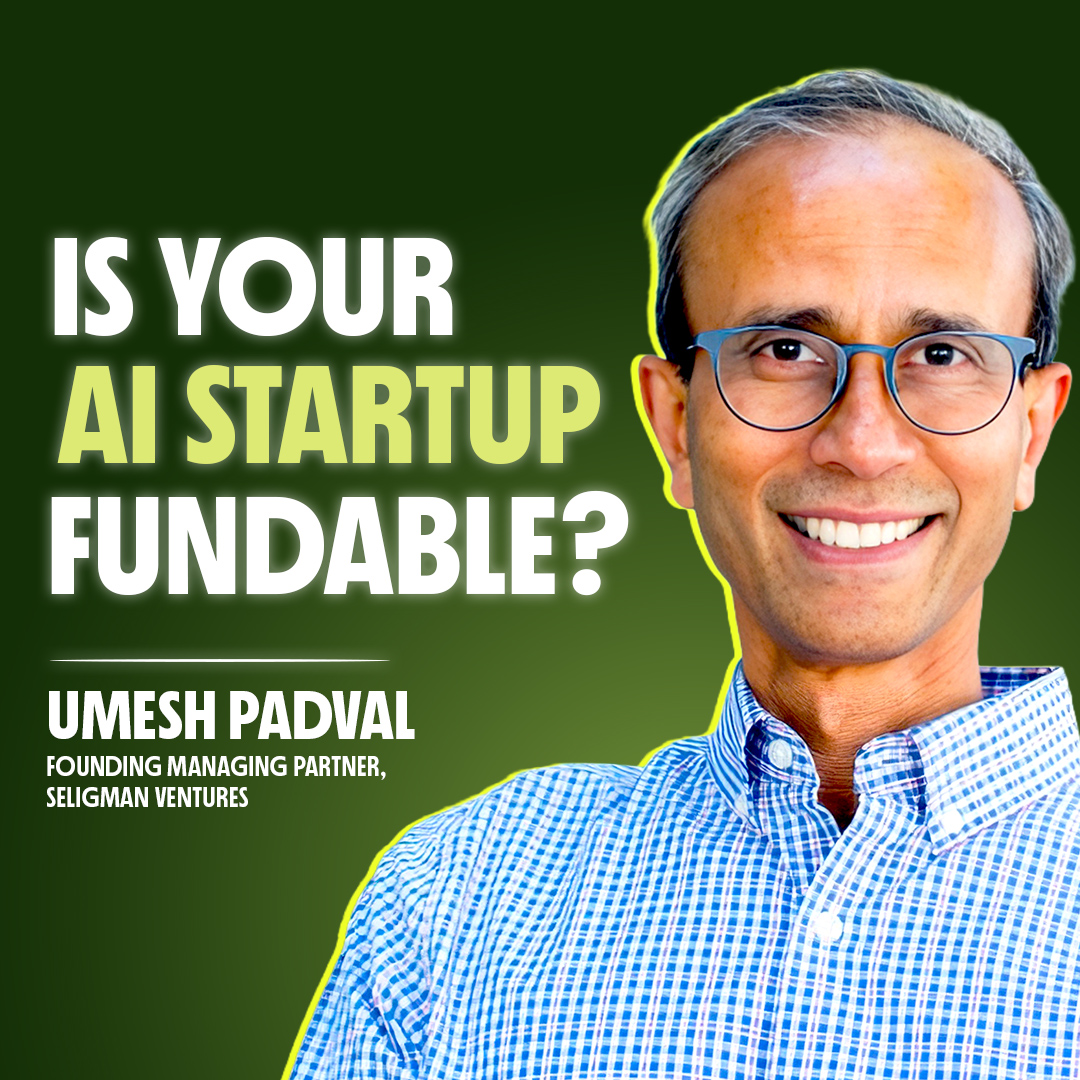
What Top 1% Investors Look For in AI Startups | Umesh Padval, Seligman Ventures, Ex- Bessemmer
Do startup valuations today make sense?
Umesh Padval, an early investor in Cohere, now valued at about $7 billion shares why Cohere stood out at the time of his investment. He shares what he saw early that made him believe this was not just another AI model company.
Umesh is the Founding Managing Partner, Seligman Ventures and previously at Thomvest and Bessemer Venture Partners. He brings experience from investing across multiple tech cycles, from chips to cloud to AI. Umesh talks about how deals are really done in venture capital and what he looks for when everything feels noisy and crowded in AI.
He also shares why many strong companies are choosing to stay private and what has changed in the IPO market. Public markets now demand cash flow and durability, not just fast growth.
Umesh talks about why open source has become a powerful sales funnel for modern AI companies. Developers become the first users, and community adoption turns into long-term enterprise revenue.
After four decades in Silicon Valley and 20 years as a VC, Umesh shares what keeps him in building and investing.
Watch all other episodes on The Neon Podcast – Neon
Or view it on our YouTube Channel at The Neon Show – YouTube
Siddhartha Ahluwalia 0:44
Hi, this is Siddhartha Ahluwalia, welcome to the Neon show. I am Managing Partner at Neon Fund, a fund that invests in the best of enterprise AI companies between US, India, corridor like Atomicwork, SpotDraft, CloudSEK. Today I have with me a very accomplished founder, board member and a venture capitalist, Umesh Padval.
Welcome Umesh on the Neon show. You have been a former General Partner at Thomvest, previously a partner at Bessemer. I would say such a rich career in the last 30 years.
Umesh Padval 1:15
Thank you. It’s entrepreneurs who make me successful and I am delighted to be here with you and thanks for the opportunity to speak with you.
Siddhartha Ahluwalia 1:23
I want to, you know, hear from you the current AI landscape. There is white coding, there is model companies and then it goes back like literally to NVIDIA. Can you share your views on how big the white coding companies can get, how much scope is there for new entrants, similarly on the LLM side and the unit economics?
Umesh Padval 1:44
Great question. So I’ll start off with saying I’ve seen so many revolutions happening in the Silicon Valley over the last 40 years from semiconductors to PC, to networking, to social media, to search, to Genentech type of companies in the healthcare area and so many others. I’ve never seen a revolution coming at you as fast as AI is.
Since November 2023, when ChatGPT came, it just set the market on fire and the money pouring in into companies and the number of companies which are being formed and the rate at which the innovation is happening is absolutely never happened again. So that presents a significant opportunity and a challenge to an investor like me. The opportunity is it’s massive.
The challenge is there’s so many companies to choose from and how do you choose them? So starting in AI, the first thing that is going in is the plumbing, the infrastructure. So the first thing is NVIDIA, AMD, Broadcom, building data using their chips and the hyperscalers and meta and others, building that infrastructure, hardware infrastructure on which all the other layers go in.
The second is LLM providers because that becomes the second thing. So you had people like OpenAI, you had Anthropic, Coherent, Meta, Llama models. Now the next question is in order for AI to go into production, you need three things.
The infrastructure cost has to be reasonable. Luckily, over the last two years, the cost per token has come down 95%, which is allowing all the startups and the large company to start using those to release to production. Second is the AI talent.
You’re seeing all these AI talent, Meta and OpenAI and Microsoft and Google buying people. Why? Because the AI talent at this time is very, very small talent pool.
Getting the best team. It’s all about team, team, team, as you know. So getting the team is important.
And the third one is development tools. Helping customers going into production, not just in prototype is other thing. All those three things are starting to now come alive two years after this revolution.
And so now we see enterprise use cases into production. Consumer has already been present. Regards white coding, it’s incredible how fast these white coding companies like Anyscale with Cursor or Windsurf and others are growing.
Going from zero to 500 million ARR in two years with just under 200 people is a fantastic achievement. The bigger question for me going forward is the unit economics for these companies, because what I heard is the 500 million of ARR needs about 600 million of investment from the LLM company they have to pay, which also requires hosting costs from Amazon and the hyperscalers of 700 million. And that needs chips worth 800 million to do it.
So the layers of which you have to pay, the concern for me is not the growth. Concerns for me is two things. One is the cost of that growth and the unit economics.
And the second thing is there’s a recent trend, as you’ve seen, Anthropic and OpenAI and also Microsoft are getting into that field. So they have an inherent advantage because they provide the whole LLM layer and everything, and they’re much larger companies. So will there be competition, which will cause issues to these white coding companies is the biggest concern for me.
And secondly, the differentiability. Can an engineer who is using Cursor stick with it because it’s ingrained or they feel like, OK, I have another tool which is as good, I’ll switch. So the two concerns in my mind, despite the growth, which is fantastic and I respect all the companies, is the quality of the revenue and the competitive landscape and the unit economics.
Siddhartha Ahluwalia 6:13
You’re saying a company at 500 mil ARR in white coding like Cursor is spending 600 million on LLM and much more they are spending on the cloud infra. Yes. So the combined spend for 500 million isn’t billions.
Umesh Padval 6:29
It is billions. And hence the unit economics are very difficult there right now. If they achieve scale and the cost of all that comes down, there’s a chance the unit economics starts going well for them.
Siddhartha Ahluwalia 6:43
And can you tell more about your investments like Cohere and Harness, specifically talk about Cohere. Why did you make it and how does it differentiate with the other LLM providers?
Umesh Padval 6:56
So I’m a very thesis driven investor. Before making any investment, I look at that particular area, which segments of the market you should invest and which are the best companies and your thesis about investing. The Cohere, there were about three or four reasons why invested in Cohere.
Cohere was very early, just like OpenAI and Anthropic at that time, so I could pick. Cohere was from the beginning focused on enterprise revenue. They were not focused like OpenAI and Anthropic on consumer, which is a large market and they’re done well, but focused on enterprise.
Second is they wanted to do only on-prem, secure AI. And the reason for that is, as you all know, LLMs have to be trained on proprietary data. So when the enterprise have their proprietary data, they’re very concerned if it’s not secure, it’s not on-prem, just like on-prem cloud when it first came out.
So we felt that was the differentiator. They focus on enterprise, they focus on on-prem, making it secure. Also, we felt they were the snowflake of the market.
They didn’t take investment from any of the hyperscalers. They had opportunities to do that, but they chose not to. So give the user and the enterprises a choice of any cloud rather than be tied to one cloud.
And then they had the fourth thing, which was really exceptional. They did is the strategics who invested in them, like NVIDIA, Salesforce, Cisco, AMD, Deutsche Telekom, LG, Fujitsu, globally the market leaders. And they give validity to the company, plus they become the channels in their countries and to their customers of Cohere product being integrated.
So that’s what excited, those were the four premises, large market, enterprise focus. Third is on-prem security, which is important for these models, because that’s going to be a big problem. Their investors and distribution channel and the team itself, they came, Aidan, the CEO, and the whole team, co-founders came from, they wrote the Transformer paper, they came from Google and DeepMind and others.
So the talent was good. And the last thing I would say is even talent, where it’s located. In the Bay Area, the cost of that talent, you know, is very expensive.
Whereas this talent is in Toronto, which has a great University of Toronto where all the AI researchers coming. The cost in Toronto is low. The churn is less.
And so we wanted, we felt that that was important piece of the puzzle, is to keep the development cost, cost of people and turnover very low. So those are some of the reasons why we invested in 2023, very early in Cohere.
Siddhartha Ahluwalia 10:00
So earlier in the SaaS, you know, the last 20 years, the thesis was at least to make a big company, you need a very strong CEO with business expertise and a very strong tech co-founder. Has it changed in AI? Because what I’m hearing is, you know, people are focusing more on deep technical founders and, you know, their assumption is these founders will learn the business.
Umesh Padval 10:26
Great question. You know, there are two types of founders. I’ve invested over 40 private companies now, and I’ve seen a trend.
The repeat founders is 75% of my investments. The reason is they’ve gone through it once. And so they have learned from it and don’t make the same mistake again.
However, in AI, there are a lot of first time founders. So the technical founders and their technical differentiation is extremely important. But ultimately, if you want to build a company which wants to go to IPO, the management team around it needs to complement these founders.
A CRO who has done it before to scale from zero to billion dollar revenue, a CMO to get the demand engine going, the customer success team around it to keep the customers and making sure they’re listening to the existing customer for product roadmap, the operations team, the finance team, all those become very important as you grow to billion dollars. And some of these companies are growing so fast that I think they’re having trouble keeping up with hiring the right talent around them. But the most core factor for me to invest is always the team.
It’s all about team, team, team, no matter where you go, early stage, seed, A, B, later stage. It’s all about the team, because you want to bet on the best team, because best team focused on a large market will figure out ways how to get there. A team which is ahead with a not a strong team will lose its edge and lose the market share to the leader.
Siddhartha Ahluwalia 12:04
And can you describe like some of the traits and the best teams that you have backed and observed them from the earlier stages?
Umesh Padval 12:10
Yes, a lot of first important thing when I invest, I look at is transparency. If I’m an investor and I take both seats, I want the CEO to be a partner with me for building this whole company. It’s not just about the money.
It’s working with you to get the best outcome over 10 years. So I look at transparency and I have this very clear conversation saying, look, a lot of CEOs are afraid to share with the board and investor problems and they want to solve it themselves. We are in it together once we invest.
So I like cooperative, transparent thing. I like founders who never take no for an answer on any problem. They’re so engaged.
People like Steve Jobs, Elon Musk, when he formed it, he went into markets and they had a belief that anything is possible. I try to assess that. I see how passionate they are about the problem and how they’re thinking about it.
I also like founders who know their weaknesses, because none of us are perfect, including me after so many years. You need to know what you’re good at and what you’re not. And what you’re not good at, you try to complement by hiring the best people and not get scared of the best people that they are difficult to manage.
You need to build the best team. And that confidence level, that integrity, that transparency and that drive in them is very important. I also ask them very clearly, what is it that driving you?
And a lot of times, some entrepreneurs are so driven to prove the passion as well as they’re so driven because they want to make it. I think that part of a drive and a fire in a person and manage fire is very important. Arrogant founders I have trouble with just because they’re not team players.
I like team players because it’s ultimately about a team. On the management side, as well as on the board side and investor side. So I think we went together as a team is very, very important for me when I invest.
Siddhartha Ahluwalia 14:23
And let’s say usually like in companies like StackGen, Sachin is a common dear friend. How old is the relationship before you take the call to invest?
Umesh Padval 14:32
So I have multiple levels of investment. If I take StackGen and Sachin, I met him in 2018 in Palo Alto. And I love the person, that company he sold quickly, I didn’t get a chance.
And the second one he sold. So I tracked him because I was very, very impressed with him. And so when he gave me a call saying, hey, I started something, I sat with him and his co-founder Asif.
And we knew the space very well because of our thesis. And we made a decision in the seed round in literally three hours.
Siddhartha Ahluwalia 15:07
Wow. There was no IC or anything?
Umesh Padval 15:10
There was IC, but we were convinced of that, that we were able to present the following Tuesday to our IC. And then make the decision, go through IC and actually fund the company in seven days.
Because we were very excited of the pain point they were talking. And he and Asif were known entities to me. So that’s an example of six years.
Relyance AI, which I let the round series be, along with Microsoft and Menlo Ventures and others, was a different story. We had done a thesis on data privacy, data security, data compliance, and nine months before. And we said, this is the area we need to go after.
And then we said, these other 20 companies in this are very good. And then we talked to the top five. And Relyance happened to be the top five.
We didn’t know him, Abhi Sharma. I had to actually court him for nine months, develop a relationship where he got confident with me. And then I was able to preempt the round because he got total confidence saying, I don’t need to look anywhere.
And we got into the deal. So that’s only nine months of relationship. And then there is Exaforce, which I did last year, which is AI-enabled security operations, which is a fantastic company and a platform where we did this series A with Mayfield, as well as Menlo Ventures.
There, I knew him for 13 years. So my relationship has been repeat, third-time, fourth-time founders from tens of years to five, six years to recent to AI entrepreneurs. But it’s about three, four months.
But typically, I like to know. It’s like when you want to marry someone, you want to date someone for a period of time to just see the compatibility. I like to do that.
I don’t like to do it when all the term sheets are coming and you’re just one term sheet. There’s no personal relationship. I like personal relationship three to nine months before with the founder so that the founder likes me.
I like him. Then it’s only a question of what is the right amount to be funded and what is the valuation. That becomes a very easy discussion at that point because both of us want to work with each other.
So that’s my philosophy. And that’s how I did StackGen, which is different than Relyance, which is different than Exaforce.
Siddhartha Ahluwalia 17:34
And how did you partner with Jyoti at Harness?
Umesh Padval 17:37
Yeah. So Jyoti started AppDynamics, which was a phenomenal company. He built and sold it for $3.7 billion. I think Jyoti felt he could have built it to a billion. So once he was done with AppDynamics, I sat with him at the same coffee shop. You and me sat at Cafe Venezia and I wanted to talk to him.
I said, I want to get engaged with you, with your next venture, whenever. And he said, Umesh, I’m going to right now do an incubator, which he did, called Unusual Ventures. And then I’m going to pick two companies and I’m going to run those two companies.
And he did it for three years later. He did exactly that, which is phenomenal. And so he started Traceable and Harness and ran them.
Now he merged them. So when this was going on, his vision of DevOps, CICD pipeline, which were competitors like GitLab and GitHub, were closed systems. And he articulated a vision saying, amongst all these six or seven CICD, CD, all these modules, CD is broken.
I want to be the best in CD, continuous development. And he came out with that product. And then I said, once that happens, I’m going to go across the stack and do all seven or eight models.
And he executed over the last five years. So when he was doing that, he called me in 2020 and said, Umesh, I’m raising money. You wanted to work with me.
I want to work with you. This is the opportunity. And that’s when I went in.
There was a very easy decision. Proven founder, amazing vision, meaning the rolodex of customers he knew, the engineering team he had put together, all that was together. And so I was lucky enough that Jyoti gave me the opportunity to invest in his company, Harness.
And since then, I have zero regrets. The company has grown 10x last year in five years. And this year, another 30-40% growth, which is incredible.
Siddhartha Ahluwalia 19:49
So you have been part of many IPO journeys in the last 20-25 years. Where do you see the current IPO market? We recently saw the Figma, CoreWeave.
Both IPO jumped like, Figma jumped like 300% or 250% on day zero, went from 18 billion to 67 billion. And there are so many companies which are between 100 to a billion. And I’m wondering, where to?
Umesh Padval 20:15
Great question. The markets were closed for the last three-four years. So venture capital and private equity companies, through the 2020 boom, invested so many dollars in all kinds of infrastructure and application companies.
But the market window last two years used to open and close, open and close. Like Arm went public, and a few other companies went public. Then Astera Labs went public six months later and market closed.
So it was opening and closing because of a variety of economic issues, political issues, and everything. However, I feel this year is different. I feel it.
There are so many IPOs which have gone. I think it’s about 14 or 15 IPOs in the tech world which have gone. The M&A has accelerated in AI, cyber, everywhere.
And I feel, fundamentally, all the big companies are doing well. The acquirers are doing well. There’s a tremendous number of smaller companies.
Some of them are being acquired for high prices because they’re doing well and it’s strategic. Some of them are acqui-hires, we have seen, because there’s too much money and too many companies doing the same thing. I think it’s acceleration in the second half of the year.
I was at the conference 10 days back. And the banking conference, they said there were over 500 companies waiting to go IPO just in the software space, which are over 300 million in ARR. So pipeline is there.
The question is, when do they go public and what valuation they go in public. Within the going public, there’s a few trends I’m seeing much more in the last five years. More and more companies are staying private because there’s so much private capital available for AI companies in particular.
Why not access private capital to keep growing rather than going public? Because cost of going public, there’s two issues. One is cost of setting up going public.
Second, once you’re in a public eye, your quarter to quarter performance starts becoming important. And I’ve been on public boards and I see that. So staying private, which Facebook started actually sometime back, they stayed private for a long time.
More and more AI companies are staying private and raising at fabulous valuation. Why should they go public? So they’re waiting.
And at some point when they become large enough need public market and large market to expand and do acquisitions, I think they’ll go public. Like Databricks and Stripe are classic examples. They can go public anytime.
But they get so much private money and they can grow. Why go public? And so they will go public in the next 9 to 12 months, I think.
Siddhartha Ahluwalia 23:03
But this poses an ecosystem question, right? Because the best of companies can choose to stay private. But what about those companies which are going 20% at 200, 300 million ARR?
Because the larger ones are not going public, right? And the few ones like Sigma that go public are going at a billion dollars revenue. There’s no precedence for the earlier stage companies because I think the bankers would say the best of companies are still private.
So rather than direct the public money towards the private company, why should I support you going a 200 million ARR company going public?
Umesh Padval 23:40
Great question, right? There’s companies which can go public anytime like Databricks and Stripe and Figma and others and Canva. There’s so many and SpaceX.
But they are staying private because they can access capital. So they don’t need to. There’s a bunch of companies which are not cash flow positive and growing slowly as you said.
And so if you’re at 200, 300 million going slowly and it’s competitive, two things have to happen. They have to sell to the large company or they merge within themselves to get scaled so they can go IPO. And the third thing is try to go IPO at a bad price and bad valuation because they really need the money.
So those are the three categories of companies. If you absolutely need money, either you have to sell, you have to go IPO at whatever price if you can go IPO. Or the third alternative is just cut cost and just survive which is not anyone wants to do.
Siddhartha Ahluwalia 24:42
If you can share right on the recent merger between Salesloft and Clari, how did it happen? How do the companies come together? And what’s the ultimate goal here?
Umesh Padval 24:51
Yeah. So since I invested Clari in 2018, they grew more in 2018. It was a series B investment very early.
They’ve grown since they’re 20x on ARR. However, the competitive market around them started becoming heavy. So their growth rate slowed down.
And there are five, six companies around that sales enablement area, which are all growing slowly. So each one of them could not go public. So getting scale and expanding the TAM was the goal for Clari.
So with this Salesloft and Clari, there’s three things that happen. Expand the TAM, you get synergies, cost synergies, and they can get to cash flow break even faster. So now with combined companies, as they take the cost out and start performing and growing again, with unit economics being good, I think the ultimate goal is someone may buy them or they could go IPO because they’ve not started to reach scale.
Siddhartha Ahluwalia 26:01
And how important is profitability for companies in Bay Area to go public?
Umesh Padval 26:09
Profitability is important, but cash flow break even, FCF, free cash flow is very important. So cash flow breakeven is important because otherwise you have to keep on raising money. And profitability, of course, everyone loves it.
And rule of 40 still people look at it. So if you’re growing too fast, the EBITDA and gross margin start becoming important. So yes, if you want to go public, cash flow break even, cash flow generation, and also gross margins and also profitability becomes very important for public investors.
Siddhartha Ahluwalia 26:44
At Neon, our mission is to make the US-India corridor 10x the size of US-Israel corridor. And we have seen something like this come out of the US-Israel corridor and to make it frictionless for entrepreneurs to build it in this cross-border ecosystem. What’s your view on what needs to be done?
And where do you see it? Can this corridor build companies like Viz or even like Figma or even Lattice?
Umesh Padval 27:15
So great question. This is top of mind for me, not because I’m from India, but also the opportunity and being Indian. I think Israel set an example 20-25 years back, and I’ve been involved with them.
We were at Bessemer, an early investor in Mellanox. I was on the board of Mellanox before we sold it to NVIDIA. They started very early.
And they started early because they were all in the military with tremendous technology available to them. So they would spin off and start a company. And they were risk takers because Israel is always on the alert.
So the characteristic of risk-taking technology background and others in a small country is incredible what they’ve done 20 years back. And their whole business model was start the company there, keep the R&D there. But the market was in the US.
Their customers were in the US. So because of that, then they would come, the CEO would relocate here and hire the management team in sales, marketing. And that business model has worked well.
Viz is a classic example of that. I feel the same way India is going to evolve. Maybe Israel is 15 years ahead, 10 years ahead.
But India-US corridor of talent. India has far more software engineers and technology engineers than Israel. So it has a larger potential.
And hence, you said 10x. I think it could be 100x if the right thing happens. But I’m very optimistic about Indian entrepreneurs in India coming here and setting up or forming companies, as you know at Neon, of one founder is in India and one founder is in the US.
That’s the best combination set up from the get-go, even better than trying to set up something and coming here. I’m seeing a lot more companies this year, actually, who are starting that way, rather than set up a company in the US and then set up R&D company in India like Jyoti did at both Traceable and Harness. So I’m very optimistic that India is falling very fast and could be 100x of the companies over the next 10 to 15 years, just like Israel did.
Siddhartha Ahluwalia 29:37
So, Umesh, you are saying this wave, and everybody’s also agreeing to that, that this wave is bigger than the previous wave of internet, mobile, and happening at the fastest pace that we have ever seen. So how do you differentiate with your experience between noise and signals?
Umesh Padval 29:56
It’s a great question. It’s getting tougher and tougher compared to 20 years back. I think it depends on where you invest.
I do the seed A, B. I used to do late stage. And those investment philosophies are different.
So early stage, it’s all about team, team, team. Meaning there’s no substitute for having complementary team with the right experience. So the first thing I look for is the founder, the co-founders.
Have they worked together? Are they complementary and others and do a lot of due diligence on that. So that’s important for me, the most important thing.
Then, coming from engineering background, I do technology stack, detailed due diligence because ultimately, if you don’t have a differentiation on your tech, it doesn’t matter. Someone’s going to catch you. Another 10 smart people somewhere else are going to do it.
So look at tech stack differentiation. Look at the competitive landscape with the other competitors in that space. Then I look at, is the market large enough?
There are two types of opportunities. Existing market, which is large enough, and there’s a disruption happening. So look at that inflection point.
Or a new market like AI coming, growing rapidly. So analyze the market to see what the dynamics are there, what the disruptions are there, and see whether these entrepreneurs are really solving that pain point. And the last one is distribution.
Do they have the right demand gen engine? Do they have the right CRO? Those kind of things are very, very important because you may have the best tech, best team, don’t have a go-to-market machine and distribution channels, you’re going to stagnate.
So again, it comes to additional team members coming there to do that. There are two different types of GTM and scaling and things which I see in the company. Some are open source.
I love open source communities because when it’s open source, software developers adapt it very quickly because it’s open source and they like the openness of it rather than being locked into it. Second is they contribute to that open source community, which I love. So then if I figure out companies and I invested in a company called Isovalent, which was an open source company, they had a community manager who managed the community to make sure innovation keeps on going, but then had a business which says, okay, it’s open source, how do I monetize that?
So it’s an art of managing. Why do I like it? Unit economics.
Because when you’re open source, software developers are coming to you and you know who’s using it and that becomes your sales funnel to start getting customers locked in and give them three-year contract support and others. Versus heavy enterprise companies typically in security and others where you need enterprise sales force and the cost of calling outbound and others, establishing a sales force is pretty expensive. AI companies are starting to be like open source companies because it’s viral with the easy to use product.
So I like that, but not all open source companies have done well. So you need a CEO who’s done it before the team which has done it before. So that’s one of the things I look at.
So team, tech differentiation, GTM, competitive landscape, and is the market large enough, and they’re solving a critical pain point. I also look at, once I decide on a company, I have about 100 CIOs and CXOs, which I know very well. I go to them and selectively ask them, is this a major pain point for you?
And get a validation and sometimes have my company talk to them. And they kind of validate my theory or sometimes they tell me, Umesh, this is not the top three pain point for me. I don’t think this will work.
And so that input at the end becomes so important for me to validate my thesis or dig issues with my thesis and then I make a decision.
Siddhartha Ahluwalia 34:22
Got it. And now I want to focus on your journey. You came to Silicon Valley in the 80s.
Originally, where in India are you from? How did you come to Silicon Valley? And how have you observed the Valley change?
Umesh Padval 34:35
Oh my God, it feels like I’ve lived 10 lives. So I grew up in Bombay and went to IIT Bombay, which was a phenomenal university. I was lucky enough to be in the 80s, late 70s, actually getting into IITs when there were only five IITs and the competition was intense.
After finishing that, I look for staying in India. However, the opportunities for grad studies were not there. So I decided to come to Stanford to do my PhD actually, finish my master’s and the revolution in Silicon Valley had started with semiconductors and personal computers.
And all my friends had finished master’s and started working and enjoying their life. So I took a leave of absence from my PhD program at Stanford after finishing master’s and went to AMD and started working there. And then rest of it is history.
My professor tried to get me back. I never wanted to go back because I was enjoying. I started in engineering at AMD, but quickly realized business is where I think I want to be.
So I moved into marketing in that area and loved it, absolutely loved it. Then my person I was reporting to him said, Umesh, you should go to a startup. I’m going and he took me there.
So that was my first experience at a company called VLSI, which did software to design chips and also doing chips for companies like Cisco and Sun Microsystem and Silicon Graphics and others which were leading provider and Apple. Loved what I was doing in marketing. Then went into sales because my friend said, unless you’re in sales, you’ll never be a good GM or a CEO in the future.
So I went into sales, came back, started running a business unit. And then I had an idea about getting into MPEG compression, decompression, because there was a transition in the industry going of analog video to digital video with EchoStar, DirecTV, Sky and everyone going. So I went to my CEO and said, look, I think we should participate in this.
I complained hard enough that he said, it’s your problem now. I’ll give you money. Why don’t you set up a team and a startup within a large company?
So actually did that, grew it from 0 to 60 million. And at that time, one of the competitors I was competing with called CQ Microsystem, major investor in that was Don Valentine from Sequoia. And the CEO, Alex Polyansky, was a founder, called me and said, why don’t you join us and run the company?
So I joined CQ Microsystem, became a CEO. It was a public company, had a great ride, sold companies in two parts to Harmonic Lightwave during the heydays of 2000 and then to LSL Logic and finished my journey as an operating partner. At that point, I had a big choice of deciding what do I want to do next, because I was getting a lot of public company CEO opportunities.
But I felt I wanted to be involved with multiple trends happening in the industry. And I said, what would expose me to working with five, six industries, five, six different companies, learning, adding value, and giving back to the entrepreneurs. So I went on the boards of two companies as an independent board member.
One was called Monolithic Power Systems, other one called Entropic Systems, which was in the networking area. I was lucky enough when I went there, it was 10 people, no revenue, real grounds up. And working with both of them, I was lucky enough that both companies went public.
I was able to sit on the public company board and stayed with them some time. One of them is the biggest success I feel is Monolithic Power Systems, which now is close to 38 to 40 billion dollar public company. As I was doing that, I started getting a lot of venture capital calling me.
And amongst many offers, I joined Bessemer Ventures. The reason is there was a partner, Rob Chandra, who had done great investments at Bessemer, but was also setting up office in India. So he was going back to Bangalore and Mumbai to set up the office in India.
And he called me and said, look, why don’t you come and let’s work together. You work on my current portfolio in the US, and then I will focus on growing the office in India. So that was great for me.
And Bessemer was amazing eight years of experience of going from operator to investor, which is completely different. I was going from chip to chip and software, and from operator to investor, which are different qualities. And had a great experience there, chip all the way to enterprise software.
As Bessemer grew, I felt like it had become a big company with large funds, and it was doing really well, no issues with that. At that time, I felt I wanted to be in a smaller firm. And we had co-invested with Tom West at Bessemer in a company.
And that became attractive to me to go to a smaller company, be within one or two investors doing the investment. So I joined Tom West Ventures in 2016, after eight years at Bessemer. And then I was thesis driven.
The first one thesis was cybersecurity. I was always feeling that it will never go away, because cybersecurity is an asymmetric problem. The hackers, all they need is one IP address to get into an enterprise and then spread from there and disrupt the company, whereas the enterprises have to be protecting it 100%, and no one’s going to protect it.
So I felt it will continue. And now with AI, it’s even worse. So cybersecurity, and we did a lot of companies like Skyhigh Networks and others.
I’ve done about 10 of them. Then three years later, I drew a new thesis on cloud infrastructure and started investing in companies like Harness and Clari and Isovalent and StackGen and others. And then three years before even ChatGPT came, we had a thesis on ML and AI, but we felt the market was not ready till the LLM start coming out.
So as soon as that happened, started investing in companies like Cohere, Relyance AI, Opaque Systems and others. So very thesis driven, three areas. I feel those are the three areas I would continue to invest in because there’s a massive opportunity.
Cybersecurity infrastructure, cloud infrastructure and AI infrastructure. I don’t do consumer. There are many people who can do consumer better.
I like the deep technical problems to be solved because of my background. Also in parallel, I sat on multiple boards of public companies, which were nothing related to private companies. And the reason for that is public markets and private markets are so different.
And I wanted experience in both. So this was one of the unique things I did. I was doing eight boards in private companies online and I was doing two, three companies in public, which is a lot of work, but I was learning so much that it was not learned for me.
So I’ve sat on companies like Mellanox, which we ultimately sold to Nvidia, to Jensen. And now he has really grown it 10 times after taking it because of his channel and his vision. IDT, Monolithic Power, right now I know a great company in a small cap area called Impinj.
So I love both the public world and the private world and continue to work on that.
Siddhartha Ahluwalia 42:29
Tell us about your overlap with Jensen.
Umesh Padval 42:33
So Jensen and me have run parallel along for a long time. We were at AMD at the same time.
Siddhartha Ahluwalia 42:41
Did you know him?
Umesh Padval 42:41
I knew him because we were in the same group. And then kept in touch because he went to LSI Logic and I went to VLSI and we were in the same business competing. And then meeting him continuously at CEO conferences or something when he started Nvidia and I was at CQ.
And then our biggest thing came in, continued to talk, and then Mellanox. So he was very interested in Mellanox. So that’s when we interacted quite a bit.
Ultimately, we sold Mellanox to Jensen and then kept in touch. And when the LLMs came, he had his fund to enable AI. He was doing investments.
So when I was interested in Cohere, the first person I called was Jensen saying, you see everything because you have a chip background. Sorry, you provide the infrastructure. Which of the 20 LLM companies you’re optimistic?
And Jensen is so humble and it’s amazing what a charismatic person he is, built a great $4.5 trillion company, but yet he’s humble. And he took my call, which I was impressed, and told me his view, but said, Umesh, this is my view. I’m sure I’m wrong.
This is Jensen, the guy who knows everything, told me. And he said, Cohere is one of the important ones for us. We are excited about it.
And I would have no doubt that it will be a successful company. So a lot of touch points from AMD to during the LSI days to C-Cube and NVIDIA days to now Mellanox and then Cohere. And hopefully I’ll do more with him investing in other AI companies.
Siddhartha Ahluwalia 44:28
And in your journey of knowing him for 30 years now or what do you think makes him so unique and so successful?
Umesh Padval 44:36
I’ll tell you what is unique is two things. The first one is recent. He has 60 reports.
I don’t know any CEO who can manage 60 reports, but I think Jensen can. I think the other trait within that he outlines to us and two years back at a conference, he was speaking in a small conference and said, I never do one-on-ones. And everyone asks why?
He says, one-on-one means politics, because I say something in a different context to one person, they go off and use that context to get things done. And sometimes the reality of what our conversation was and what happens is different. So he says, when I get a request for one-on-one, I said, what problem are we trying to solve?
Who are the parties involved with it? And bring all of them here and let’s solve the problem together. So managing 60 people, his one-on-one style, never doing it is a unique characteristic of the person.
Second thing, which is phenomenal is his amazing reader. He educates all the time. He’s running a major company, but he’s constantly reading about AI evolving, models evolving, what are the next problems?
And he can compartmentalize into two, short-term problems and long-term vision of how to enable market. And so he was saying he spends one day, one morning thinking about what are the short-term problems and then Monday morning meetings, he will explain what the problem is and then go solve it. And then second one, he’s always thinking about new applications like robotics, accelerating drug discovery in the future.
How can Nvidia position, partner, provide things, long-term things, and how do you enable them? So incredible leader, always optimistic, always humble, always thinking about next problems to solve. And his classic thing is don’t solve the easy problems.
Someone will. We need to solve the impossible problem. And that drive of him to say what is impossible and I’m going to solve it is a classic entrepreneur.
Even now after so many years, he started Nvidia. Incredible idol for me.
Siddhartha Ahluwalia 47:01
And what do you think made Nvidia sit at right place at the right time when AI happened?
Umesh Padval 47:08
So his architecture, so he started off in graphics and make the graphics experience better and better and he succeeded. But that market was so big. Then he got into the bitcoining because that architecture lend itself to that.
But that’s when he had an architecture which was parallel architecture and suddenly early days of 2013 and 2014, Fei-Fei Li and others were looking into this and then he saw the opportunity that his architecture fits it. So is it luck? No, I don’t believe in luck.
I believe in people working hard towards a goal and luck is just a small part of it. So he had an architecture, he saw the light of AI earlier than anybody in the world and jumped on it and created. That’s why he has this dominance in his market.
Second is he thought about how do I get developers engaged? So he started with CUDA, which is a brilliant move because now you get 30-40 million developers knowing CUDA. So now a new language like PyTorch or some of the open source come in, it takes time because the developers are not.
So he went from chips to all the stack about a development environment to almost software libraries to now networking hardware and data center in a box. So people think he’s a chip company. He’s actually a system company and the brilliant strategist in him is that even the hyperscalers are dependent on the chips, but he’s also competing with them by enabling people which are competitors by doing his own cloud for customers.
So it’s a brilliant strategist, execution machine and great humble character.
Siddhartha Ahluwalia 49:07
It’s amazing. You have accomplished so much in your career and what I appreciate about you is you are still working like 70 hours a week. You sit still on board of so many companies and are able to help still so many founders.
Like in my group prepare for the podcast, I called for a few founders that I knew and the one trait they highlighted, you are humble, grounded and always in the thick of things. You are not just giving advice. You are in the grind, which is rare.
Umesh Padval 49:40
So I’ll tell you my wife, my children, my friends have always asked, why do you need to work? I don’t need to. The reason I’m working is because I love what is happening, the revolution that is happening in the Bay Area.
I’ve been here 40 years. It continues to amaze me. Second is if you’re enjoying what you do every day, it’s not work.
So I keep telling it’s enjoyable. 70 hours of work is far more enjoyable than 30 hours of hard work. So I don’t even think about how many hours I’m working.
Whenever an entrepreneur calls me, I’m available. In fact, weekends is the time when most of my CEOs call because they’re so busy during the weekdays and I have no problem. I actually love building companies with these entrepreneurs every day.
Operating experience, introduction to customers, helping them hire their team members, strategy. What do you think we should do here? We have three opportunities.
How do you focus on this? I think I just love it. And my wife asked me, what are you going to do?
Are you retiring? I said, no. I love travel.
I love meeting entrepreneurs in the coffee shop and I work in the boardroom. So where I’m going to die is one of those places, it’s family vacations in the boardroom or working with entrepreneurs solving a problem at a coffee shop.
Siddhartha Ahluwalia 51:09
That’s so amazing. Thank you for being who you are. Thank you for being humble.
Thank you for being so helpful. And thank you for doing a podcast at such a short notice. You’re just coming after a board meeting and I don’t see any amount of tire in you.
Umesh Padval 51:25
I love this. Thank you for the opportunity. Pleasure to meet you.
Let’s find more ways to cooperate with you besides the podcast. I’m excited about what you’re doing in your own fund at Neon and maybe at some point we’ll have a relationship with that and work together.
Siddhartha Ahluwalia 51:40
Yes, absolutely.
Looking forward to that.
Umesh Padval 51:43
Thank you very much. Appreciate it.


Know when new episodes are released. Subscribe to our newsletter!
Explore Playlist

The #1 Mistake Killing B2B Startups | Arun Penmetsa, Storm Ventures