




326 / September 1, 2025
7 Myths About Selling B2B SaaS In India ft Unicommerce Founder Kapil Makhija
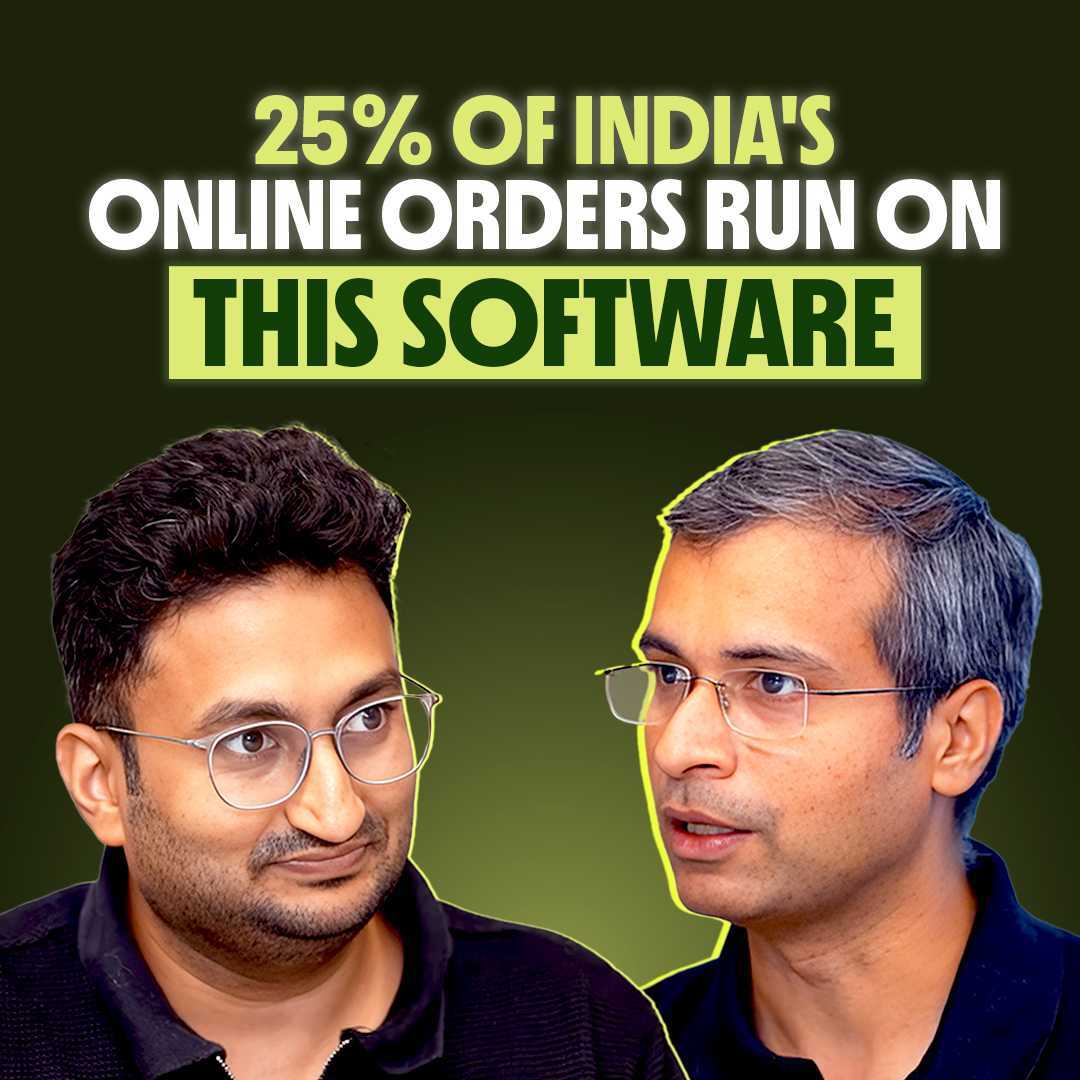
The software that powers 25% of India’s e-commerce transactions, processes a billion orders each year, and in 2025 alone fulfilled 20 million quick-commerce orders: Unicommerce sits at the core of India’s digital retail ecosystem.
It is one of the few SaaS companies from India to go public, doing so after nearly a decade of steady growth without fresh primary capital until its IPO in 2024.
In this episode of The Neon Show, we sit down with Kapil Makhija, CEO of Unicommerce, the company quietly running India’s $60B E-retail market (set to hit $2 Trillion in the next two decades).
The conversation goes beyond the company’s journey to unpack how perceptions of Indian SaaS customers are changing: from the old belief that they “don’t pay” to a more nuanced reality where they value communication, support expectations, and long-term relationships define success.
We also look ahead to the future of SaaS in India: from the impact of AI, to the challenges of scaling from zero to $100M, to the balance between pricing and value, and identifying the sectors most ready for building large SaaS companies.
This episode is for anyone curious about the story of SaaS in India, from how it is being built, scaled & the opportunities ahead.
Watch all other episodes on The Neon Podcast – Neon
Or view it on our YouTube Channel at The Neon Show – YouTube
Siddhartha Ahluwalia 1:09
Hi.
This is Siddhartha Ahluwalia, your host at Neon Show and also managing partner of Neon Fund, a fund that invests in the best of enterprise SaaS and AI companies built out of India serving global markets. Today I have with me Kapil Makhija. Kapil, welcome on Neon Show.
Kapil Makhija 1:31
Thanks Siddhartha.
It’s a pleasure to be here.
Siddhartha Ahluwalia 1:33
Kapil, it’s a unique podcast for us because we are doing… There are very few founders in India or CEOs in India who have taken SaaS companies public in India. Right.
You are one of them. I think the other we have done is with Abhishek Goel from Tracxn and Neha from Tracxn. Right.
You are the second one. It’s a very unique position to bring to our audience the insights, the journeys. Right.
And again, Unicommerce is very differentiated because today I think the revenue as I saw is like 135 crores as declared on the public market. You are valued somewhere between 1,100 to 1,300 crores in public market. And your entire revenue comes from India.
So you have completely broken the myth that you cannot build SaaS companies for India. So welcome on Neon Show. First of all, Kapil.
Kapil Makhija 2:23
Thank you.
Siddhartha Ahluwalia 2:24
And I want to start with two of your quotes that you have quoted previously. The first is decoding target addressable market.
And you have said that in India, markets aren’t found, they are built. What do you mean by that?
Kapil Makhija 2:43
So see, India, as you rightly said, most of the SaaS companies are built for the world. We are a very unique example where we built for India. India is a very diverse market.
And that’s very tough to crack because the consumer habits are evolving. The enterprise habits are evolving. So I think when you’re building for India and when you are winning in India, it’s not not only because your product ready, you’re actually pressure tested because the requirements are very diverse.
They are where you can be successful in India through building for various use cases. And the product needs to evolve constantly. Like in our journey in e-commerce, we have seen e-commerce industry evolve continuously right from 2012, where there were the journey started with building for distributors who had taken the plunge on getting online.
Then around 2015, 2017, when brands themselves wanted to come online directly, then Omnichannel started to become a buzzword. Then pandemic came where it led to acceleration of e-commerce. And now in the last couple of years, quick commerce has become a big buzzword.
And we had we had to constantly evolve the product to be able to cater to this evolution. When we started, we were probably doing a million shipments a year. And at that point of time, people like most of if anyone would have told us that he would someday do 100 million shipments a year, we would have probably laughed at that.
But like most of us around laughed at that. But we firmly believe that that potential is someday possible. And today we are doing a billion transactions.
So when we were building out, we built out for those million shipments a year, then slowly newer use cases keep emerging. And that is when when you’re doing 100 million shipments and then a billion shipments, newer use cases need to be catered to. And that’s what I really meant by that.
You need to start small because India rewards depth more than width. So you need to go deep, solve for the pain points. The way we have built is to listen deeply to our customers and continue to evolve as their needs evolve.
And through this journey, the product evolution happens. So you don’t build for a large TAM to begin with. You start small, go for depth and then eventually expand your TAM as the time goes by.
Siddhartha Ahluwalia 4:59
And the second quote that you mentioned like in your 20 years of doing go to market in India, like India doesn’t reward size, it rewards focus.
Kapil Makhija 5:10
Yeah. So it’s similar to that, that it is very extremely important to be focused on a particular niche. A beauty about India is that it’s a large market in itself.
So even if you pick a niche within India, that’s also sizable in itself. So start with a small niche, go deep in that, be a very focused solution like we built out for e-commerce for a very specific use case where brands or sellers could manage their orders and inventory across different platforms. As the e-commerce ecosystem started to evolve, we started to expand our TAM.
We launched a warehouse management system. Then we launched an omni-channel system. Now we are, we have launched a B2B system where we are enabling these brands going offline, being able to sell to general trade, modern trade and also have built a quick commerce offering.
Today our quick commerce offering is processing 20 million order items on an annual basis in a very short time. So that’s how you start small with a very small use case as we started with our order management system. And as the market needs continue to evolve, the product continues to evolve with that.
Siddhartha Ahluwalia 6:13
Now I would like to dive into your journey. How did you became the CEO of Unicommerce and what were you doing before that? And the second part is how has the evolution of Unicommerce been?
What did you, if you can remember, started on day zero at which year you built more capabilities and what were the revenue inflection points during the journey?
Kapil Makhija 6:34
Sure. So I have, I started my journey as a techie. I graduated from IIT Delhi in 2004, worked for five years in technology sector like you have also coded yourself.
And then I did my MBA from IIM Bangalore, then joined a consulting firm called AT Kearney where I worked a lot in supply chain. So in 2015, when I joined Unicommerce, I joined as head of strategy. It helped me combine my experiences with more technology and supply chain.
And at that point of time, coincidentally, Unicommerce was acquired by Snapdeal.
Siddhartha Ahluwalia 7:07
After you joined, it got acquired?
Kapil Makhija 7:08
It was in the same week the acquisition got announced. They were just a pure coincidence that I happened to be there. And then for the two years, I spent a lot of time with the founders, understanding the landscape.
I joined Unicommerce because I firmly believe that it is solving a very important pain point. I firmly believe that e-commerce will become a way of life. E-commerce will become mainstream.
And that’s, and at that point of time, a lot of, there was a lot of buzz around B2C. There was not so much about SaaS, but I had been a B2B guy then consulting. So I understood the B2B world a lot better.
So that was, this made sense to me. So when I joined, and the company started in 2012. So the first five years, until the time the founders were around.
So founders had sold the company in 2015. They had a two-year lock-in. They amicably exited.
And that’s when my name was recommended to lead the organization. So I’ve been leading the organization since 2017. So the first phase of the company, 2012 to 2017, was a lot about building the product, the OMS that I talked about, which was helping small and medium businesses to list, like to manage their orders and inventory across multiple platforms.
2017, when the mandate was given to me, that was one inflection point when I reflect on this journey, where we started to focus on enterprises. One, because we felt that that will help get more revenues, turn the business profitable. FI18 was the first year we turned the business profitable.
It has been profitable since then. We just had one year of PAT negative in FI20 because of ESOP expense, which is a non-cash expense. And we have been PAT positive since FI21.
So in 2017, when the new management, including me, took over, we started to focus on enterprises because we saw brands directly wanting to get on the e-commerce bandwagon. That was an inflection point. And that is when we also launched our WMS, which is focused on brands.
Then this was an interesting journey, where we built a fresh management team, where to change the outlook of the company to focus also on large brands and not necessarily the small and medium businesses that were coming on board. Then 2018-19 is when we started to hear about Omnichannel as a buzzword and we started investing behind it. In 2020, the pandemic hit, which led to a lot of e-commerce acceleration, which is another inflection point where Omnichannel became mainstream.
And there was a need for a very credible and stable software to be able to manage this e-commerce complexity. So far, I think, and this is how we have seen the e-commerce journey. E-commerce is like a big swimming pool where people have been always on the boundary line, sort of speculating whether to jump in.
The brave ones took the plunge early on and many of them were on the side, but pandemic kind of made sure that this was a necessity and many took the plunge then. But then they needed a swimming coach or a life coach to help them guide through these waters because e-commerce is extremely complex. And Unicommerce platform became that coach for them to be able to navigate the complexities of e-commerce.
E-commerce by the time pandemic hit, it was already fairly complex. You had to deal with multiple marketplaces, your own website, you had to make sure that the data was syncing because unified commerce was being talked about, but it became a reality. Now it’s a survival tactic.
You can’t have your orders, inventory, data sitting in silos. They all have to talk to each other. So that became an inflection point.
And then as e-commerce became more mainstream, the complexity increases further. Now, quick commerce has added further to the complexity. A lot of digital first brands are expanding offline.
Traditional brands are coming online. So the world is going towards being omnichannel. And now Unicommerce now processing a billion transactions, about 25 to 30% of India’s e-commerce volumes is that standard back, a very strong, solid backbone for e-commerce operations for any brand to make sure that they’re able to navigate the complexity.
Brands know that they cannot plan their retail strategy without e-commerce in mind. And they know that if they’re planning e-commerce, they cannot plan it without a software like Unicommerce.
Siddhartha Ahluwalia 11:23
And in India, if you have to see the landscape today, right? How much, you know, of the Indian e-commerce companies today, let’s say even e-commerce first brand, as well as the brands which later jumped on the bandwagon are dependent upon ordering management system like Unicommerce.
Kapil Makhija 11:43
You see, it is a, it’s a very strong, strong backbone. Today, a brand, if they have a meaningful e-commerce presence, they cannot manage their e-commerce business. The analogy that I keep giving is that for airplanes to fly, you need an airport controller.
Today, Unicommerce is that control mechanism at the backbone for a brand to run their e-commerce operations. It is just impossible for a brand to have a meaningful e-commerce presence and not have a software like Unicommerce on the backend. And while the perception may be that we get a lot of revenues from digital first brands, actually, we get almost equal revenues from digital first and traditional brands.
It is, and today no brand is like only digital first or traditional, right? Everybody’s getting omnichannel. Digital first brands are expanding offline to get more reach and traditional brands are expanding online to get a direct connect with the customer.
So I think we are seeing that penetration all across what pandemic and ensuing acceleration of e-commerce that has happened has resulted in a lot of brands coming online. But I still feel that we have touched tip of the iceberg because if you look at our shipment volumes compared to China, India last year processed about 4 to 4.5 billion shipments. China did 130 billion shipments.
There is significant headroom for growth. A lot of traditional brands are still, a lot of legacy brands are still yet to come online. A lot of categories are yet to come online.
So all of that is, is still yet to happen in China still has a very organized retail where the retail is extremely broken experience. And that’s what quick commerce is also latching on. And that’s why I firmly believe that there is significant headroom for growth.
And as the growth happens, the complexities even going to increase manifold and more and more softwares, more and more brands will need softwares. And there is this popular myth that tech is only needed for startups. Actually, it’s the legacy brands which need this tech because as I said, if you have to navigate the complexities of e-commerce, you will need a backbone like this.
Otherwise it will be a rudderless ship going anywhere and not leading to any meaningful outcome for you.
Siddhartha Ahluwalia 13:51
Got it. And how much of the market that is present today in order management system in India, especially in e-commerce is owned by Unicommerce.
Kapil Makhija 14:00
So we are a dominant player. We are the largest player in this market. And as we were exchanging notes before we start talking about this topic that a lot of software, a lot of businesses still run on manual operations or Excel, which is the case in e-commerce also because e-commerce is still very nascent today.
The biggest competitor for us is these manual operations. So and hence as software in India gets built through education, evangelization, and which is what we are doing through various initiatives. We conduct various events.
We have these annual properties called Saral Marketplace Conclave, which happen once a year. And these are not small events by any stretch of imagination. For example, the last edition of Saral had 3000 e-commerce sellers on a single day attending our event on Jawaharlal Nehru Stadium in Delhi.
We have also started a series called e-Kumbh focused on tier two cities. We have held it in cities like Surat, Ahmedabad, Jaipur, Lucknow, etc. to evangelize the e-commerce business.
And we are now seeing more and more brands having this mindset that early on they would need, they would want to keep a software to make sure that their operations are back and streamlined from day one. So the time for our core Uniware product, OMS and WMS is about 260 million dollars, of which 85 million dollars is on a software, of which we have a sizable share. Our revenues are in public domain.
So we have a sizable share of that. But now the interesting trend we are seeing is that more and more brands are shifting from Excel and looking at a software at a much earlier stage in their journey. And this 15% will aggressively change to a larger number in years to come.
Siddhartha Ahluwalia 15:40
And you also expanded your capabilities by acquisition of Shipway. So can you tell more about it? And what is the revenue split across the e-commerce, across various products, for example, the OMS, Shipway and other products?
Kapil Makhija 15:55
Sure. So our vision is to become a one-stop shop for e-commerce enablement and our acquisition of Shipway is in line with that vision. If you look at e-commerce value chain, there are three key layers.
There is customer engagement layer, where essentially a customer is placing the order. Then transaction processing layer, where our OMS, WMS sits and then order fulfillment layer, which is where Shipway operates. So as a consumer, when you’re ordering online, you see the website on which you’re placing the order, which is essentially the customer engagement layer.
And you see the delivery boy that’s coming to your doorstep, which is the order fulfillment layer. Whatever happens in between is the transaction processing layer, where our OMS, WMS all stand. So with Shipway acquisition, we get a play in order fulfillment layer through the logistics aggregation that Shipway offers and we get a play in the customer engagement layer through a tool called ConvertWay, which helps in marketing automation.
It’s again a depth first product, where while there are many horizontal marketing automation products, but we are building this focus on e-commerce and the benefit is that in a market like India, brands prefer to have everything under a single umbrella. They effectively want a want a single neck to catch that because today the biggest headache in a brand’s life is that if something goes wrong, they go and talk to their vendors. Vendor A ends up blaming Vendor B and Vendor B ends up blaming Vendor A.
So they would want everything under a single umbrella and that’s our vision is to serve and simplify this ecosystem by being that single neck to ensure that everything for them is available under a single umbrella. The beauty of that is that today when a brand is using our order management and warehouse management system, they can simply at a click of a button extend it to Shipway, manage their logistics as well, as well as extended to ConvertWay to manage marketing automation. We don’t publish the product-wise revenue, but large part of our revenue of Uniware comes from order management and warehouse management.
They get sold as a bundle together and Omnichannel and other offerings are relatively new, so contribute lesser on our revenue. As I mentioned, we have launched our B2B and QuickCommerce suite as well, where we are getting very good traction and we have launched a reconciliation suite. Today the brand selling on e-commerce faces a lot of leakages when they are selling on marketplaces in terms of the right payments that they should get.
UniReco addresses that. And Shipway, we published our data for Uniware and Shipway. So Uniware is at about a 110 to 120 crore ARR and Shipway is about 70 to 80 crore ARR.
That’s the split and within Uniware, OMS and WMS contribute majority of our revenue.
Siddhartha Ahluwalia 18:33
Got it. So the total right ARR for the company would be roughly 180 crores then?
Kapil Makhija 18:38
Yes. So that is what, if you look at our Q4 results, we had published about 45 crores in Q4 revenues. That’s about a 180 crore revenue run rate for us.
Siddhartha Ahluwalia 18:48
Got it. And what do you think, let’s say maybe by the March 2026, we will be at 200 or 240 crore, we don’t know yet, but what do you think will make Unicommerce a 1000 crore revenue company?
Kapil Makhija 19:02
So I think, like I said, our vision is to become a one-stop shop. We feel that market in India is fairly large and by being that one-stop shop, it will help us open new avenues. The pillar for us to be able to achieve a large scale is going to be launching of new products.
See for us, there are three growth levers. One is we are effectively an index to e-commerce market. We are processing a billion transactions.
So as the e-commerce market growth, our growth will come from that. The second is getting new and new customers. As I mentioned, we have just touched the tip of the iceberg.
The early ones have jumped into the swimming pool, but there are vast majority who are still on the fence and who will be coming into the swimming pool to grow the e-commerce. The third is launch of new products. We do it whether organically or inorganically.
We have launched, we built UniReco in-house and we have acquired Shipway through which you got both Shipway and Convertway. So we’ll continue to add these product capabilities and the fourth lever for us is international expansion. Today international is small for us, but as I said in India, when we have built for scale, you are not only product ready, but you have pressure tested.
So you have built that product which can work very well in the international markets and this is what we realized when we expanded into Southeast Asia and Middle East that a product is ready. Our investment is now required for sales and marketing and for which you have got local teams to help sell that product. So these four are our growth levers, e-commerce growth, new customers, new products, international expansion and all these four done consistently on a like I am a firm believer of compounding.
So as we do well, execute well on all these four levers, we like in some time we will hit the 1000 crore revenue as possible.
Siddhartha Ahluwalia 20:44
Got it. And you know, how did you decide to go public? Obviously you were profitable, that would have given a lot of comfort in going public, but how was the decision of going public made within the board and the broader ecosystem at Unicommerce and on the, can you tell us more about the process of going public?
Kapil Makhija 21:06
Yeah, sure. I think it has been an interesting journey for us. I think what has worked for us is one very stable financial, we have been profitable for many years.
We had built the company with a lot of fiscal discipline and also a very strong corporate governance. The practice of quarterly audits started many years ago, where there were not even any talks of us going public, but we believe that’s the right way of building the business. So we have not only built it with a lot of fiscal discipline, we have ensured that a lot right corporate governance practices have been in place.
I think that gave us a very strong comfort because we had built the business with a very strong foundation. And while there aren’t many examples which list on the main board at our scale, and that’s the question that we used to get, we kept checking with the ecosystem at what the right time would be. And with traction getting listed, I think that gave us confidence that at this scale also there are takers.
And then we started to dig more. And like, then we came across many examples from the past. Can you imagine at what scale when Infosys went public in 93?
At what scale would they be? They had 14 crores in revenue. That is how it used to be back then, that you went public at a small scale, because for public market investors also they need a growth story to come in, like they also want to see, participate in that growth.
And through us, the public market investors are now getting a chance to participate in e-commerce growth because there aren’t one many SaaS examples today. So they get to participate in that story and we are an e-commerce index. So they get to participate in that story as well.
So I think when we started working on the process, we got a lot of positive feedback on the story, on the way we had built the business. And then as we were talking about the experience of Roadshow, as a business, we had never raised primary like post the acquisition by Snapdeal in 2015. The company has not raised any money.
We have been profitable for many years. So dealing with investors is a muscle that this company had lacked, like I had not done that before. And I think that was a very interesting experience where, and what we were amazed by was the depth of the public market.
Today, there is money available for any story. That’s the depth of the public markets. It’s many times fold compared to the private market.
And today, I think the public market investors are also waiting for stories like these. So what we ended up experiencing during the journey of interacting the Roadshow is that the discussions were a lot about corporate governance, making sure that the management team is professional. So a lot of it was about sizing of the management team that whether it’s the right team, can they bet their money on this team.
And then the business came and business evaluation was a lot about stable financials. There were discussions about TAM, growth potential, etc. But it is also about very stable financials.
Public markets love predictability. So they need to see a predictable financial outcome that have been delivered in the past and a hope of delivering it in the future. So those were the nuances.
When I, before going to the Roadshows, when I talked to my counterparts who had raised money in the private market, the conversations are a lot different, a lot about TAM, a lot about growth potential, sort of undiscovered TAM, etc. Here it’s a lot about corporate governance, financial discipline and predictability. I think those are the three things that we learned in this process and a wide variety of public market investors.
You deal with a mutual fund, to a family office, to a HNI. I think the kind of questions that come in these meetings are very different depending on who you are dealing with. So the variety of people that we get to meet in this process is also a learning process in itself.
Siddhartha Ahluwalia 24:53
And today, how many customers would Unicommerce have?
Kapil Makhija 24:56
We have 7,000 plus customers. We have a combination of enterprise as well as small and medium businesses. We started by serving small and medium businesses and then started to focus on enterprise businesses.
In due course of time, we have realized like today enterprise businesses for Uniware contribute 90% of our revenues. And by enterprises, I don’t mean that these are large 5,000, 10,000 crore businesses. These could be a seller setting out of Surat or Indore.
Enterprise is a function of their e-commerce volume and the product that they want to use. Today a large brand, let’s say a Lacoste or a Meena Bazaar are on our SMB plan, but because their e-commerce volume today may be small. But a small seller as I mentioned, today there have been so many great, very inspiring stories from small town like Adil Qadri, then Family Care from Indore.
Then we have X5X from Ahmedabad. They have been very inspirational stories. And all of these are users of our enterprise plan because they have been able to build a large enterprise or a large e-commerce base for which they obviously need a credible offering to be able to manage their back end.
Siddhartha Ahluwalia 26:01
Got it. So right now, what would be the average annual contract value across these 7,000 customers? And how would you define, let’s say, and the average contract value across an enterprise?
Kapil Makhija 26:14
So enterprise is 90% of our revenue for us. So we earn about 1.1 to 1.2 rupees per item on an average and that translates about a 10 to 12k ACV for enterprise customer. The realization for Shipway is different.
It’s about 70 to 80 rupees per shipment, I think. But in all businesses, what we have done is we charge basis the unit of item. So for example, in Uniware, it’s the item that’s going out of the warehouse.
We get charged on that. In Shipway, it’s the logistic shipment. In Convertway, it’s a notification.
So we get charged on that. So the charging potential is different. But on the enterprise one, it’s about 10 to 12k ACV is what we earn.
Siddhartha Ahluwalia 26:54
And 10 to 12k in dollars?
Kapil Makhija 26:56
It’s in dollars, yeah.
Siddhartha Ahluwalia 26:57
Like roughly around 10 lakh rupees a year?
Kapil Makhija 27:00
Yeah, 10 to 12 lakhs a year.
Siddhartha Ahluwalia 27:01
And what would be, let’s say, the ACV across your top three or top five customers?
Kapil Makhija 27:05
So what we have been able to do over time is we have been able to diversify our revenue. Today, top 10 customers constitute only 20% of our revenue. This number five years ago used to be 50% plus.
So through this motion of getting new and new customers on board, as I said, as more and more customers came on the e-commerce bandwagon, they needed a software like ours. We have steadily ensured that our revenue is fairly well diversified. Today, no single customer is contributing more than 8% of our revenue and top 10 is only 20%.
So we’ve kept fairly well diversified. There is no strong revenue concentration with any customer.
Siddhartha Ahluwalia 27:42
So the highest revenue per customer would be, as you said, roughly 8CR or 9CR. And on the average, among the top 10 customers, the average revenue would be 2CR INR. That’s a very healthy.
So one of the journeys in which companies struggle, especially SaaS companies from India, they are not able to do the journey from SMB to enterprise. So can you share your learnings on the way that how did you manage to go from a SMB native company today to now an enterprise native company?
Kapil Makhija 28:17
I think as I mentioned, the inflection point for the company was in the new management team was getting formed. At that time, we made sure that we are getting the right talent on place from the right professional team to be able to help with this transition. And at the same time, what helped in our case was this transition of brands also coming on the e-commerce bandwagon.
And as I mentioned, one of the DNAs of the company has to be focused on innovation. We continue to launch new products on a regular basis and products in India to be successful. It is not when you are selling well, it is when you are building deeply.
So we sit with our customers, understand deeply what their problems are and build accordingly. And there is a lot of focus on customer success because I firmly believe that success in SaaS is not when you sign up a customer, it’s when they don’t leave. And that’s why we’ve been able to build a significantly sticky proposition for our customers, where it becomes a backbone for them.
And this was not something that we built in a day. We listened deeply with our customers as the new brands were coming on board. That has been the need of a warehouse management system came up because the warehouse management system is a hundred-year-old problem.
There are many, many warehouse management systems that are available, but where we differentiated was we launched the e-commerce first warehouse management system because there are very specific nuances for e-commerce. A brand may want to ship Amazon Prime customer orders first or other regular customer orders, or they want to prioritize shipping of a particular channel or other channels because that channel may have stricter SLAs or managing returns. There are nuances like these that we started building by working deeply with our customers.
I think that helped us. I think having the right professional team like my background of dealing with enterprises and having the right leadership team who could work with enterprises to be able to help with the switch. So I think that has really helped us and working deeply with our customers. These two things I feel has been good for us and now we are able to manage this balance very well.
It’s not that we have abandoned the SMB, right? We still have nearly 6,000 small and medium businesses on our platform of the 7,000 total customers that we have. So we have balanced this well and today the SMB, the customers who sign up on the SMB plan are a funnel for enterprise for us.
So they start with our startup pack, experience the product. Once they realize that they have hit a certain scale in e-commerce, they want to upgrade to the enterprise plan. So it becomes a good funnel for us.
Siddhartha Ahluwalia 30:46
And what are the challenges serving Indian customers? Because they are saying that, right? That the Indian customers don’t pay for software or SaaS.
Kapil Makhija 30:54
Yeah. No, I think there are a lot of myths and I’ve just recently started the series called SaaS Shastra on which I’m trying to break some of these myths through the learnings that I have amassed over the last 10 years. I think one of the biggest myths is that Indian customers don’t pay for SaaS, but I’ve just shared what our ACVs are, right?
So it’s not if customers see value, they are willing to pay. I think it is, as I mentioned, it’s important to build product, working deeply with the customers because innovation is extremely important. I think the Indian customers really push you.
As I said, you’ve been in India, you’re not product ready, you’re actually pressure tested. So they will push you in multiple directions. But not just us, I know many examples like Exotel, Darwinbox, Yellow, they are able to build or get large customer contracts in India, SpotDraft as you were talking about.
So they have been able to sign up enterprises in India which are paying good ACVs to them. And that market is increasing. I think there’s the second myth that is there, that Indian customers want endless customization.
That’s not the case. I think customers are also realizing the power of platform. We have built this like a platform.
We’ve made sure that the platform is configurable to cater to different use cases. And that’s what Indian customers want, that it should be able to cater to their use cases. They don’t want customization, they do not want the headache of having their customization.
So a lot has changed in the last 10 years. I think when we started out, the challenges were about discovering the customers, discovering the problems. Today, I think there are plenty of forums for you to discover that.
Now the pushes, especially with the advent of AI, the push is to like it is pushing the founders to push their boundaries to innovate fast and make sure they’re able to adapt and evolve rapidly. And that I feel is it’s at the right time where I feel a lot of businesses that can be built for India and for the world. Like we are, we built in India, built for India, but we are now expanding to the world.
We’ve taken into Southeast Asia, Middle East. I feel more and more stories will come. There are many stories now compared to 10 years ago and more such stories are going to come where the beauty of having a large tech talent here, a great ecosystem to help you enable.
Because when we grew, we did not grow because of our product. We grew because of the ecosystem. So we enabled the ecosystem to grow, which led to our growth.
And that is the approach that one has to take for growing in India.
Siddhartha Ahluwalia 33:24
And can you share examples? How did you help the ecosystem grow?
Kapil Makhija 33:26
So, for example, some of the forums that I talked about, like Saral, Marketplace, Conclave, so we are helping evangelize the adoption of e-commerce. The second is as the software was being available for small businesses also, when you’re doing only 50 orders a month, people may think that they can work with Excel, but when you’re dealing with multiple e-commerce marketplaces, it becomes a nightmare. I remember back then one of the founders called me that after he implemented e-commerce, he said that this is the first flash sale through which I’ve slept through peacefully.
Otherwise, I used to panic a lot during earlier sale period, but this is the first time I could sleep peacefully through it. And that is when we realized that we are building something beautiful that could add value. So and then as we continue to evolve the product, it helped the ecosystem because back then the ecosystem needed an OMS to be able to just manage multiple marketplaces.
As the e-commerce ecosystem evolved, we were able to offer another offering and Unicommerce integrates into multiple ecosystem players. So today when a new logistics player launches or a new ERP launches, they integrate into Unicommerce and as more such options become available, it helps the ecosystem. So that’s another way Unicommerce has helped the ecosystem to grow.
Siddhartha Ahluwalia 34:43
And there’s another myth that like Indian customers expect enterprise level support or a forward deployed engineer at their location, but want to pay like SMB for support.
Kapil Makhija 34:55
Yeah, I think that is also changing. I think, see, definitely it is required that the Indian customers, as I said, are seeking value. And if the product is not intuitive enough or it’s not something that can be easily worked on, then obviously they will need support.
They will need an engineer to be deployed to help them. And that’s why it is important to build in India with a very simple interface. Today the users for our products are workforce that’s stationed in the warehouse or in the head office.
So we had to make sure that the interface is intuitive enough for them to be able to use it. The beauty of this is that once a person in India gets used to a particular software, I think then they’re able to use it like a machine and like they’re able to do it with the efficiency of just knowing what needs to be done. So I think that part you have to cross the hump where you make sure that the user is able to use this intuitively and again with the help of AI and new technologies that are there.
I’m seeing the new interfaces are much cleaner, much easier. And that way I’m seeing a lot more stickiness within the Indian enterprises and not as much need of a support as used to be the myth before. There is definitely support required, but there are now avenues available in terms of automation technology to be able to provide that support for the Indian enterprises.
And now they’ve started to pay like Indian enterprises as well, not like not paying like SMEs anymore.
Siddhartha Ahluwalia 36:24
And another myth which I would like to burst for the founders watching this podcast is that Indian enterprise like to choose or even SMBs like to choose the cheapest software rather than the best software. What are your learnings on that?
Kapil Makhija 36:38
So I think what they’re looking for is value. It’s not the cheapest software that they’re looking for. They’re obviously looking for value.
But yeah, if there are two softwares giving the same value, obviously they would want to go for the cheaper one. And that’s what I think it’s as much as it is about building the product. It is also about communicating value effectively.
So you need to talk in their language because a lot of SAAS companies may get built out of with engineers where as founders, we are very passionate about what we have built, but what needs to be communicated is the value to the end to the brand or to the end customer. And that’s what we have focused on. Like when our software gets used, they are able to reduce their returns.
They’re able to do things a lot faster. For example, again, a brand that used to work with, they started with 30 orders a day. And today they’re processing 4000 orders a day and with a very, very small team.
And that’s the power of automation. And that’s the value that needs to come out for them. They need to see that value.
They need to see that they don’t need to build a large team. They’re able to do things a lot faster than they would have done otherwise. And it leads to meaningful business outcomes in terms of fill rates, returns in our case.
If those values they can see or is communicated, I think they’re willing to go for the software that gives the maximum value.
Siddhartha Ahluwalia 37:56
And there is another myth or in the ecosystem globally that most of software or SAAS will be replaced by AI. What is your view on that?
Kapil Makhija 38:08
So I think what AI, as I said, AI is helping simplify a lot of things for even as a SAAS founder, where it is helping us build faster. We are able to deploy it, for example, in automating various business functions like sales, customer support. It’s a new world for everyone.
And I think it’s just changing the way SAAS or software is getting built. I don’t think it’s an end to SAAS, but it’s definitely going to evolve the way things are getting built and the way in which value can be created because with the advent of AI, simple applications can be done by the brands themselves. It’s plug and play.
Hence, you need to push your boundaries in figuring out new use cases that cannot be solved. So I think AI will lead to a new version of SAAS, new version of software. It’s not going to kill it, it’s going to enable and make sure that we are providing a much bigger, a higher value to the businesses, whether in India or abroad.
Siddhartha Ahluwalia 39:06
So you don’t think that AI will replace SAAS?
Kapil Makhija 39:09
Not at all. I feel that it will enable and it is already enabling. I am seeing as I exchange notes with other founders also, it is enabling founders to do things a lot more efficiently internally and provide a lot more value.
Just giving examples of few of the AI interventions that we have done. Today, we are in the process of launching a very simple interface wherein for processing the order today, a user has to do many clicks. We are going to give a text interface through which they can just give the instruction, a natural language interface.
They give an instruction and all their orders will be processed automatically. They don’t need to do anything else. In Shipway, we are using leveraging AI to build predictability on RTOs to give them best courier on multiple parameters, cost, SLAs, RTO, etc.
Similarly, on ConvertWay, AI is being leveraged to generate newer templates using AI and much faster and better engagement with the customers. So that is how we are leveraging the power of AI. That’s why I’m saying it will help elevate the offering and provide greater value.
But if you’re doing just plain vanilla things, obviously there is, you will get disrupted. And that’s what AI has to be used as an enabler and not as a threat is what I feel.
Siddhartha Ahluwalia 40:27
Got it. And can you tell about your journey? How would you put yourself between a role of a founder and CEO?
Kapil Makhija 40:36
Yeah, so I think in a startup, I feel they’re both the same because it’s the same growth mindset that they have to bring in. I think the job of founder or a CEO is to being able to zoom out to focus on the macro or the big picture, but also able to zoom in to make sure that there is operational rigor. As I said, we have built the business with a lot of discipline.
So I think that a CEO in a startup also needs to balance that because and now as a publicly listed CEO, obviously we have to make sure that we are delivering results on a consistent basis. So I don’t think there’s a big difference between a founder and a CEO. Now, virtually I have spent 10 years or more than a decade here.
So I have virtually operated like a founder, spend more time than the founders themselves. But so I think I’m as emotionally attached as a founder would be to this. So I think for a startup, I don’t really see that there’s a difference between a founder and a CEO.
Siddhartha Ahluwalia 41:32
But would you advise founders to get you know, it’s very hard to get, but it’s not repeatable, but still get external CEOs early on in the journey? Because you know, you came with a skill of scaling company, you came with a skill of enterprises, and maybe the founders are good in zero to one journeys. And also, I don’t know about it, but maybe you have been less detached.
So you would have been able to take more objective decisions throughout the journey.
Kapil Makhija 42:04
So I think it’s a function of the skill sets. I think a company to grow requires multiple skill sets, product, technology, sales, marketing, customer success. So if the founders put together are able to bring those skill sets, then I think getting a CEO may or may not help.
But it’s important to form the right team to be able to plug the skill sets. And there I feel many founders may make the mistake of like being emotionally attached to the team or the founders that they are. I think that decision making needs to be very objective, that you need to be very clear on what skill set each founder is bringing.
And if that if the founder group is missing certain skill sets that needs to be supplemented through a leadership team or a CEO, that honestly doesn’t matter. I think as a CEO, it requires a lot of passion and emotional attachment to be able to grow the business. And that’s what I also exercised.
And I’ve seen founders also being able to detach when they are growing companies. But I don’t think it’s a function of a founder or CEO. It’s a function of a person who’s leading it.
So it truly depends on that. But I think what’s extremely important is to get the right mix of skill sets to be able to grow the company. When we were building the team, I was very careful in getting the right team on board, which were bringing these skill sets in terms of sales, customer success, who could complement me and make sure that we are able to grow.
And in hindsight, I think that was extremely important for us and has really worked out well, where many of those leaders actually gave many years of their professional journey. In this growth, I’m truly thankful to all the contribution. And that in hindsight was like the biggest sort of benefit in building this team.
We built a strong culture on three tenets. One is making sure that we are very innovative. We are working deeply with our customers.
So getting the right leader to be able to drive that. Second is agility. We were operating in an ecosystem which is very, very dynamic.
E-commerce changed every two years, every one and a half years. So we had to be very adaptable and agile. So the leaders that we brought in also were demonstrating that mindset.
And they were building that. And third is customer obsession. In India, you cannot build if you’re not listening to a customer.
As you said, the myth has been that they want endless customization. You can avoid that by building deeply with the customers and making a configurable product. So that was also important that all the leaders who are coming in were coming up with a very strong customer obsession.
And these three tenets, I feel, have worked very well for us to be able to scale the company.
Siddhartha Ahluwalia 44:35
Where would you say your scale lies the most? Is it 0 to 1 or 1 to 100 or both?
Kapil Makhija 44:40
So I have honestly done the 1 to 10 and 10 to 100 journey. We are on the process of the 10 to 100 journey and we have done 1 to 10. I think I feel that where I’ve been able to add values to, as I said, build a strong team and having this culture of being involved, two things that I feel that have worked out well is the one I’m a very hands-on person.
So I work closely with the leaders and making sure that and second is bringing this customer obsession. So I work closely with the customers. Even today I am directly connected to hundreds of my customers where they can reach out if they face an issue.
So I feel that I’ve been very thankful to the team that has come on board. I feel my biggest value add has been getting that team being able to identify and setting the right processes coming in from the professional background in the 1 to 10 journey. What was the right foundation that needs to be built?
Brainstorming with the leadership team in building that foundation. We have built this company, not with the mindset of growth at all costs. We build this company with the mindset of sustainable and predictable growth.
And I think I’ve been fortunate with the trust of my board to have that patience that we will build this patiently. As I said, I’m a firm believer of compounding. So I’ve always, always talked about building this brick by brick and making sure that we are able to give this compounded growth.
And I think that has worked really well. And I was fortunate to get the team with the and who had the patience and who had the like-mindedness on operating on these standards.
Siddhartha Ahluwalia 46:26
If it’s possible to share, right, what’s your ownership today in e-commerce in terms of percentage, right? And how has that grown over a period of years?
Kapil Makhija 46:35
So we are processing close to 25 to 30% of India’s e-commerce volumes. E-commerce has got three models, technical detail, but I think important for everyone to know there is an outright model where platforms are buying inventory from a brand. There is a fulfilled by model where platform brands are keeping inventory in a platform’s warehouse.
The third model is a dropship model. Dropship model is where brand is taking complete control of the end-to-end customer experience and by fulfilling the demand to stock that’s lying in their own warehouse or in the warehouse of a third-party player. We are most aligned to the dropship model and dropship model actually pre-pandemic was about 10-12% has now become nearly half the e-commerce market.
Of the dropship market, we are doing about 30% of the market already, like the of the 4 to 4.5 billion shipments that we talked about. Half market is dropship, about 2 billion shipments. Each shipment is about 1.5 items, 3 billion items of which we are doing about 1 billion items, about 30-35% is a share that we are dealing on the dropship model.
Siddhartha Ahluwalia 47:39
Got it. And let’s say, I believe you are a public company, but you still have the agility of a startup, right? The way that you have described the journey. So if I have to ask and it’s a public company, so listeners can also view on the public portals, but what does the cap table look like today of e-commerce?
Kapil Makhija 47:58
Yeah, so that’s available in the public domain. About 37% is held by the promoters. Then it’s a…
Siddhartha Ahluwalia 48:09
Which includes you and…
Kapil Makhija 48:10
No, promoters are Kunal, Rohit, AceVector, which is our parent company. Yeah.
Then it is Softbank, which is through their balance sheet. It’s not through the vision fund. Rest is held by the public, the pre-IPO investors like H&I offices, mutual funds, public market and employees.
So that’s broadly, it’s a very, very clean cap table. Like we’ve, it’s not a splintered cap table at all. And that gives us the…
Siddhartha Ahluwalia 48:35
How much does the leadership team including you own on the cap table today?
Kapil Makhija 48:39
So it’s about 10% is the ESOP pool for us. A large part of it is the leadership team.
Siddhartha Ahluwalia 48:44
Got it, got it. And over the course of next 10 years, right, where do you think will, you know, you would want to take yourself in Unicommerce?
Kapil Makhija 48:55
As I said, our vision is to become a one-stop shop for e-commerce enablement. So we want to make sure that, and there are still many white spaces that exist. As an example, like Convertway is an entry into the customer engagement layer for us.
There are many, many white spaces there. Even in the post-purchase journey, there are many white spaces. And the beauty of e-commerce is that it’s a fast evolving industry.
So many more white spaces continue to emerge. For example, quick commerce is a white space that emerged two years ago. And that’s why we very quickly built integrations.
And in no time, we are now processing, as I mentioned, 20 million order items on an annual basis. So I think we want to continue to build for these white spaces, whether organically or inorganically. So, and we want to continue to execute for this vision of becoming a one-stop shop for e-commerce.
Siddhartha Ahluwalia 49:40
And where do you think both quick commerce and e-commerce in India are growing? Let’s say if you can share some ballpark numbers on where it is today in terms of consumption or in terms of how big billion-dollar industry it is today. And what’s the growth rate in the next few years?
Kapil Makhija 49:58
Sure. So I think e-commerce journey has had its own interesting journey. The earlier era was a lot about early categories like fashion electronics growing.
During the pandemic, we have seen categories like beauty, personal care, health and nutrition growing a lot. And we continue to publish, by the way, these trends report on a regular basis. So now there are newer emerging categories like pet care, then sports and fitness, and home decor.
These are new categories that are continuing to emerge. And another interesting trend we are seeing is that the growth in the smaller towns, tier 2, tier 3 cities continues to be strong. In fact, we published a report yesterday itself where tier 3 constituted about 20% plus growth in the overall e-commerce growth.
And e-commerce in the last two years, the growth has been slightly subdued, where during the pandemic, the market was probably growing at 30-35%. But in FY24, we’ve seen growth of about late single digits, early double digits. And we’ve seen growth in last year of early to mid single digits.
And while e-commerce at a smaller base is obviously growing a lot faster. But what we’re seeing is pockets within e-commerce are growing a lot faster. And we have been able to build a very category agnostic platform.
And that’s why we’re able to publish this data because we have got brands from various categories and we can share these categories specific nuances. Today we are able to support 45 plus product categories on our platform across both digital brands and traditional brands. We have a Marimekko on FMCG, we have Gini and Jony for children, FabIndia for fashion, Camper Shoes for footwear.
And also the new age equivalents like Mamaearth, Boat, M Caffeine, etc.
Siddhartha Ahluwalia 51:44
And today, what is the, if you have to say, the market share owned by e-commerce and quick commerce of the entire retail?
Kapil Makhija 51:52
I think we are serving e-commerce and quick commerce. I wouldn’t have a point of view. There are varied studies.
Some studies say that early double digits to some studies, but for our brands, there are some brands who have shared as high as, and I’m talking about traditional brands share as high as 25, 30, and some have gone up to 50, 60% also where e-commerce is contributing. But as a whole, I don’t think we’ll have a view on that. But anecdotally, what I’ve heard is, and some studies that I’ve seen, some quotas to be early double digits to about 25, 30% as well.
Siddhartha Ahluwalia 52:24
And do you think India will have a point where quick commerce will completely overshadow or cross e-commerce?
Kapil Makhija 52:30
I think, as I said, the world has become omnichannel. Today, a brand has to sell on retail, sell on e-commerce, sell on quick commerce. I don’t think it’s a either or.
They have to sell everything. And that’s why integrated commerce and on top of that integrated insights is now a survival strategy. It’s not good to have.
Hence the brands need to focus on that. So I don’t think it’s a either or, or a growth of one channel or other. Customers are everywhere.
The same customer shopping on e-commerce, horizontal, as well as vertical, as well as quick commerce, as well as retail. A brand will need to serve on all of that. And that’s what a platform like Unicommerce as a backbone for an omnichannel commerce is what it is providing to ensure that brand is able to offer a seamless experience on all the channels.
Siddhartha Ahluwalia 53:19
And what would you advise for SaaS startups in India? That when should they say that they are prepared to go public?
Kapil Makhija 53:28
I think it’s two or three factors that one needs to keep in mind. As I said, public market investors love predictability. So you need to have a predictable journey on your financial outcomes.
You know, to be profit making, it can’t be that you’ve just turned profitable in a quarter and then you decide to go public. It has to be some history of being able to demonstrate strong financials. Strong corporate governance is extremely important.
So having good auditors, doing quarterly audits, etc. is extremely important. Not just for going public, it generally gets, gives you, gets a lot of discipline within the company.
I think that has been one of the biggest benefits for us as a company when we started doing quarterly audits. It brought a lot of discipline within the management team. And third is, which is true for any business, that you have to need to have a good story in terms of the potential, what you’re solving for.
I think those three things are important. Scale, as I said, we have demonstrated through our strategy and many other examples that it’s, it’s not that big a question mark. Obviously, scale is a, scale is also an indicator of predictability.
That if you’ve hit a certain scale like 800 crores, that means that you’ve got the PMF, you’re not going to struggle with that. So I think as long as you can demonstrate predictability, strong corporate governance and a good story in terms of the potential that lies, I think that can, those are the three ingredients. And then there obviously it’s a long elaborate process and you should be able to have the, the energy and the financial sort of, sort of financial muscle to be able to withstand that.
As long as that’s there, I think we would, we would love to see more and more companies coming on this side and getting listed on the public markets.
Siddhartha Ahluwalia 55:14
Is there any favour, because still SaaS companies are very new on public markets, there’s a supply and demand. So public markets or retail investors or HNIs and banks also favouring, favouring SaaS companies. Do you see any love?
Or still it’s very new for them?
Kapil Makhija 55:34
I think it’s new for them. There aren’t many examples on, on SaaS. So I think, but I don’t think it’s a function of supply demand.
Supply demand obviously plays everywhere. So it’s not just focused on SaaS. I think, as I said, the depth of the public markets is a lot, there is money available for the right story there, whether it’s SaaS or non-SaaS.
So it’s about having the right story and all the three ingredients that I talked about. So those are more important than it being SaaS. SaaS obviously helps ensure and I did a post about profitability as well.
It ensures that you are able to run it in a profitable manner. Although in our ecosystem, we are the only profitable player as of now amongst the top five players, but it helps get you that cushion to be able to run this with discipline. So SaaS helps in that way.
But I don’t think it’s, it’s, it’s a function of it being SaaS. Any good story, you will find a ticker in the public market.
Siddhartha Ahluwalia 56:27
Kapil, at NEON fund, we have a lot of institutions or family offices, which are from Europe and from US. And their question is that, hey, NEON has a track record today of investing in companies with the founders are Indian, tech team in India, but selling in the US. But they’re still asking a question.
Is there a market that can India create billion dollar SaaS companies focused on the India market?
Kapil Makhija 56:54
I think, I firmly believe that India is a large market, as I said, in India, because of the large use cases that we have, even small niches can be meaningful TAMs for players. Taking our example, when we were doing a million shipments a year, people always wondered whether how large can it be? I think the question of TAM for Unicommerce has been there right since the beginning.
But I think now we’re doing a billion transactions a year. I think that question is very well taken care of. Today, it may not seem evident that focusing on India, can you build a billion dollar enterprise and by billion dollar, I don’t mean valuation, I mean revenues.
Today, probably we have a line of sight of getting a hundred million dollar in revenues, or let’s say a couple of hundred million dollars. But I think a time will come, given the potential that India holds, I firmly believe that there can be a company that can be created where we’re getting billion dollar in revenues, like we believed 10 years ago that e-commerce will get to a scale where we’re doing a billion shipments also.
Siddhartha Ahluwalia 58:01
But you think that a billion dollar valuation is possible for an Indian SaaS company focused on India?
Kapil Makhija 58:09
Yeah, definitely. I feel there is a lot of, there are now meaningful TAMs that are available in India, through which you can have unicorns that are created a billion dollar valuation. Although we are rooted in India, so we would love to see a lot more Unicorns which are profitable with meaningful revenues.
But I firmly believe that there are enough sort of market sizes available, niches available, through which you can get a billion dollar valuation. But I am not the one who looks at valuation. For me, what’s meaningful is revenues and profits.
So I feel that in India, markets will be created where you are able to make billion dollar in revenues by serving Indian clients.
Siddhartha Ahluwalia 58:53
Like roughly today, you are at around 20 million in ARR and 150 million in valuation. So if you keep on growing at a steady space, like so if at a certain point in time, if you reach like 150 million in ARR, definitely you will cross a billion dollars in valuation.
Kapil Makhija 59:12
Yeah, again, as I said, I don’t track valuation. I think and I’m fortunate our board also doesn’t push us that. I think our focus is to consistently grow on the revenues and profits.
I’m a firm believer of that. We have been demonstrating a consistent growth in revenues and profits and that’s what we want to work towards. I think the rest of the things follow automatically.
Siddhartha Ahluwalia 59:32
But there’s a lot of narrative in the western markets that hey, now 0 to 100 million ARR with companies like Cursor, Loveable is getting crossed in a couple of years. Whereas in India, the journey from let’s say a 0 to 150 million kind of a revenue, Unicommerce has been there for let’s say 10 years now. And it might take another 5 or 10 years to reach that.
So the time horizon is huge. You think that’s a bug.
Kapil Makhija 1:00:03
Well, see, when Unicommerce started, I don’t think there was a lot of focus on SaaS. But now we are like, it took us probably 10 years to get to a 10 million ARR. But now I’m seeing examples of companies focused on India who are able to achieve the 10 million mark sooner.
So I think it’s a matter of evolution of a particular geography, particular industries. I think the times will shorten, even in the western markets. I think earlier it took a lot longer than it takes today to get 100 million ARR.
That’s bound to happen for the Indian market as well. I am very convinced that there will be large businesses created. I am a firm believer of serving the Indian and the emerging markets.
I am seeing a lot many more examples, as I mentioned, Darwinbox, Yellow, etc, who are also building both for emerging and the western markets as well.
Siddhartha Ahluwalia 1:00:53
What, what from first principles gives you enough confidence that SaaS companies focused on Indian markets can at least produce 100 million ARR outcomes consistently in less than a 10 year period of time?
Kapil Makhija 1:01:06
So I can’t really say that it’s going to be less than 10 years, but I’m saying that time timeframes will get shortened for sure. I think what gives me confidence is the empirical evidence, because when we were at a million ARR, I think there were always questions, can we hit 10 million ARR by serving Indian businesses? We and many others have been able to cross that benchmark.
There will be many, there are only a handful of companies who are 100 million ARR today from India, and they are mostly serving the global markets. There will be a time in due course of time, and there will be companies who are building 100 million. I think seeing this journey of 1 to 10 and 10 to 100 for Unicommerce is, and few other companies that I have been privy to as an outsider, I think gives me confidence that it will get created, whether it happens in the next 10 years, 20 years, I can’t really comment on that, but I think just this journey itself gives me strong confidence, and I firmly believe that India has a large potential.
The takers for SaaS obviously has changed. Like I said, the early part was about discovering problem, discovering customers, and a lot has changed in the thinking process of amongst the new age entrepreneurs. Today, a lot of our customers are deploying Unicommerce right at the start of the journey.
That wasn’t the case before. Like I said, 85% of the market still operates on Excel. That’s the first go-to platform for any business, but that’s changing.
With that change and with the large market size that India has, those two things give me firm belief that we will have a billion dollar in revenues also someday, that a company serving Indian market.
Siddhartha Ahluwalia 1:02:34
If you were a founder today again in 2025, and if you were asked to build a 100 crore revenue company in SaaS, what would you do differently this time?
Kapil Makhija 1:02:46
I think, like I said, the journey when Unicommerce started, when I started my journey, it was a lot about discovering problems, discovering customers. That is, I think, solved for. I think some of the things that I’ll keep consistent is building deeply with the customers, listening in intently, and building for that, starting small, starting in a focused manner and growing.
What I’ll do differently is because today, building a software is a lot easier than it was probably 10 years ago. So I think building that first alpha ready product or MVP, I think is a lot easier and you can iterate a lot faster. So I think that I will do differently because earlier it was just about sort of building with three or four customers and building deep with them.
It took us longer to get our versions out, but today we can iterate a lot more quickly. So I think that would change definitely. Our motions on sales and customer success can be extremely different, very automated, do not need to be as people intensive as it was when we were in the first phase of Unicommerce.
I think those are things, how can we leverage AI and the new edge technology to build a lot more efficiently? I think that will change, but the core principles, I would want to keep it consistent, building deeply with the customers, building with a lot of fiscal prudence and making sure that we are building small in a focused manner and continuing to grow our time.
Siddhartha Ahluwalia 1:04:08
And what would be your go-to market strategy today? I know it’s a generic question, but if you have to think about it from first principles, what would you do?
Kapil Makhija 1:04:19
What would it be true for a new startup?
Siddhartha Ahluwalia 1:04:22
To reach 100 crore revenue mark.
Kapil Makhija 1:04:25
Yeah, so I think it is a function of the product and the customers, how we can discover the customers. For Unicommerce, it’s a combination of outbound, inbound and partnerships. And I think partnerships, I feel is very underexplored.
It has worked very well in the traditional technology space. In the SaaS space, I personally feel it’s very underexplored. So I think that I would want to leverage a lot more than we did in the earlier phases.
Our earlier journey was a lot focused on outbound and that still is the largest channel for us. Then inbound, we started focusing on inbound a lot later and then partnerships, but I feel inbound and partnerships can actually help scale a lot faster. And we would want to focus it a lot earlier than we did in our Unicommerce journey.
Siddhartha Ahluwalia 1:05:09
And what advice you would have for B2B SaaS founders in India on the mistakes to avoid, like some mistakes that you made during the journey or you have seen other make during the journey?
Kapil Makhija 1:05:21
I think one of the things is, one of the mistakes that I keep seeing a lot of founders is this question on TAM and chasing large TAMs. And I’ve mentioned that before as well. I think you have to go deep and solve for a very small niche and then expand time.
And I’ve seen this work both in SaaS and non-SaaS worlds if you’re serving the Indian markets. I think that people need to be very clear on. You have to avoid this FOMO of somebody doing a large fundraise for a large TAMs.
You have to have very strong focus and strong conviction on what you’re building and be open to feedback. So if you’re constantly iterating on feedback, I think it will go. The second is giving up.
India is a tough market. You have to build deeply. Indian customers are demanding, but they are now giving value for the demands that they are providing.
So I think I am a big believer of persistence and as I said, compounding. So you have to persist and make sure that if you’re listening deeply and being true to what you’re offering, that’s the second mistake that I see people giving up early, changing tracks very quickly. It’s good to be agile, but for the right reasons, this is a market feedback.
And the third mistake that I see that ends up happening is there is a lot of focus on chasing revenues, chasing growth, but not so much focus on the bottom line on cash flows that’s changing. But I still see that’s a small portion of founders that are getting focused on. I think there’s a lot of focus on growing very fast, growing rapidly.
I don’t believe in that school of thought. For some, it does work, but there’s a lot of risk riding behind it. So having a fiscal prudence, making sure that there is a hawk eye on bottom line and cash flows.
I think those two are extremely important. If not more, it is as important as revenue growth. I think that’s the third mistake I see that it’s not very adequately followed.
Siddhartha Ahluwalia 1:07:23
And you’re saying you have seen people make mistakes on not focusing on revenue.
Kapil Makhija 1:07:32
No, revenue growth is a lot of focus. I think people have that skill set, but in terms of focusing and making sure what ends up happening is that in chasing growth, many companies end up taking up a lot of experiments. Resources are limited for everyone, even with a large fund that they may have raised.
I think what I’ve seen is typically what works is that you have to identify your cash flows, build for those, get those cash flows and then double down on those and have one or two experiments running, which help you at least stay agile. But I have seen many companies running like 10 experiments at the same time, hoping that something may work. It’s a lot about planning well, figuring out and focus.
I think it’s very hard to cut out noise and be convinced that these are the two experiments that I want to go after, make them successful and define milestones for that. I think that focus, I feel I don’t see that very often, which is why there’s a lot of money that goes in just chasing growth and ultimately there isn’t as much focus on the bottom line and more importantly cash flows.
Siddhartha Ahluwalia 1:08:35
It’s also quite a lot of mistakes that founders make on building their sales and marketing muscle. Can you share your example and what are the things that you incorporated on day zero to day ten on the sales and the marketing side?
Kapil Makhija 1:08:54
Yeah, so I think there are two things that I see there. One is many founders see it’s important for founders to be involved in sales because that’s how you get feedback from the market. But not every founder may have a skill set of being a great salesperson.
So many founders may make the mistake of trying to keep that very close to themselves and not letting go. And that’s why I come back to the example of understanding very objectively what are the skill sets and what are the strengths of the founders and that needs to be complimented. Selling is not a skill set, get a sales head.
But also you would not want to get that very soon because you also want to get the market feedback. You have to find the right balance. So in the zero to one journey, the founders have to do the sales, get the feedback, get the product ready.
But the one to ten and ten to hundred and that has worked very well for Unicommerce getting the right team in place, getting the right sales head in place to make sure that we’re able to execute the GTM well for one to ten. So that’s extremely important. So the founders have to be very well aware of their shortcomings and their strengths through which they can supplement those shortcomings.
Siddhartha Ahluwalia 1:09:59
Another myth that I want to discuss is that D2C brands, not talking about a traditional retailer, but D2C native brands don’t pay well for SaaS. One reason is because their own margins are razor thin.
Kapil Makhija 1:10:16
Well, I think I would again bring back the point of seeing value, whether it’s a digital first brand or a traditional retailer. I think both are seeking value. If they see value, I have seen brands pay extreme, like the ability to pay has definitely increased in terms of them as long as the founder is able to demonstrate value.
So it is in our experience. We haven’t seen any difference amongst a digital first brand or traditional brand. As I said, we get almost equal revenue from them.
And I don’t think in terms of the buying behavior, we have seen digital first brands coming in at a cheaper price versus a traditional brand willing to shell out a lot more. It’s value. The perception of value can be different.
The pain points can be different for different organizations. But the solution has to be communicating and delivering the value to them.
Siddhartha Ahluwalia 1:11:10
One point I want to reiterate again, it’s one of the last points, right, that Indian founders in B2B SaaS and because it comes from the DNA of selling IT services before, try to product, you know, outcompete by pricing, whether it’s in India market or in the US market. How sustainable do you see that strategy going forward?
Kapil Makhija 1:11:36
So while you’ve talked about the comparison of digital first and traditional brands, I also want to highlight that today we’ve got large brands coming in from smaller towns as well. From towns like Surat, Tiruppur, Ahmedabad. And we haven’t seen a difference in the value in terms of the paying capacity for them as well.
They want to see value. The value may be very different. For example, the interface for them has to be a lot simpler.
We very recently launched a blink mode, where it becomes very easy for them to process these orders at a click of a button. So the interface is a lot more simplified for these markets. So they have to see value like that.
These markets are also very relationship driven. And today, thanks to shows like Shark Tank, where we’ve seen a lot of examples of from these smaller towns like KV Kisan, Adil Qadri, we’ve seen many other examples where there have been, they have been an inspiration for a lot of these new age brands or traditional brands coming on the e commerce bandwagon, because we saw a lot of demand coming from tier two, tier three towns. We are seeing tier three, as I said, contribute 20% plus growth in the overall market grew in single digit.
So given the strong growth that’s coming from tier two, tier three, we are seeing these small town brands now getting created to serve that demand. And one of the founders had recently called me and said that like, tech is not my strength. All I need is a player who can just do this end to end.
And that is when they ended up taking not just Uniware, Shipway, Convertway, everything. And they said, I just need to hire one person and that person can take care of everything, manage that tech. And that’s the value somebody needs to demonstrate.
And then today, some of these players are paying me probably higher than brands, traditional brands in metro cities. So that’s the power of communicating value.
Siddhartha Ahluwalia 1:13:34
And the other thing that I want to continue on this thought is, how much percentage of the revenue, let’s say a brand or a retail company is earning 100 crores annually, right? How much percentage on a yearly basis, they’re spending on technology out of there?
Kapil Makhija 1:13:54
Overall technology, I may not have a point of view. But today, like I mentioned, we earn about 1.1 to 1.2 rupees per item. So that’s also a very small fraction.
We are effectively an invisible cost item for most brands. So yeah, I think on the overall technology spend again, the range may vary. Some depending on the various use cases, some may be spending a large portion of the revenue.
The exact figure I may not have a point of view on how much of the overall SAAS spends they’re doing.
Siddhartha Ahluwalia 1:14:27
But for example, a SAAS company doing 100 crores of revenue would definitely spend 10 to 10% of their overall revenue on cloud and overall combined 20 to 25% on all the technology tools at least.
Kapil Makhija 1:14:45
Right, that’s true. That’s true. And in fact, I posted this recently, for a SAAS company to also build efficiently, I think one of the one of the things that they have to keep sacrosanct is their gross margin.
And the biggest contributor to that gross margin is the cloud spending. And I’ve seen a lot of money getting spent on over engineering and on infrastructure that maybe may not be required. So there has to be a constant stream on making sure that you’re optimizing this and there are a lot more options available today compared to few years ago on optimizing some of these spend.
So I think it’s extremely important that your cloud spends need not be as high as 10 to 15% of your revenue, it can be a lot lower, which is the case in our case as well. So that is what as a founder, one needs to take care of. And that’s what brands are also seeking.
When you say Indian brands are looking for cheaper alternatives, what they’re looking for is value. If they can achieve the same thing by spending half the money, they would definitely want to do that.
Siddhartha Ahluwalia 1:15:45
Which brings me to my next point, right? Traditionally, Indian SAAS founders have built good products, but they have taken the strategy of outcompeting their competitors on pricing. Thereby, if you outcompete on pricing globally, you’re not able to spend the best money on branding.
What are your thoughts on that?
Kapil Makhija 1:16:13
So I think we have taken the route of keeping our services premium, we are still about 50% more expensive than the other softwares that are available. And that’s why I think we were able to get a lot of room to be able to invest in R&D, we stood for the best platform out there. So we continue to invest in R&D.
I think the choice that a founder needs to make is not compete on price, but compete on value, because that’s extremely important, because there is no end to a price. And I’m now seeing that change, maybe that was the case early on. But I think now I’m seeing a lot of companies actually focusing on communicating value, getting the right value.
I am seeing Indian SAAS examples in global markets, getting higher than the global counterparts because of the value that they are and they are now in the consideration set for even Fortune 500 companies. I’ve heard a few examples already, where they’re able to charge similar if not more from the global counterpart. So I feel that’s changing.
Some founders may take the call of competing on price and that may be a strategy that may have worked for them. But I feel that’s not sustainable, because ultimately, you need to make sure that you’re actually building a great product. That’s what India needs to stand for in the global landscape that we are a great product nation building great world class products coming out of here.
And there are great examples of that already. And building a great brand, focusing I don’t think SAAS companies do a great job of marketing and talking about the or building the brand themselves. But I have now seen that change also in the new age world with all the tools that are available at disposable disposal of the founder.
We see we have seen that change also where founders are building their own personal brand as well as the brand of the company. So I’m seeing that change. But yes, there are all kinds of founders and founder stories that are available.
Siddhartha Ahluwalia 1:18:08
This is my last question, you know, before we conclude the podcast, you have been championing e commerce and e commerce enablement. But what are the other domains in India, which you see are rife for adoption of SAAS, where SAAS has not been adopted yet?
Kapil Makhija 1:18:25
I think, while there is some penetration of SAAS in majority of the domain, but as I said, there are many, many niches that are available. Not even within e commerce retail, there are many niches that are available, which are right for disruption, there is a SAAS play that is either coming up or will come up in due course of time. And there are plenty of sector like pharma, banking, insurance, there are, I think there are white spaces within each, because technology is playing a role in now almost every sector.
But there are white spaces available in almost all sectors where I feel there are large SAAS companies can be created. Can’t talk about specific spaces, white spaces, but I’m seeing very interesting examples across varying sectors, where they start with a very small problem, but has the potential of actually becoming a large company. And those are the bets I feel would deliver an outstanding outcome in terms of getting to 100 crores or 1000 crores in revenue in the next few years to come.
Siddhartha Ahluwalia 1:19:27
Thank you so much Kapil, it’s been an amazing conversation. I learned so much. I think this podcast serves as a playbook for founders building from zero to 100 crore revenue in B2B, SAAS for Indian markets.
So thank you so much for laying it out candidly.
Kapil Makhija 1:19:41
No, thanks for having me. It was a pleasure talking to you as well. Thank you so much.


Know when new episodes are released. Subscribe to our newsletter!
Explore Playlist