




321 / July 21, 2025
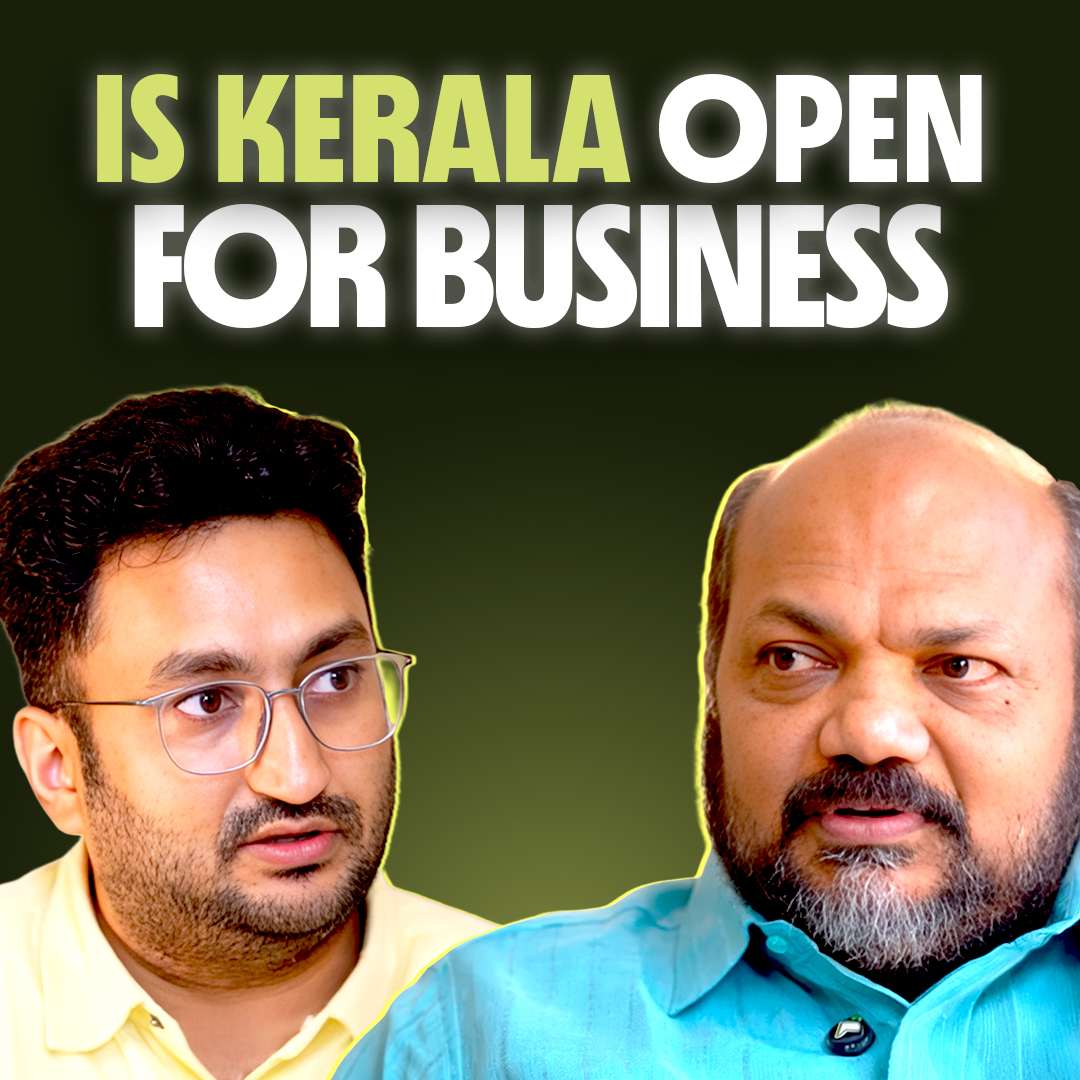
Growth, Migration and FDI: The Real Kerala Story with Minister P. Rajeev
What The Kerala Model Must Fix
This episode is not just about Kerala; it is about how a state with limited land, strict environmental regulations, and a long history of outmigration is approaching investment and growth.
Kerala is a small, densely populated state with limited land to spare, not the typical site for industrial expansion. Yet it’s taking a distinct approach to building a knowledge based economy.
P. Rajeev (Minister for Industries, Law and Coir, Govt of Kerala) joins us to break this down.
We discuss how Kerala rose from the bottom to become the top-ranked state in Ease of Doing Business, what’s behind the ₹1.5 lakh crore in investment pledges, and why the state is prioritizing high-value industries over land and labour-intensive manufacturing.
We also unpack how Kerala plans to convert MOUs into functioning factories and real jobs, and why startups that once moved away are now beginning to stay.
Tune in if you’re curious about how Indian states are attracting investment and rethinking their development models.
Watch all other episodes on The Neon Podcast – Neon
Or view it on our YouTube Channel at The Neon Show – YouTube
Siddhartha Ahluwalia 1:20
Hi, this is Siddhartha Ahluwalia, your host at Neon Show and also managing partner of Neon Fund, a fund that invests in the best of enterprise AI companies between the US and India corridor. Today we have a very different guest and you will be glad to know I have with me Minister Shri P. Rajeev. He is the Minister for Law, Industries and Coir in the Kerala government. So, welcome sir to the Neon Show, so glad to have you.
P. Rajeev 1:47
Thank you and it is also a privilege for me to be here with you. Your channel is very credible, the podcastings are also very interesting. You are trying to unclose the real picture of investment scenario of the country and the world.
It’s good, thank you for this podcasting.
Siddhartha Ahluwalia 2:08
Thank you so much. And today we are going to discuss about how Kerala is evolving as a state, you know, from a tourist, like the number one tourist destination in India to being among the top in ease of doing business in India, which many people don’t know about. But you know, in the recent past, what many people know about Kerala or their misconceptions about Kerala that like, you know, movies like Kerala Story got produced and things like that, you know, on communism, that’s a communist state, right, who want to clear the air with facts to our audience.
P. Rajeev 2:42
That’s true, deep-rooted presumptions was there, very negative narratives are there, Kerala is not suitable for industry, where communists have ruled there for several decades, labor disputes are very strong, but that is far away from the realities.
Kerala is a small landscape, only 1.16% of the landscape of the country and 2.8% of the population of the country. Kerala is the land of highest number of 5-star hotels of India, the latest data of tourism ministry that is 91 and financial capital of the country is in the second place, Maharashtra. That shows the strength of tourism and how to link this tourism and industry.
I would like to share one interesting experience. All of us using Uber, one of the founder of Uber, he visited Varkala and his team stayed for several weeks. From Varkala, that is one of the famous beach of Kerala, from Varkala they wrote this program of Uber.
Then work from Kerala, very good air, you cannot move outside in different parts of the country without wearing a mask. Come to Kerala, take a deep breath, very good for your health and very good water, quality of water is very good, 44 rivers and the total atmosphere is very good, ecosystem is very good. Not only for tourism, in Scandinavian countries you can work only 3 or 4 months outside your home.
Then you please come to Kerala the rest of the year and work from there. We will provide all facilities, high speed connectivity, you can eat anything as you like, you can wear anything as you like, you can speak anything as you like, no restrictions. Freedom of expression is there, freedom of thinking is there and academic freedom is there.
Then that is the right place, not only for tourism and work from Kerala. That is a new slogan we have mooted. One presumption is all youth are going away from Kerala.
Then Kerala is an old age home. All people from the world at their old age come to Kerala and senior living with high class facilities. We have a high class, world class health care system, public and private. It is there, good air, everything is there.
Then at the age of 60 or 70 you please come there. We will provide all facilities. That is also another avenue for investment. Some of the big brands are coming to Kerala for investing to establish in these type of senior living and residential buildings. Then for industry, actually manufacturing is the face of industry. The latest edition of Economist, one leader is the world must escape from manufacturing delusion.
Actually this Taiwanese investor, Mr. Stan Shih has developed a smile curve. The Raghuram Rajan also in his new books here described us.
This is a curve. Manufacturing is the middle. Then value division is left and right.
This innovation, concept, innovation and branding and design, all the R&D, this is very value added thing. Then manufacturing, manufacturing is only assembly. In some of the videos explained this iPhone manufacturing cost is 10 or 20 dollars.
But other cost is from this side and that side, this smile curve. One is innovation, branding, R&D, design and development. Other side, distribution, marketing and service after sales.
These two sides are value division. Then we are focusing on this. Manufacturing, it is not easy for state of Kerala, big manufacturers.
If you are asking 1000 acres of land for me, it is very difficult. For acquiring 100 acres of land, I have to discuss with more than 1000 landowners. In other parts of the country, if you want 1000 acres of land, you have to discuss only 1 or 2 persons.
That is the difference. Then Kerala is, I have mentioned, very small landscape and ecologically very sensitive. That is why we are focusing on this knowledge based industries.
We are not trying, competing to be a cheapest destination of manufacturing industries. But we are trying to make Kerala as an innovative and sustainable, future ready economy. Smart economy.
That is our plan and perspective.
Siddhartha Ahluwalia 7:34
Sir, for example, if anybody is trying to set up their IT firm in Kerala, let’s say, a much smaller version of Infosys or a startup. How do you suggest about the 1st is, going about acquiring of land, acquiring of economic IT park, which is called economic, special economic zone. And the 3rd is, you know, the manpower, IT trained manpower. So, what is your view on that in the next few years?
P. Rajeev 8:02
Actually, we have established the 1st Techno park of the country in 1990 at Thiruvananthapuram. That is the largest Techno park of the country. Then, we missed the bus at the 2000, the changing of world technology industries.
At that time, we missed that bus. That is true. Now, the last 9 or 10 years, we are improving in a big manner.
Now, our IT parks, most of the IT parks are full. Very difficult to allot land. Several companies are in the queue.
Big companies are there. IBM started their campus 3 or 4 years back. Their plan to recruit 100 people within a year as a pilot project.
But within a year, they could recruit more than 1000 youth from state of Kerala. Then, he, the senior vice president Mr. Dinesh Nirmal said, only because of the output of the youth, they have developed 2 successful tools within a year. One is purchased by Facebook. Other is by Delta airline that give more money to IBM. Then, they have, we have organized a big GenAi conglomerate. The first GenAi conglomerate of the country.
Hosted by state of Kerala along with IBM. Now, IBM has established the first GenAi innovation campus in Kochi. Then, IT park is there.
And also, now Kerala, one significant feature is very difficult to demarcate between villages and cities. If you are traveling in other parts of the state or in New York, big city, then big gap, then some other part. But if you are traveling through Kerala, very difficult to find a walk of space.
Residential buildings, commercial buildings. Kerala is the most urbanized state of the country. Actually, de-facto Kerala is the largest city of the world.
If you are taking as a whole, Kerala is the largest city of the world. Then, we are expanding IT corridor. Not only focusing on the cities, Trivandrum to Kollam, Kochi to Cherthala, Kochi to Koratty, or Calicut to Kannur, several IT corridors.
We are providing land for IT companies to establish their industries. And we have established one of the best startup village and also maker village in the state of Kerala. Several startups are there.
And the startup ecosystem, I think, affordable startup ecosystem, Kerala is the number one in the South Asia. And the growth rate is larger than the world growth rate of startups. But we have faced some difficulties.
After a certain stage, they are moving to Bangalore or some other parts. Then I had interaction with them. Why?
What is the shortcoming from our side? What the government should do to scaling up your startups? Then they had raised some concerns.
This prototype manufacturing and scaling up the talent of the skill of the youth. Then we have introduced certain things. Full-time internship to the students, IT firms, and also more seed money, and also giving more backing for prototype manufacturing, design side also.
That is what we are doing.
Siddhartha Ahluwalia 11:14
And sir, one question I had for you is, for the longest period of time, like Kerala has seen talent from Kerala move to other states, let’s say, for example, to Bangalore, or even outside India, let’s say, to countries like Dubai. Do you think now, in the future, there is enough depth that can keep the talent within Kerala?
P. Rajeev 11:36
Not only they keep the talent, the reverse migration is also happening. Earlier we are sending people to all over the world. Now we are inviting all to Kerala to build up a high-tech manufacturing state.
And that is also happening. While interacting with the employees of certain companies, either in IT or medical device industries, or new technology sector, AI or blockchain technology, or big data analysis, or the robotics, the talent people are coming back to the state of Kerala. The geopolitical situation is changing.
Nobody can stay in some countries. The visa regulations are changing from morning to evening. Very difficult to stay in the developed countries.
Then some of them will be compelled to go back to their home, to India. Wearing a cuff or without, that is the question now. Then we should provide.
Then what is the reality? The people from Kerala, youth from Kerala is going out for jobs. Earlier it was to Mumbai, then to Ceylon, then to Gulf.
Now it is to America, UK, Australia, or Canada. People from Bihar coming to Kerala. People from Assam, Northeast, coming to Kerala.
Some other parts of the state, they are coming to Kerala. Then what should we learn from this? In Kerala, jobs are there for these unskilled laborers.
But we have such a shortage of jobs for our own people, highly skilled. Then our objective is to ensure this opportunity for our own people. Then which sector we have to focus?
Big manufacturing, actually unskilled labor. If you are giving all incentives to a garment industry, 10,000 people are working there. Average salary is 10,000 rupees per head.
That means 120 crore per annum. If I am giving a big IT company like IBM or ACL or Cognizant or any other companies, 3,000 people is working there. Average salary is 20 lakh per annum.
That means 600 crore per annum. 10,000, 120 crore per annum. 3,000, 600 crore per annum.
These 10,000, most of them migrant labor. They are sending money outside. These 3,000, most of them are Malayalis.
They are spending money there. It will generate 3 or 4 indirect employment. It will create more opportunities.
For this talent that you have mentioned, earlier capital, land and labor. Now it is changing, intelligence and technology. Knowledge becomes capital.
The objective of Kerala government is transforming the economy into a knowledge-based economy and the society into a knowledge society. For knowledge, economy means knowledge becomes capital. That is highest potential.
That is the advantage of Kerala. Readily available talent pool. Highly skilled talent pool.
In this, recently I read this book, Raghuram Rajan book. The government of India spent 50% of the total capital cost of migrant company for establishing a semiconductor company in Gujarat. 20% for Gujarat, 70% incentive.
That means for 16,500 crore rupees for a single company. Total expenditure for higher education in India is only 43,000 crore rupees. One third of expenditure of higher education of the country for a single company that is creating only 5,000 jobs.
That means 3.2 crore rupees per job creation. If you are spending this money for universities and colleges and if the talent pool is available, then companies will come to India. If the talent pool is here, they will come.
That is the strength of Kerala. This innovation side, we have very good ecosystem. Out of 100, 16 best colleges in Kerala, 9th best university as per national ranking, 10th and 11th universities are in Kerala.
And for innovation, what is the best inevitable requirement? That is free thinking, freedom of thinking, freedom of expression, freedom for economic institutions, then no attack to privacy, they should ensure the privacy, democratic function, transparency. The youth need these.
If you are creating all these things, the innovation automatically will come. Then the industry will come to here for this side, this value addition for innovation side. That is the need.
Then we are focusing on that.
Siddhartha Ahluwalia 16:35
Got it.
I just want to lay out some facts that at Invest Kerala Global Summit, the state secured proposals worth Rs 1.53 lakh crore from 374 companies including Rs 30,000 crore from Adani Group alongside 24 IT firms pledging Rs 8,500 crore for 60,000 IT jobs. And, you know, a decade ago, Kerala wasn’t seen as an industrial hotspot, more known for tourism, literacy, social development. But with these developments clearly changing now, big investors are showing interest and there is serious infrastructure coming up.
What is driving this shift? You know, you laid out some facts also. And why are you trying to reposition Kerala as an industrial and investor friendly state now?
P. Rajeev 17:27
That is true. We are repositioning our own state. We are trying to showcase the potential. Kerala is contributing 20% of the turnover of medical device industries of the country.
20% is small landscape. And IT also, we have started very early. Now we are trying to make up the shortcomings.
And also in 1973, Kerala has established the first electronic company, Keltron, that has manufactured the first colour TV of India. And also the ticketing system of first metro in Calcutta. The traffic security system of India, first in Asia, in Delhi, that is Keltron.
Now we are focusing on this side. But the deep root of presumption was Kerala is not suitable for industry. Some issues were there, but it is an old story.
Earlier our ranking was 28th in ease of doing business. That is business reforms action plan. That is exclusively based on feedback.
100% feedback. Now, Kerala is number one in business reforms action plan.
That is ease of doing business. That is a herculean task, but we could achieve. Then now, our task is to maintain that position.
And we are, after discussing with all investor community, we have adopted a new industry policy. Our motto is very interesting. That is nature, people, industry. Not in the reverse order. If you are confident with this, then you please come. Responsible investment, responsible industry.
Nature first. And the color of the cover and the color of the font is intentionally selected as green.
Siddhartha Ahluwalia 19:08
At the Invest Kerala Summit as announced earlier proposal of Rs 1.5 lakh crore was signed. Turning MOUs into actual factories campuses and jobs is a real challenge. So, the first question from my side is what is the follow through plan to make sure these projects move fast and don’t get stuck. What is the timeline to make these MOUs into action so that it can contribute back to Kerala GDP and national GDP?
P. Rajeev 19:41
There is another question that I have mentioned earlier. We have specific plan. Time-bounded plan.
Categorization is there. A team is working. 12 teams are there.
They are working on each sector and we are monitoring. I think more than 50% we can convert into real investments.
Siddhartha Ahluwalia 20:01
In how much time?
P. Rajeev 20:03
This month I got the privilege to lay the stone of 13 factories. The next month I think the 21st I will go to lay the stone of 7 companies. 23,000 crores already started.
23,000 crores. Very good move. Very good successful move.
Siddhartha Ahluwalia 20:28
And Vizhinjam port is said to be a potential game changer for the state. What are your expectations from that port?
P. Rajeev 20:36
Vizhinjam. Whenever you can pronounce Vizhinjam properly, then you can do anything. That is the first comment of the former CEO of Vizhinjam.
Very difficult to pronounce Vizhinjam. Vizhinjam very high potential for the state of Kerala. That is very near to international sea route.
Natural depth. If you are using Vizhinjam then the ship can save 8 to 10 days compared to Colombo or Mumbai ports. Saving one day that means saving 25,000 dollars.
That means if you can save 10 days you can save 2,50,000 dollars. This saving should be reflected in the raw materials or other commodities imported through Vizhinjam and also products exported through Vizhinjam. That is the cost effective.
Then we have already created a master plan. A manufacturing zone should be there. A corridor, growth corridor.
The raw materials from different parts of the world you can bring to bring through Vizhinjam. Then you can save this much money. Then assemble it.
Then again send back to the port, to the ship. Then export to different parts of the world. Then it is the production cost may be very less compared to other parts of the country.
That is also a big advantage. And also our infrastructure. Total connectivity.
That is one advantage of state of Kerala. We are going to completing the widening of the national highways and waterways also. Four international airports.
Fifty is coming within this small landscape of the country. The highest number of international airports of India in Kerala. This small landscape.
Then we are using all these things and Vizhinjam gives very good potential for the state of Kerala. It should be a game changer. A gateway not only for Kerala but India also.
Siddhartha Ahluwalia 22:47
So other states have attracted big names like Telangana with Microsoft and Microsoft has contributed huge to Telangana. It was originally Chandrababu Naidu who brought Bill Gates to India and then to specifically to Hyderabad. Then Gujarat with Foxconn.
Foxconn is setting up huge amount of their plants in Gujarat. So, is Kerala also looking for such an anchor investor?
P. Rajeev 23:17
Yes. IBM is there. Cognizant is there. Now 60 to 70% of the Tata Elxsi’s workforce is in Kerala now.
TCS is also one of the leading company. If you are providing all these things. Highly available, talent pool.
Then all companies are coming. Then now capital needs intelligence over infrastructure. That is the reality.
Then we are creating that. Several center of excellence. We have established first digital university of the country.
First blockchain technology academy of the country. First center of excellence on nutraceuticals. First digital science park.
Last year honorable prime minister laid the stone. Fully state government program. And we are thinking to complete it within this year itself.
Then center of synthetic biology. Center of sustainable development. First genome data center of India.
That is in Thiruvananthapuram. And one of the best virology institute. Then very good ecosystem for IT and also for VT, life science.
And students studying in 7th standard in public education in schools of Kerala. They are studying AI and robotics also. We gave training to 2 lakhs public school teachers on AI.
How to use AI tools and agents for teaching over in the Wales. This public education institution. Then these things this fundamental things that create a very vibrant ecosystem for IT industries, GCC industries and also life science industries, new technologies, space also.
Space, ISRO is there, VS is there. Several space companies are there. Now Indian institute of space science is also there.
Very good ecosystem. I think within 10 to 15 years Kerala should be the destination of high tech knowledge industries of the world.
Siddhartha Ahluwalia 25:29
There was some buzz recently when Kerala reached out to Bangalore based IT firms during the water crisis. It drew a sharp response from Karnataka government. What was the thinking behind that move?
Was it more of a signal that Kerala is growing readiness to host large tech firms? Did it result in any tech firms moving from Bangalore?
P. Rajeev 25:50
Actually every states are competing. But we are not competing to attract the cheapest labour cost industries. We are focusing on these type of industries.
But we can work together. If some companies work here, stagnation is also here. Then they can come there. Some companies can move from there to here.
Then I think all of us have our own space. The southern states, most of them are developed. In Kerala our model is well appreciated by the world.
Kerala model of development. Now one shortcoming for that development model, that is stagnation in productive sector.
Now we are trying to overcome that stagnation, and we are trying to utilize all opportunities, but not blaming this state or that state. We are sending flight to some states to attack, no, our feeling is the investors will come by using their own flights to establish industries or IT firms or B campuses in the state of Kerala for providing all these facilities for them, not incentives, GCCs are coming not for big incentives. If you are ready to available the talent pool according to their requirements, then they will come.
Then outcome, what is the outcome of this talent pool, that is very good, highly productive. Then I think not competing, we are complementing each other, and we all have their own space for growth and development.
Siddhartha Ahluwalia 27:24
There was a recent story that you know, a large tech firm CEO was coming to Tamil Nadu and similar in manufacturing also, but Mr. Chandrababu Naidu met them before they could take the flight and directed them to his state. So, is such competition like healthy within India, like states competing with each other?
P. Rajeev 27:46
That is not healthy, but that is happening, that is happening, the ministers came to that state or this state, we are going to other places also, but only to showcase the potential, discussing with other investors, not invest this state, please come to my, no. And we have certain limit, we are not in a position to give big incentives, lands, parcel of lands, very difficult. I cannot give 100 acres of land free of cost to any company, no, but I can, our government can give some incentives, like only 10% in the first year, three-year moratorium, then you please deposit these within 10 installments, that time we can, and also a talent pool, full-time internship.
Now, we have introduced a novel scheme, private industrial park, 37 private industrial parks already established. And first time in the world, we have established another novel scheme, campus industrial park. Higher education institutions can establish industrial park, we will give industrial status, student studying in B.Sc. computer science, she or he can work in the IT firm of this campus industrial park, she or he availing a wage from this for his or her part-time job, at the same time, they will get a credit or bonus mark or grace mark from the higher education institution. These type of things we are focusing, that companies will come, not sending charter flights or sending any special incentives, no, they will come.
Siddhartha Ahluwalia 29:25
In Kerala, geography, as you pointed out, is usually tight, dense population, forests, coastal CRZ zones, ecologically sensitive wetlands, right? Given all these constraints, how are you planning the industrial development? And some critics have said that Kerala’s environmental regulations are too rigid, too tight, and others say it can be a strength also.
So, how do you strike a balance between sustainability and investment promotion?
P. Rajeev 29:53
If you are considering the people, planet and community, then you can come to Kerala. If you are trying to destroy all these things, then it is very difficult. And one speciality of the state of Kerala is the decentralization of power and the transparency. Local self-governments.
I think then compared to other parts of the country, Kerala is the least corrupted, no bribery, no hidden cause. Anybody can establish industry, but in accordance with the rules and regulations prevailing in the state of Kerala. But any rule or act is not practical, then you can come to us.
Not for you, any special order for you. No, we will change that. That will be applicable to all, irrespective of whether they will come to us or not.
It will be applicable to all.
Siddhartha Ahluwalia 30:47
So, Shri Sanjeev Sanyal, who is advisor to Prime Minister Modi, he mentioned that West Bengal and Kerala are same to same. Both are communist state and because of that, both are not developing as fast as India’s top five states. What’s your view on that?
P. Rajeev 31:05
Actually, that is, an economist should speak on the basis of the facts, not on the basis of the propaganda. Amitabh Kant correctly stated, Kerala is the best state for ease of doing business now. Recently he has mentioned.
An economist should based on the facts, that is FTA. If you are taking FTA, the growth rate of FTA in the state of Kerala is 100% within a year and the position of Kerala has jumped to 9th. But that is not big because the FTA, 90% FTA belongs to three or four states.
That is the reality. But we could improve 100%. And also, one IAS officer, young IAS officer, few years back, he has shown courage to resign from civil service and start a small company in the state of Kerala.
The significant feature is that company, he had started utilizing the technology developed by a Kerala institute. That is central institute working in Kerala, Sree Chitra Tirunal. The product is blood bag.
Now that blood bag company Terumo Penpol is the largest blood bag company of the world. Not only India, but the world. And it is working in, this factory is working in a small village of the state of Kerala.
And few years back, a small man started a small industry to manufacturing artificial teeth. Now that company is the largest company in Asia. And small company, small startup, it was started, I think, in 2018 or 19 for engineering students.
On social commitment, with the help of the startup mission, the government, they could develop a small robot for manhole cleaning, gen robotics. Now that is one of the largest company employing more than 900 people. That is some examples.
The thing is, we are not trying to attract more investment on low productive, low value addition industries. And earlier I have mentioned, we are not in a position to give high incentives for creating one job, 3.2 crore rupees. No, that is not good for the country also.
But you please look at the high value addition that Kerala is transforming. For industrial corridor, Kochi-Bangalore industrial corridor, we could acquire 1700 acres of land within 10 months. Now SP is formed.
The developing process is going on. And also the connectivity side, no labor issues. But this negative propaganda is very high.
Because communists are, you have mentioned Bengal, Kerala communists. If you look into the history, in 1957, April 5th, the first communist government had assumed power. E. M. S. Namboodiripad was the chief minister.
At that time, communists were shouting slogans against Birla, Tata, Goenka. The same time period, E. M. S. invited Birla for a breakfast. And they have discussed, give certain incentives.
And the first company established in Calicut, Mahabalipuram Royals by Birla, another same company. The budget speech of that government, the then finance minister, C. Achutha Menon has mentioned, we should give confidence to the investor community. For that purpose, government should take stake, equity in private industries.
That time PPP is not familiar to nowhere in the world. First time a government has allotted money in their budgets for taking equity for private companies. Give confidence.
That is because we are working within the framework of this country. We are trying to attract more investment to the state to give more employment to our own youth. That is our responsibility.
But it should be responsible, transparent. Now, Kerala has been changed in a big manner. In certain period, we are facing certain not good things are happening.
That is the reality. But that is an old story. Now, Kerala has been transformed.
The ease of doing business, ranking is done by the union ministry, not by us. And also, prime minister has recognized the novel innovation in MSME sector, model experience in MSME sector, our year of enterprises campaign. American Society of Public Administration, first time in its more than one and half centuries history, recognized an Indian government initiative as a novel innovation in public administration.
That is our year of enterprises. We could establish more than 3.5 lakhs small enterprises within three years. That is empowering women.
31% are women entrepreneurs. Then they are transforming their ornaments to capital or bank deposit to capital. Whenever an ornament is transforming to capital, it should generate employment, more than 7.15 lakhs employment opportunity. Now, that is a very old story. I think he is living in, while stating this, he is living in three, four decades back.
Siddhartha Ahluwalia 36:30
And then where does this narrative come from? Because of like deep-rooted communism.
P. Rajeev 36:38
That is our deep-rooted presumption was the negative propaganda. People are more interested in negative propaganda. One thing is Kerala.
Now, I have seen some changes. Kerala media has also tried to propagate in small things. Yes, no perfectism is existing anywhere in the world.
Some new shortcomings will come. Then we are trying to rectify that. Then another things may become.
Then we are trying to rectify that. Then that is the way adopted by most of the, all of the governments in the world. Here we are trying our best to attract more investment, to create more employment opportunities and also strengthening our ecosystem.
Now, we are on the right path. That is the reality now.
Siddhartha Ahluwalia 37:27
And you know, movies like Kerala story, right? I believe they were banned in Kerala for some period of time because they were highlighting places like Kasargod to be of, you know, either Islamic rebels which were converting girls from Kerala and sending them to Afghanistan. So, was there at any point in time things happening like that in the past?
And how did in Kerala?
P. Rajeev 37:50
It is not a real Kerala story. That is why it was rejected by all of the people in the world. No need of any ban.
What is a real Kerala story? You can, this festival of Islam, they can use the temple permits also for this iftar. And at the time of Pongala, one of the big festivals in Thiruvananthapuram, the Muslim and Christian centers are open for the devotees of this temple.
That is happening. And recently this Kashmir incident was happening. One Tamil was died by the, killed by the terrorist.
Then his daughter, she was noticing this. She said, I got two brothers, Muslim brothers. Because they drove the car at that time and they stood with her to the airport.
All things are doing by them. Then she said, I lost my father but I got two brothers, Muslim brothers from Kashmir. That is the real Kerala story.
Kerala’s, the significant feature is, that is Raghuram Raman said, for innovation, a free, freedom of thought, freedom of expression. It is there. Transparency is there.
Accountability is there. You are free in the state of Kerala. You can eat anything.
You can wear anything. You can profess whatever, your religion also. No, no restrictions.
Temples are there. Churches are there. And Muslim, Dumas are there.
Masjids are there. All of them are there. They are living together, secular state, progressive state, democratic state.
That is strength, not the weakness.
Siddhartha Ahluwalia 39:37
And one thing is that, you know, which I appreciate, how did Kerala rise to be the number one education index for literacy?
P. Rajeev 39:46
That is a long story because of the Renaissance movement. In 1907, the first strike in the agrarian sector that was led by Ayyankali. The slogan, if you are not giving opportunity to our children to study here, then we will not enter to this paddy field, boycotting.
That is the first strike. Nowhere in the world, the first Renaissance movement for, first strike for the…
Siddhartha Ahluwalia 40:15
This is which year?
P. Rajeev 40:16
1907. That is the first decade of the 20th century. And Shri Narayana Guru, Renaissance movement.
And also missionaries movement. Then the continuation, left movement, communist movement. And the culmination of this, 1957, the first government.
Free education, free meal, free textbooks, and also uniform free. And we are providing all facilities. Now, interactive screens in the government schools.
Compared to private aided schools, number of laptops and systems are higher in public schools. Then the NEET exam, the Kerala public school gave for the first in Kerala. Then we are strengthening this public education.
But we are facing certain shortcomings. That is quantitative is okay. Qualitative is we are facing some limitations.
Now we are focusing on that, changing the things. It’s a long story and now it is right path now. We have certain shortcomings.
Now we have overcome that also.
Siddhartha Ahluwalia 41:23
So what have been these shortcomings that you keep on mentioning about that have been there in the recent past? And some of them are still there.
P. Rajeev 41:32
Yes, always there. Some certain shortcomings, no perfect system. But what was our shortcoming in Kerala model of development?
One advantage is, it is almost same literacy level, healthcare level compared to developed countries. Women literacy, girls literacy compared to China and USA, almost same. And healthcare system, almost same.
But that said, we have recognized a shortcoming. That is quality. Then now we have establishing first government owned organ transplantation institutes in the country.
We are, our expenditure is around 500 crores. Fully government owned organ transplantation. You can transplant a heart in a government hospital, district general hospital, nowhere in the country.
We have very good. Then quality healthcare. Earlier healthcare, now quality healthcare.
Then education, now quality education. Then the second generation problems. If you, if a child born in state of Kerala, she or he can live 10 years more than other states.
Life expectancy is very high. Then geriatrics is a must in our healthcare system. Then this lifestyle diseases are very high.
Our expenditure should be more for that purpose. And this palliative care is also big need. Now we are establishing grids, first time in the world.
All palliative care patients should get an assistance from a volunteer. Anybody can register. If you are ready to spend at least one hour within a week to sit with a palliative patient, you can register.
Then we will give training. Then that is the things we have developed. But major shortcoming that is saturation in production sector, agriculture also, industry.
Normally, first agriculture, industry, service. And service, okay. But the productive sector, we are not improved.
Earlier we could not improve. If we could not, we cannot improve this, then we cannot sustain the achievement of this Kerala model of development. We should get more resources.
That is why we are focusing on infrastructure. Four-lane highway, waterways, four airports, and also high-speed connectivity. First time in the world, Kerala is a state which have recognized internet right is a basic right of the citizen.
Not only on paper, we are providing high-speed connectivity. KFON, government’s own mechanism for laying optical fiber cable network, for providing connectivity at affordable rate to all citizens, and free, of course, to the BPL and government offices. These are the steps we have taken.
Now I think we are on the right path. The last nine years is a transformation years of the state of Kerala to be a knowledge-based economy. And from the cheapest manufacturing destination to a smart economy, smart factory system.
Siddhartha Ahluwalia 45:06
And for the longest period of time, Kerala has been known that you have the best nursing colleges in the country. And nurses from Kerala are not only known within India, in the US, in Dubai. So is there a plan to like increase that over a period of time or you are happy with that?
P. Rajeev 45:29
We will increase in number of seats. And also our nursing institutions are not sufficient because people are going to other states. And our nurses are going abroad.
They are getting more wages. Then we should increase the wages. Our wages is better than other states.
That is true. But compared to other countries, it is not that much. Now we have a very good public healthcare system.
At the same time, we have a very advanced private healthcare system. Now as an industry minister, we have organized a meeting of these private industry hospitals to attract more patients from other parts of the world to the state of Kerala or from Arab countries, African countries. And our students are going to other states for studying.
But students from African countries are coming to Kerala. Nepali students coming to Kerala. Arab countries students are coming to Kerala.
Then we are studying Kerala. Private university we have recently adopted. And I think all these things will change the scenario in a big manner.
Siddhartha Ahluwalia 46:46
So you are saying you are attracting international students to study nursing in Kerala.
P. Rajeev 46:52
No, nursing Kerala’s international, other courses. If you are a citizen of any country, before you die, you should see a Malayali doctor or should touch of a Malayali nurse. That is reality.
That is why I have said earlier, please come to Kerala. The senior living with all modern facilities, Americans, British, Europeans, after 60 or 70, please come here, invest in Kerala. Then you can live here, new business opportunity.
Siddhartha Ahluwalia 47:28
And how easy it is for a person of other state or a person from other country to buy a land in Kerala for agriculture purposes or if I want to build a home in Kerala?
P. Rajeev 47:41
Yes, but as per the law of existing in the country, for foreign citizens, there are restrictions. For NRI citizen with citizens of other country, then this overseas status, then they can purchase only agriculture land. That is monitored by the, governed by the union laws.
We have no authority to change that laws. But other states, no difficulties. You can buy and you can leave, you can establish, no restrictions.
Siddhartha Ahluwalia 48:15
But are you seeing like people used to buy farmhouses in northern India, in the hills? So are people buying their farmhouses in Kerala also now?
P. Rajeev 48:27
That type of things are not available in the state of Kerala, farmhouses. We have big plantation is there. That is true.
Now we are trying to change the definition of plantation. Now five or six crops are there. Recently IIM Calicut had conducted a very good study and the major recommendation to diversification of the crops.
All these more than 10 years of life should be included in the plantation definition. And also land ceiling is there. A person cannot own more than 15 acres of land.
For more than 15 acres of land, you should get an exemption from the consent authority.
Siddhartha Ahluwalia 49:09
On the startup side, you have only one unicorn from Kerala, which is open. And that too, the companies now, you know, started in Kerala, moved their HQ to Bangalore. And whenever they go public, they’ll go public in Bangalore.
So what is your vision to attract more companies to become unicorn?
P. Rajeev 49:27
That is true. I have earlier mentioned some limitations were there for the scaling up time. Beginning seed money and seed, that is okay.
For scaling up, they are facing certain difficulties. We had discussed it. On the basis of that, now we have formulated several schemes.
Huddle, the festival of the startups for this by Kerala startup mission. It’s a great event. They’re attracting from startups and vendors and virtual capitals, other funds from all over the world.
So now I think we can see a good change. Positive things could be happened within a short span of time.
Siddhartha Ahluwalia 50:07
Do you think that there could be a scenario where tens of unicorns can come from Kerala?
P. Rajeev 50:13
Yes, yes. Most probably. We can see good changes.
Siddhartha Ahluwalia 50:17
Yeah, I think we need to make that happen.
P. Rajeev 50:19
Yes, our youth have a very high potential. If you are facilitating, they can make wonders. We have trust and confidence with them.
Siddhartha Ahluwalia 50:29
What about the status of companies going public from Kerala? I think Kerala also lags behind in that.
P. Rajeev 50:36
Yes, yes. Now this changing is happening. Some companies are family-owned companies, partnership companies, and digital technology utilization, new methods.
Now virtual funds are there. They are investing in healthcare system. Yes, change is there.
That is why 100% increase in FDI within a year in a small state. That reflects this change. I think the more than 1 trillion capital for Muthoot first time, recently reported by the media, 1 trillion rupees capital for Muthoot companies.
That is a good change. I would like to congratulate them.
Siddhartha Ahluwalia 51:18
Thank you so much, sir. It’s been amazing to learn more about Kerala from you and dispel the common myths which we have about the state. And we look forward to do more of these so that we can bring out more facts on the ground which are happening on Kerala.
P. Rajeev 51:34
Thank you. This is also a very interesting experience. I consider this as an opportunity to showcase the potential of my own state.
This is an inevitable opportunity because you have mentioned deep-rooted presumptions are there. A negative image for the state of Kerala. All this propaganda is far away from the reality.
Then what are the facts? I’m talking only on the basis of the facts. No other things.
Only on facts. You can check with any reputed sources, union government sources or credible agency sources. That is the reality.
Then I think this is a great opportunity. Thank you for giving this opportunity for the state of Kerala. This is my responsibility to go anywhere to showcase the potential of my own state to attract more investment, to ensure employment opportunities to our own youth.
They should remain in the state of Kerala. Then their productivity would be increased. If they are working in the United States, sometimes they are called from their mother or father, they are not well.
Then they are not in a good mental position to write the program. If in Kerala they can go home and sit with their parents, they can write the program. Then productivity may be also high.
It would be beneficial for the society also.
Siddhartha Ahluwalia 52:57
Thank you so much, sir. It shows the kind of effort that you are putting. You have come from Kerala to Bangalore just to record this podcast.
Thank you so much. It’s a sense of very deep commitment.
P. Rajeev 53:08
Thank you. Thank you very much.
Siddhartha Ahluwalia 53:10
I really appreciate it and look forward to doing more of these.
P. Rajeev 53:13
Definitely, we can work together.


Know when new episodes are released. Subscribe to our newsletter!
Explore Playlist

Is India Making Most of It’s GDP Growth? with Prof. Arun Kumar