



344 / November 14, 2025
How Repeat Founders Build Startups Faster and Cheaper | 4x Founder Shreesha Ramdas (Lumber)
When Shreesha Ramdas left Medallia after a $6.5B acquisition he decided it was time to reinvent.
At his 4th startup Lumber, before writing a single line of code, he hired a sales person and ran 200+ interviews across the industry to understand the real pain points. The interviews gave Shreesha the insight that though payments were a problem, it was neither big enough nor urgent.
But it was very difficult to hire workers, and even more difficult to retain skilled craft workers. In the U.S alone 41% of construction workers will retire in the next six years, leaving a massive gap in talent and experience. As a big believer in vitamin vs. painkiller, Shreesha is now building where the pain is deepest.
We discuss what truly needs to happen before building a startup, the foundation that will shape everything that follows. From his days at Yodlee during the dot-com boom to leading StrikeDeck and selling it to Medallia, he is now building again with clarity and intent for one of the most traditional industries: construction.
But here’s one thing that probably tells you more about Shreesha than the companies he has built and scaled. He said, “My heart beats for other founders. Startup is my world, this community is my tribe.”
Watch all other episodes on The Neon Podcast – Neon
Or view it on our YouTube Channel at The Neon Show – YouTube
Siddhartha Ahluwalia 01:04
Hi, this is Siddhartha Ahluwalia. Welcome to The NEON Show. I’m your host and managing partner at NEON Fund, a fund that invests at the earliest stages in the best of enterprise AI companies between US and your corridor, like Atomicwork, CloudSEK and SpotDraft.
Today, I have a serial entrepreneur with me who has built companies, sold companies, been part of the journey to taking them public and has started another company in a very tough space and has garnered success in the initial parts of it. Shreesha Ramdas, founder of Lumber. Shreesha, welcome on The NEON Show.
Shreesha Ramdas 01:41
Thank you, Sid. Pleasure to be here.
Siddhartha Ahluwalia 01:44
Shreesha, I’ve known you for a while and I have really respected for the grit that you have displayed in your journey as an entrepreneur.
Shreesha, I want to start by maybe giving an audience a flavor of Lumber. So you started in your payroll management for construction space and construction is a very tough space dominated by old players like SAP, on the other end like Oracle and on the payroll side like ADP. So when you were starting your next company and probably this is your company you want to run for 10-15 years.
How did you decide on the space after your exit?
Shreesha Ramdas 02:23
Yeah, so as you said, when I came out of Medallia, when Tom Brown picked Medallia for a 6.5 billion transaction, I was bored of technology vertical. For my entire life, I’d solved problems for technology vertical and it was time to reinvent.
And I wanted to go after a hard problem, go into an industry which is considered boring, where digital transformation has not yet done its magic and take that industry forward, have a big impact. And that’s what led me to construction industry. I’ll give credit to my co-founder who had prior experience at Oracle heading in construction engineering.
And he was the one, if you’re looking at one of the toughest industries and with a lot of problems to solve, then take a look at construction. And when I did some research, talked to a few people in the industry, I was convinced that this is a massive opportunity to leave a legacy. Construction, if you look at it, it’s one of the fundamental pillars of the economy.
And if we can move construction industry ahead, we would serve the economy, help economy do better. What can be a better mission in life than that?
Siddhartha Ahluwalia 03:52
And how did you choose to solve for payroll and not for ERP or any other workflow inside the construction?
Shreesha Ramdas 03:59
Yeah. So actually, Sid, I started thinking about a different problem to solve in the construction industry. I was part of the Yodlee team years ago and because of that fintech background, I was thinking about going and solving payment problems, basically how a contractor pays a subcontractor or subcontractor pays their supply. So I was thinking about solving that problem.
But before I start thinking about solution, one thing I did, looking back, I did the right thing. I hired an HDR on my payroll and I asked her to set up about 200 interviews. So I spoke to construction industries, small and large, just to understand what problems, challenges each of them face.
And one theme that kept on coming again and again was how it’s very difficult to hire workers, and it’s even more difficult to retain skilled craft workers. And every CFO or back office person I talked to, they didn’t think payment was that big a problem. So somehow they had duct taped.
There was no perfect solution there, but they had duct taped and they didn’t feel the pain. And I’m a big believer in painkiller versus vitamin. If you have a painkiller, you cannot wait.
To have vitamin, to consume vitamin, you can wait. That decision can be postponed. So I was like, you know, every construction company needs a good payment solution, but that can wait.
But a solution to bring workers on board and to get them up and running and get them productive and harness the knowledge that they get over time, over the years, that’s really, really important. And that’s critical. It has to be solved today, right?
The industry is in a crisis and to get you to understand the size of that problem, about 41% of the workforce will retire in the next six years. So think about this. 41% of the workforce will be gone.
And for every 12 workers you’re losing, you’re getting one or two interns coming over to take their place. So think about the experience that’s going away and people lack of experience coming in, right? So that’s why it’s a massive crisis.
And every company is aware of that, conscious of that, and thinking about what tactics and strategies can solve that issue. So that’s what got me excited.
Siddhartha Ahluwalia 06:44
And this is very interesting. You went ahead and interviewed 200 people, right? How is it possible? How can somebody set up meetings for you?
You said that the founder has to go ahead and set up all these meetings for yourself.
Shreesha Ramdas 06:56
No. So this is where I hired an HDR and basically asked her to set up meetings.
And I didn’t give a lot of specifications. I didn’t say that I need companies only of this size, or I need X percentage of this size companies. I just asked her, gave her a big list and asked her to set up meetings.
And then I also tried to incentivize people who were forthcoming with their time. So either a Starbucks card of $50 or $100 for the time they spend with me. And usually it was $50.
The folks who did really well, were generous with their time, I rewarded them with $100. So that’s how we went about doing the interviews.
Siddhartha Ahluwalia 07:39
I think this is a quality of second-time founders.
I’m not discrediting first-time founders. I have been a first-time founder sometime. You have been a first-time founder sometime.
But second-time founders are usually very thoughtful about the problem they want to solve. I think this was a step in that direction only.
Shreesha Ramdas 07:55
Absolutely.
So the second-time or multi-time founders, we understand the value of structure. We understand the value of rigor and going about in an organized way much more than first-time founders. When I was a first-time founder, I wanted to jump into the problem straight away, not waste any time.
And so patience was not a virtue back then.
Siddhartha Ahluwalia 08:24
And let’s relate it to the other journeys before I dive further into a number now. Can you describe your first journey as an entrepreneur? Which year did you start your own first company?
Shreesha Ramdas 08:35
Yeah. So my first taste of startup was back in 1999 with a company called Yodlee, which was instrumental in shaping my career and my life.
Yodlee was a fintech platform. And I was part of the early team at Yodlee. And it was a time when dotcom fever was at its peak.
And it was literally wild, wild west in terms of taking ownership and going solving problems. And so that whole energy and excitement of solving a problem, of creating something out of nothing, really changed my life. That’s why today I call Bay Area as truly a Disneyland for tech entrepreneurs.
There’s no other place, right? You just get inspired by being here. Every fourth guy you meet has an idea.
Every Starbucks speeds you go, there are ideas being discussed. So that’s whole inspirational. And so that changed my life, like from where, you know, growing up in India, it was all about continuing to work hard and moving up the hierarchical ladder.
You know, from that, like thinking that this is my world, startup is my world. Startup founders, and this community is my tribe, right? That feeling came from there.
So that shaped me. And then when I came out of Yodlee, when a P company came into Yodlee, I came out with a realization that in order to be a good founder, I need to understand world outside of engineering. So at Yodlee, I was focused on engineering and services.
Siddhartha Ahluwalia 10:20
What were you doing before Yodlee?
Shreesha Ramdas 10:21
So before Yodlee, I was a solutions director in number of different technology companies. And so, I was like, in order to be a good founder, I need to understand world outside of engineering and services.
So that’s when I did something that normally engineers won’t do. I decided to go into the dark, move over to the dark side, which is sales. And it was for an engineer, who’s used to be an introvert, it was really tough induction.
So, but it was worthwhile.
Siddhartha Ahluwalia 10:57
Which year was this?
Shreesha Ramdas 10:57
Because .. this was back in 2007. And so, learned everything that sales has to offer. And then I started my next startup, which was LeadFormix, which was a marketing automation platform, we computed against Marketo, Eloqua.
And because that was a marketing automation startup, I really learned how to run marketing campaigns, what’s growth hacking, because I was day in and day out, I was talking to CMOs, VP marketing, growth guys. So that shaped my perspectives on marketing. And really, I got schooled in truly growth hacking, what it takes to have a growth campaign going.
And then after that, I did a company called Strikedeck, which was a customer success platform competing against Gainsight. So, I would say that Strikedeck, I truly understand what it is, what it meant to build a team, to get a team going to trust a team. And then as it got sold to Medallia, Medallia is where I learned the value of brand building, what’s good storytelling.
Medallia was a survey company, but the survey word was banned. It was all about capturing signals. And the Medallia customers thought their life depended on Medallia, and what a wonderful work they were doing.
So, I understood the power of storytelling with respect to your customers life and how it could influence their outcomes. And the first company was acquired by? So, Yodlee, you know, Wobble Pincus came in, but eventually 2014, it went public.
And then Leadformix was acquired by SAP. And then StrikeDeck was acquired by Medallia. And then, yeah, so by around 2012, I started investing in companies.
Very fortunate to be part of Workato. And then got into many other companies, got involved in the Indo-US corridor with a company called Rev, which is Rishi Samir. They got picked up by LegalZoom.
Was fortunate that many other forward-looking founders, I got to work with Sri from Rocketlane is another one. Murphy Eye, Jaisal from Avenir and many others.
Siddhartha Ahluwalia 13:40
And you came out of Medallia, which year?
Shreesha Ramdas 13:43
So, Medallia came out in October of 2022.
Siddhartha Ahluwalia 13:47
And then you started working on?
Shreesha Ramdas 13:49
Then I raised my seed round in May of 2023.
Siddhartha Ahluwalia 13:55
So, if I have to imagine, it’s been a long and a very different journey every time. Right?
Shreesha Ramdas 14:01
Yeah.
Siddhartha Ahluwalia 14:02
First journey was an engineer, then you learn sales, then you dabbled in marketing, and then you learn how to build brand, how to build team. Now, Lumber journey is a culmination of all those experiences.
Shreesha Ramdas 14:17
Absolutely. Yeah, absolutely. And if I had to share important lessons that I’ve learned, the most important lesson, and this, I’ll put it into right perspective.
The first startup that I did, it was all about me. I know the pain, this is my startup. And I need to be in the thick of things.
Every workflow, I need to be involved. So, from there to Lumber, where now I realize team is everything. And for a founder to trust his or her team is a big thing.
Because as humans, we trust ourselves. Right? So, today, I firmly believe that my team should be running the company.
I should be working on things that are one year down the line. Right? I should be working on anything that’s 10x, that brings 10x impact to the company.
If it’s 1x impact, it should be done by my team. And I strongly subscribe to the philosophy that if a company is successful, it’s because of the team. If a company is a failure, it’s because of the CEO.
Because CEO could not bring the team together. So, that’s a big, big lesson. For first time founders, get into a habit of trusting your team.
If you can short circuit the time to understand and take it in, you’ll be doing yourself a favor. The second important lesson that I’ve learned is that as startup folks, startup founders, we all dream big. But it’s really, really important to sequence the execution in small steps and demonstrating success along the way.
A lot of the founders, we look at the big vision and we are impatient to get there. And that won’t take us anywhere. You have to sequence it in smaller, measurable steps.
That’s the second important lesson. The third important lesson is as a startup founder, we like to hack. We like to take shortcuts.
That’s because speed has to be the best friend for a startup. The big companies have all budget. But startups, all we have is speed.
We move fast, we make things happen. And in that hurry, in that haste, we take shortcuts, which is good. But it’s important to track the debt incurred because of those shortcuts.
And because you have to fulfill the debt in order to build something that can scale. If you keep incurring debts, then you will see that it will become a big, big barrier for you to scale the company. Be it in engineering, be it in go-to-market, be it in solutioning, be it in product.
All the shortcuts that you’re taking, make sure you’re keeping an account of all those. And then when you have time, you go and solve those long-term issues.
Siddhartha Ahluwalia 17:25
So, this time, we discussed about the idea. We discussed about the playing points. This time, how you’re doing the GTM differently?
Shreesha Ramdas 17:35
Yeah.
So, as I mentioned, said, after Medallia, I think I have been oriented towards GTM. I look around the valley. I know that a lot of founders who are product-led, product-first CEOs.
I also know that there are other CEOs who are sales-led, sales-first CEOs. I think I’m a marketing-first CEO. My brain is wired now in a way that anytime I look at a problem, I look at the solution, but I also think about how can I market it?
How can I take it to the market that it resonates with them? So, a few things that I did differently in Lumber is once I narrowed down the problem that I’m going after, I just didn’t go out and hire engineers. I hired engineers, but I also hired a salesperson.
I also had a marketing person with me. And a lot of the founders will say it’s counterintuitive because you want to get the product out in the market as fast as possible. They want to hire engineers, people who can build the product.
But the reason I hired a sales person, a marketing person right from get-go is because I wanted to hit the market with a solution, not just a product that I can demo. I wanted to go and talk to them that here’s a solution that we are building or we are thinking, are you ready to buy? And if they were ready to buy, I would have fulfilled it with services while building a product at the same time.
But why I wanted to hit the market quickly is because I’ve learned the value of customer feedback coming in as quickly as possible. If customers are having objections, then let me hear it first. Right.
Now, I’ll tell you how it is counterintuitive. So, what happens is, there’s a common theme in the valley and in the startup world that the first sales has to be done by founders. Founder-led selling, right?
Which is not bad, which has its merit. But here’s what happens. I, as a founder, start building the product, hire engineers, build the product.
Then I look at design partners in my network. If I’m going and getting design partners in my network, because there’s some prior relationship, they are biased to give me feedback that I like to hear. And that has a big impact on how I build the product.
And I’ve seen repercussions because of that in my previous startup. So, that’s the I wanted to bring in a salesperson who goes to the market and gets the raw, unfiltered feedback and brings it to the product team and to me. And to an extent, I remember I was pushing hard my sales guy that sell the solution, let the customer start paying even before I built a product.
And four months down the road, my sales guy came to me and said, I cannot sell. And that I wanted to hear that. And I said, sounds good.
Tell me all the objections that you’re hearing. And that helped me in a phenomenal way.
Siddhartha Ahluwalia 21:03
So, what you are suggesting is, do your market research as the first step, how good SDR can be the first hire that you can make. Second is, build a wholesome team, just not hire engineers, hire a marketing person, hire a good salesperson along with the engineer. And get the sales guy before, because as a founder, you can definitely sell. And second time founder, you can even sell better.
So, hire the sales guy and let the sales guy face rejection and objections. Because ultimately, if the company has to scale, it’s the sales person who has to build the team and then sell. At the stage zero, if they have faced those objections, as a founder, you can help solve those objections, rather than helping them with a fish.
You are helping now them catch a fish.
Shreesha Ramdas 21:55
Yeah.
For this to happen though Sid, the caveat is that you need to raise your seed funding as quickly as possible.
If you’re bootstrapping, then you cannot hire a salesperson because the salesperson who is coming, they need to have their salary, their commission. And in our case, when we didn’t have the product, I clearly mentioned it to my sales guy that you are part of building the MVP of the product. You are a part and parcel of that.
So, you should not think commission, but I’ll definitely pay your salary. And once we have built the product, after that, we will move into this commission model.
Siddhartha Ahluwalia 22:43
And can you help share your perspective, let’s say after raising the seed round, right? Were you paying market salaries to your team or were they taking a salary cut?
Shreesha Ramdas 22:52
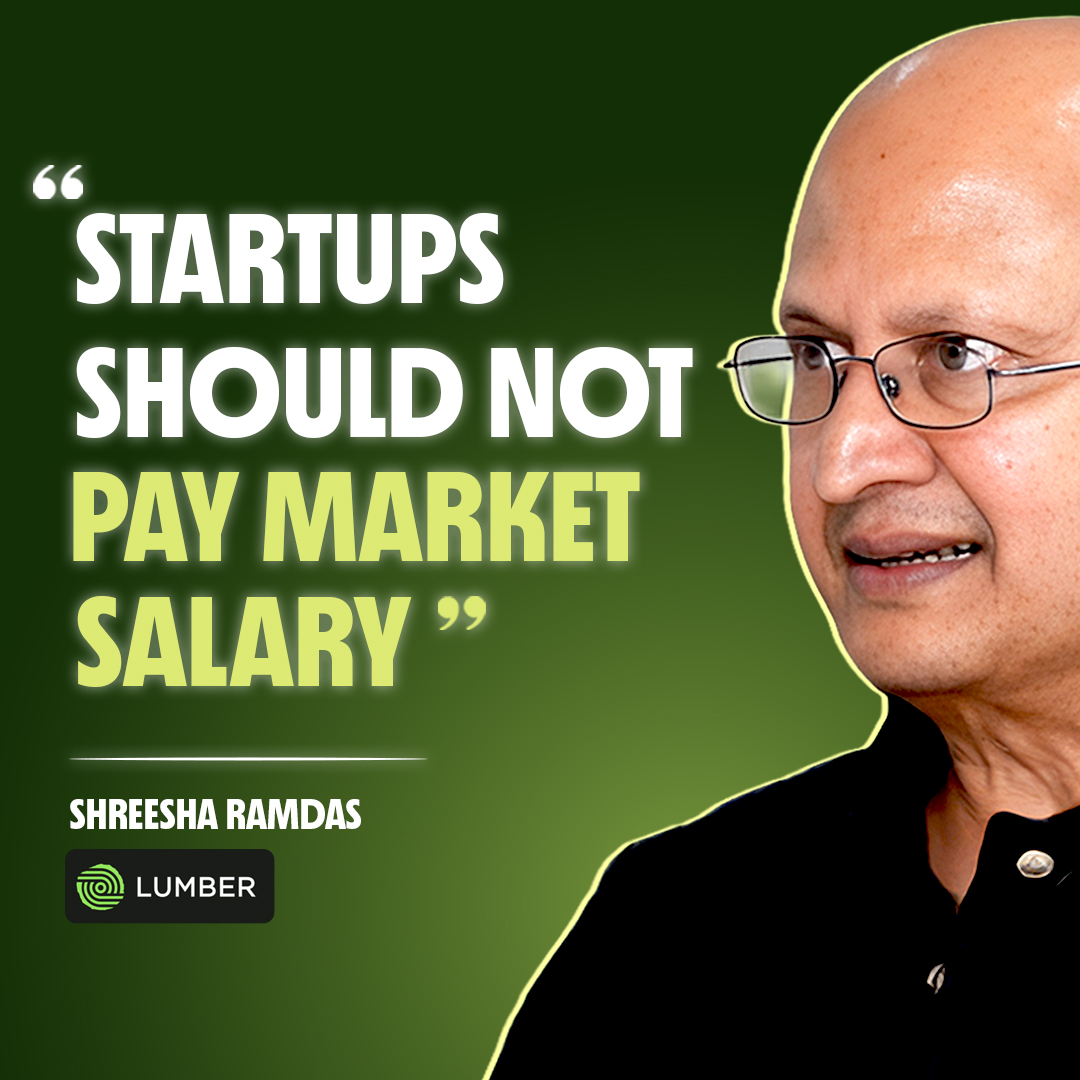
Yeah. So, even if a founder has raised multiple early rounds, Sid the founder, the exec team, and the larger team should never be paid the market salary.
Because you have to move fast, as I said. But you’re also… These days, every space you take, it’s noisy, it’s crowded, and there are large incumbents.
So, the only way you can move fast is by having a decent sized team going at the problem, going multi-product as quickly as possible. And so, that’s the reason why I’ve never advocated taking market or above salary. I advocate being lean, mean, and going at it with everything that you have.
Siddhartha Ahluwalia 23:52
Understood. So, there are two kinds of founders in Bay Area, even among the experienced founders. Founders who are amazing at storytelling, and founders who are great at execution. So, which category would you put yourself in?
Shreesha Ramdas 24:07
Yeah, I would put myself in more in the storytelling category. Having said that, I think I’m good at execution as well.
I would say that there are two camps, Sid. One is founders who are technically brilliant, right? Rather than execution, I would say technically brilliant, they are able to think about technology from the future perspective.
How it’s going to unravel, how it’s going to shape up, they are on top of that. And then there are founders who are good in putting together a story, building a team. I think I belong to the latter category.
Siddhartha Ahluwalia 24:50
And can you share your storytelling like how, let’s say, once you were pitching to investors, how would you introduce Lumber then in your first round?
Shreesha Ramdas 25:01
That’s a great question. So, my storytelling process is paint a larger than life picture.
Whatever your dream is, present it in an unapologetic fashion, right? What happens is a lot of the technology, technical founders, technical bent founders, they curate their dream. They want to be humble.
They want to present humility. I would say don’t bring humility into storytelling. Be unapologetic about it, present the grand vision and demonstrate passion.
So, at Lumber, for example, when I was presenting, I was not talking about taking a solution to the construction firms. I was talking about solving the workforce problem for the construction industry and moving an entire industry ahead, creating not only a category leader that defines the back office, but shapes the next generation workforce that’s entering into the industry. I talked about working with trade schools.
I talked about uplifting the worker’s life, transforming their life, right? And I also painted the picture that in this AI world, people who work with their hands will be valued even more. And that’s where there’s an opportunity to dramatically transform how construction industry operates.
Siddhartha Ahluwalia 26:36
And that’s a grand vision. And you have also painted the details of it. And what I realized is you don’t require, like a lot of technical founders, what they imagine of storytellers are that they’re slick salesmen.
It doesn’t require you to be a sales, like a typical image of a salesman to be a great storyteller.
Shreesha Ramdas 26:55
Absolutely. Absolutely.
Siddhartha Ahluwalia 26:57
It’s a larger than life picture of what the world can be with you.
Shreesha Ramdas 27:01
Right. Yeah.
You know, for me, especially with startups, storytelling has to be how you are how you are changing the industry, how you’re empowering the folks who are in the industry, and how 10 years later, you will be that transformative magical company in the industry.
Siddhartha Ahluwalia 27:23
So you described storytelling Shreesha, right? And it’s a beautiful way how you described it, right?
And you don’t need to be, let’s say, quote, unquote, great in communication, right? You have to be great in a vision and able to transfer that vision to somebody else. But in this industry, it’s a very complex industry.
When people dive into the second layer of storytelling and the third layer of storytelling on nuts and bolts, how would you go then? Maybe you can take examples. For example, when people would ask, you know, ADP might be the largest payroll company in this, and you don’t know the revenue of ADP.
Shreesha Ramdas 28:01
Yeah. ADP is big, massive, right?
Siddhartha Ahluwalia 28:04
Maybe they’re earning like a couple of billion dollars from abstraction. And they might have been assumed for 20-30 years in this, right? So then the next set of questions in the storytelling would be how would you go about replacing them? What are the first few years look like on the replacement?
Shreesha Ramdas 28:22
Right, right. How will the story evolve as you scale?
Siddhartha Ahluwalia 28:26
Yes.
Shreesha Ramdas 28:27
So, as I talked about, the initial storytelling has to be about the vision, the brand that you’re building. As an example, you know, even how I pick the name Lumber, we all know that construction, especially in the Bay Area, it’s all about wood.
Siddhartha Ahluwalia 28:49
Yes.
Shreesha Ramdas 28:50
Wood is there in the foundational material of any construction site.
Siddhartha Ahluwalia 28:54
Very unique name, I must say.
Shreesha Ramdas 28:55
Exactly.
So, came up with Lumber, but then it’s not just wood. I wanted a word that can be used as a verb. So, just how you and I, we say Slack me the document, right?
So, I thought Lumber is a word that can be used as a verb as well. So, I visualized myself that contractors are saying, or the workers are saying their firms Lumber me the payment or Lumber me the compliance documents. So, I visualize that.
So, Lumber is a very powerful word. Plus, I also wanted a cool sounding name that reflects success. So, the way I imagined and it has to become, you know, the name has to resonate to the founder in a way that it reflects success for the founder in future, right?
So, I visualized as Twitter, Tinder, Uber, Lumber, right? Like it’s a part of a successful series of companies. So, that’s how the word Lumber came about.
And how that’s meaningful is like when I today present Lumber, I say it with an air of confidence. Because the word is, the word Lumber is close to my heart. It’s my passion.
It should, it reflects my passion, right? So, that’s in the initial days. And then over the time, as you start engaging with customers, as you start presenting your solution to larger companies, not just, you’ve moved on from your design partners.
You’re now in a full-fledged mode of selling the solution. Your storytelling also should scale, right? It cannot be that I’m this early company.
It needs to reflect confidence that you are now, you belong to this club. You are here to stay. And usually at that phase, Sid, you are also running into incumbents, folks who have been there in that industry for a long time.
And one thing which every founder should capitalize on is that anything, any company that has stayed on for a long time, their technology is old. They are an old tech stack. And they, you know, all the workers, especially the newer workers who are coming into the industry, associate anything that’s old that has been for a long time with a lot of manual steps that needs to be done in order for that solution to work.
And so now your story should incorporate all of that element. It should paint a picture of how there is drudgery in using that platform. And how you are going to liberate them from that drudgery, from that old school of thinking.
You are going to usher them into a new wave. So you had to paint that picture. So that story should now graduate in some ways to that new way of, you know, from larger than life to now going into practical way of building the solution for them.
Siddhartha Ahluwalia 32:04
So that your story for customers and investors, does the storyline follow the same patterns?
Shreesha Ramdas 32:09
It could have common elements, you know, where with the investors, you are presenting them larger than life vision that I talked about. With your customers, you have to match your story to the outcomes that they care about.
So that’s where the difference.
Siddhartha Ahluwalia 32:28
What are the outcomes that your customers care?
Shreesha Ramdas 32:29
Yeah.
So when I’m presenting to investors, for example, I’m talking about solving the generational workforce problem that industry is facing now and will increasingly face in future years. But when I’m talking to a construction firm, I’m talking about solving their problem of job costing, which they face, right? The payroll is not real time.
The payroll data going over to their accounting books is not being reflected in a real time. And that creates problem with job costing that creates problem for them to go and bid for new projects. So that’s where you talk about, you can start talking about how we will retain workers for them, how we will craft new workforce experiences for them.
But at the same time, connected to the outcomes that they care about, which is the job costing, which is time tracking, right? Workers don’t like to use time tracking applications. So they don’t input data.
If right input, right data is not there, then they cannot budget well. And that reflects in their ability to go and bid confidently for newer projects. So you tie that to the outcome, and then you’re making that whole story come together for your customers.
Siddhartha Ahluwalia 33:53
Well, I remember, I have known you almost for two years now, Shreesha. I remember sometimes speaking to Ashok, trying to understand from him, why foundation, bad Lumber? And he explained to me very simply, I would say that’s the power of storytelling that once your investor can tell in your world.
So he told me that there’s a worker who is working the same, two different construction firms, or maybe same firm, one in San Jose and one in Palo Alto. And both the regulations are very different.
Shreesha Ramdas 34:22
Absolutely.
Siddhartha Ahluwalia 34:23
And then how would the construction company match the compliances as well as the payroll for the worker for two different locations? That’s what Lumber solves.
Shreesha Ramdas 34:36
Absolutely.
Yeah. Yeah. So the construction, if we talk about construction industry, it’s one of the highest regulated industries in US.
And the regulations are even more dense when you are doing projects related to government, either the federal, the state, or the county. And then if you’re dealing with unions, it gets even more complex. So how do you help these construction firms navigate through all these complex regulatory world, and yet focus on their construction projects?
They are there to build, they are there to create structure, they are not there to file paperwork. So if we take that, those complex headaches, if we solve that for them, then they will consider you as their best friends.
Siddhartha Ahluwalia 35:26
And how hard is it to replace incumbents right now, like ADP, does it take six months to nine months to replace them? How do customers think of risk when they are thinking of replacement?
Shreesha Ramdas 35:39
Yeah, you hit the nail on its head, right? If I have got my payroll in ADP, and I’ve had ADP for years together, then obviously, adopting a new system is coming out of the comfort zone.
And so you have to show them value that motivates them to come out of the comfort zone. Also, in construction industry, change management is a big, big problem. If the workers have spent years in the industry, they’re even more reluctant to change.
The younger workers are more eager to try out new technology stuff, the older workers are not. So Lumber, we address those challenges in two ways. One is during the sales process, in order to motivate the companies to move from their legacy system over to a newer platform like Lumber, we show them the amazing value that they will get, which is basically, you can do payroll what you do with ADP through Lumber, but you can then solve your compliance headaches that you do manually today.
So to give you an idea, a construction company that has billion dollar revenue, they have about six workers who manually reconcile all the compliance and regulatory stuff that’s mandated. They are dealing with about 40 unions. So 40 unions, 6 to 8 workers who are manually doing the work.
And so if you can show that like these 8 workers are now free to do other work and do not have to do the manual drudgery work that they have been dealing with ages, that then is a motivating factor for the construction back office to move from ADP or other horizontal payroll providers over to a construction specific payroll platform like Lumber. So that’s one. And then once they have selected your platform, they have moved on to your platform, that’s when you encounter change management.
Now you need your workers in the field to adopt Lumber mobile solution. And so with the newer workers, they are more than eager to embrace newer technology. They are used to smartphones.
But there are older workers who are going to say over my dead body. Then what we have done is that’s where we have used the modern AI technology. We have an agent that takes in manual timesheets and converts into digital record.
And this is not a trivial thing to solve. The worker’s handwriting is worse than a doctor’s and they may capture the image in scenarios where there is poor lighting. And so we have now taken the confidence level from around 82% by using off-the-shelf technology to 96%.
And that those kind of technology evolutions or innovations actually will help us solve the change management issues.
Siddhartha Ahluwalia 38:52
And it’s very interesting that what I see repeatedly is repeat founders solving hard, complex, vertical problems. Why is this? Mostly if you go in vertical software or vertical AI, we’ll find repeat founders. In horizontal, we’ll find constant founders. Do you also have the same observation?
Shreesha Ramdas 39:13
Yes. So I’ll tell you my motivation. So if you take any category in technology space, you will see that there are a number of old players, incumbents still there going strong.
And you will also see a dozen plus sometimes 50 startups going after the same problem. So for example, you take RevOps or you take marketing automation, you will see 50 to 100 companies there. There then the challenge is said that you have to put in efforts to be seen, to be heard.
So a lot of GTM efforts is just to how do you bubble above the noise. Once you are seen and heard, then you have to put in effort to be believed in. So the effort that’s needed in overcrowded categories is double the normal effort.
Versus in vertical, the challenge is to understand the domain really well and to establish go-to-market activities that are very specific to that industry. But then you’re not fighting the battle of the category itself being overcrowded. So for example, in construction industry, it’s an old school industry where a lot of things are discussed sitting face to face.
And so go-to-market motion has to take that into consideration. So we have to do a lot of things centered around event marketing. We have to go into the industry events and then define our playbooks.
How do we go about that events? How do we do prep work three months before we actually go to the event? How do we do follow-ups after the event?
And there needs to be a rigor, there needs to be a structure and that needs to be a big portion of your go-to-market activities.
Siddhartha Ahluwalia 41:21
So what you’re saying is having insights on a vertical, you spend half the effort and obviously then maybe less than half the money to be visible to your customers. And adoption, that’s why might be much easier.
And what are the challenges in vertical? Like you’re told about the good side.
Shreesha Ramdas 41:42
Yeah.
So on the vertical side, the biggest challenge is domain expertise is one. You know, for example, I’m not from the industry. When I came in, I obviously didn’t know the ways of the industry, but I actually brought in talent who have been in the industry for a long time.
So for example, my sales guy started out as a carpenter in the industry. My co-founder, he was leading Oracle Construction Engineering. So he was not from the industry, but he had built solutions for the industry.
Our first few engineers all came from Oracle. So we had that domain knowledge come in that way. That’s one.
Second is you have to understand that the technology industry is an early adopter of technologies. So it’s easier to find forward-thinking leaders who are ready to be your design partners. Whereas in construction industry, it’s a laggard.
It’s laggard for a reason. They are not early adopters of technology. They are skeptic of suits coming in and telling them how to run their work.
They don’t believe. So you have to be ready to put on hard hat yourself, wear the jacket, go into their sites, spend time with them, meet them in the industry events and tell them about the solution, not in a techno speak. Tell them in a way that they understand what, how their outcomes will be met with the solution that you’re presenting.
So that’s a big challenge. So you have to be ready for that. You have to be ready to incorporate those aspects into your go-to-market motion. And then you have to design your cycle to meet where they are.
Siddhartha Ahluwalia 43:37
The other challenge, I believe it would be that attracting talent from that specific industry would be hard.
Shreesha Ramdas 43:46
Yeah.
So as I said Sid, you have to bring in that domain expertise.
Siddhartha Ahluwalia 43:52
And the talent availability might still be a pipeline issue.
Shreesha Ramdas 43:55
Correct. That’s right.
And so you’ll have to factor that in. You have to figure out how do I recruit, right? What does it take to recruit people from the industry?
How do you make it attractive for them to come and contribute? And even managing those talent, right? You are, we are, all of us are used to managing technical talent.
But this is a different culture that you have to get them to understand this culture and then align them in the right way.
Siddhartha Ahluwalia 44:25
So Shreesha, now a very different question for you.
How many years ago did you think you became financially free? And what did wealth unlock for you?
Shreesha Ramdas 44:36
So I’ll answer it in two ways.
So first is, you know, after my first startup, you know, sort of, you know, financial securities, you know, ceased to exist. Right? Having said that, it’s also about what do you care about?
Over the years, you stop caring less about showing off the wealth. It’s more about having a meaningful life. Right?
So those two aspects basically culminated in me thinking that, you know, I’m going to go all out in lumber.
Siddhartha Ahluwalia 45:22
Yeah.
Shreesha Ramdas 45:23
I’m going to take the time out of that equation. You know, I want to leave a legacy. I want to build a big company.
Siddhartha Ahluwalia 45:31
What does legacy mean for you?
Shreesha Ramdas 45:33
Legacy is moving the industry forward. Legacy is making an impact in the industry.
You know, so that’s where we are not about just solving the regulation challenges. We are there to solve workforce challenges. Regulatory challenges, solving regulatory challenging, solving labor compliance issues is a wedge that will help us penetrate this industry because it’s a major, major pain.
But then solving the workforce challenges, working with trade schools, so that the students in trade schools understand what’s the career path, how can they unlock their productivity levels when they enter the field. And then once they are there, once the workers are there in the industry, how can we shape their career path? How can we get them, you know, forge a better career in the construction industry?
That’s what leaving a legacy means.
Siddhartha Ahluwalia 46:38
Another interesting thing is, how is AI changing, you know, what you observe around you, what, you know, other entrepreneurs in software are doing and obviously in your industry? Because one narrative is that software had a golden run in the last 20 years, right? And you had both been entrepreneurs in software. So what does next 20 years for entrepreneurs in software mean? Is it getting too overcrowded right now because building is becoming easy, right?
Or is there a fear of, you know, model companies themselves building the applications because most software today are built on model companies?
Shreesha Ramdas 47:19
Yeah. Yeah.
So if you think about technology trends, right? One big trend was internet boom, we talked about, that’s when, you know, I joined Yodlee. Then the second trend was mobile, right?
So if you think about the company that became really big during the internet boom was Google. If you think about during the mobile era, the company that started becoming big was Facebook, right? Meta.
And then you think about, you know, I would put Amazon also in that earlier category. And then if you think about AI revolution, open AI is on its way to become a massive company. It’s already a massive company, right?
So the other aspect Sid, if you look at it, the time it takes for a trend to accelerate, it’s becoming shorter with every trend. So the time it took for internet to become a trend or to become a last, to having a lasting impact, it was many years. But with mobile, it became shorter.
With AI, it’s becoming even shorter, right? So there is no doubt in my mind that with AI, there is an opportunity, massive opportunity to rewrite rules in every single category out there, in every single workflow that’s that’s been there for many years, that could be disrupted with AI. So it’s an opportunity of a lifetime for all the entrepreneurs to go and build stuff, right?
I’ve seen a lot of my founders who have actually retired, come back because of this massive opportunity that’s there. It’s not just the younger entrepreneurs who are excited. So even some of the older entrepreneurs want to be part of it.
They say that it cannot be missed, right? To have that impact. And you know, from my perspective, the key thing to keep in mind is that do not think about AI as bolt on.
Think about how do you start thinking from AI first perspective, right? That’s an important thing. At Lumber, we were fortunate to get hold of a AI team that unfortunately had not found success before.
They were thinking about disbanding, we went and took over the team that has really worked well, right? And so that’s where we are thinking about agentic approach in every aspect. How payroll is run, how compliance workflows are being constructed, and then how workflow with respect to employee onboarding and retaining employee happens, right?
The whole, I would call it workforce experience. We are recrafting it through AI. Apart from that, the other thing is, I feel every founder should think about AI as an opportunity to elevate human potential.
And take away any activity that’s draining the soul, right? Which is monotonous, which is a man work, right? So, that’s an opportunity of AI.
In construction specific, there are plenty of opportunities. Truly, right? Why?
Because you think about the workforce in the construction industry. They have not been on the forefront of technology revolution. They have not benefited from the technology revolution that happens.
But if we can take away all the drudgery, all the monotonous, all the manual work that they have to do, and let them focus, building, constructing, creating wonderful structures in the world, then that’s where we truly unleash the potential, huge potential of AI.
Siddhartha Ahluwalia 51:18
And now, you have accomplished so much in your life. What have been your principles on giving back?
Shreesha Ramdas 51:25
Yeah, so my heart beats for other founders. Sid, that’s the reason why I went in and invested in other startups, advised or joint boards, just to help out the founders. So, I’ve always been a founder first guy, created a community called Funda For Founders.
So, my way of giving back is basically helping other founders. And once Lumber is done, my dream is basically go and start helping founders who are thinking that this is the last roll of dice. Like founders who are saying, I’m tired.
I cannot do this anymore. I don’t know how to transform a company. I want to go and help those founders.
Because if I help founders, then I’m creating more job opportunities. I’m helping create innovations that can reshape the society. So, that’s how I’m thinking about giving back.
Siddhartha Ahluwalia 52:25
And it’s been amazing to your journey, how you started investing very early on and supporting entrepreneurs early on, since 2012, even before it became popular to become an angel investor.
Shreesha Ramdas 52:39
Correct. Yeah, I’ve been sort of lucky that I got exposed to investing.
And I’ll thank Workato founders. I had just wrapped up LeadFormix, come out. And I remember it was one small room where Workato founders and I were thinking about which industries to focus.
We were working together on an onboarding campaign. And that led to me to investing in Workato. And when I saw Workato scaling well, it then ignited the desire to go and help other founders.
And I remember that when I was writing the check, my wife would not be happy because she was getting to understand what this was all about. But it didn’t stop me from writing the checks to back the investors. And then I also got, I was among the first few folks to get into the Indo-US corridor.
And that I have to thank, you know, say thanks to Rev founders who had come out of Freshworks and started Rev. And then they introduced me to other founders from Freshworks ecosystem, you know, Sri, Shiva and all, and I got involved with them. And so being lucky that way that I got to work with amazing founders who have taught me a lot more about startups, perhaps than I have shared with them.
Siddhartha Ahluwalia 54:04
You see, my mission in life, you know, when I sold my company, I was asking me what to do next.
So the first mission was learning how to learn better. So that’s why I started the podcast.
Shreesha Ramdas 54:15
Absolutely.
Siddhartha Ahluwalia 54:16
And the second, which I saw that, you know, Freshworks created like 1000 millionaires sitting out of Chennai. And it completely changed an ecosystem, how founders give back. And what I saw, it’s a bigger wave than the IT services wave.
Shreesha Ramdas 54:29
Yeah.
Siddhartha Ahluwalia 54:30
Right. In terms of building India.
Shreesha Ramdas 54:32
Absolutely.
Siddhartha Ahluwalia 54:33
IT services created Bangalore, created Mysore, created Pune, cities like that. But now the software wave and the AI wave, you know, and then now founders have much more access to go global.
Shreesha Ramdas 54:46
Yeah. No, absolutely. I’ll tell you that the founders inspire other founders.
You know, let’s take example of Eric Yuan, the founder of Zoom. He even now lives in Saratoga where I live. And I’ve met him in his office before Zoom went public.
He was actually sharing the office with another gentleman, right? Like he was very modest. And he gave me actually a book that day when I visited him.
And he was very involved in the Saratoga school where his kids were studying. So that was inspirational. Same age founder who was doing amazing thing.
And that, you know, convinced me that I need to do a startup that scales immensely, right? That was where the dream was born, meeting with Eric Yuan. And then you take Girish, you know, Freshworks.
You talked about Freshworks. The image of him when Freshworks went public, he had his wife, he had a dog, he had his kids there along with him. It was an amazing visual coming out of that Freshworks going IPO.
Siddhartha Ahluwalia 55:56
My dream is, you know, to make the India-US corridor even bigger than the US-Israel corridor.
Shreesha Ramdas 56:03
That’s a wonderful dream. It takes a village to do anything monumental.
And you’re not only doing yourself, you’re bringing an ecosystem together.
Siddhartha Ahluwalia 56:14
Thank you so much Shreesha. It’s been wonderful, you know, and I feel grateful to do this conversation with you.
Shreesha Ramdas 56:20
Absolutely, a pleasure always.
Siddhartha Ahluwalia 56:21
Thank you so much.


Know when new episodes are released. Subscribe to our newsletter!
Explore Playlist


AI Needs to Know Why You took THAT decision | Ashu Garg, Investor at Foundation Capital