



343 / November 12, 2025
The Founder Who Mastered Timing Ft Sachin Aggarwal | Stackgen
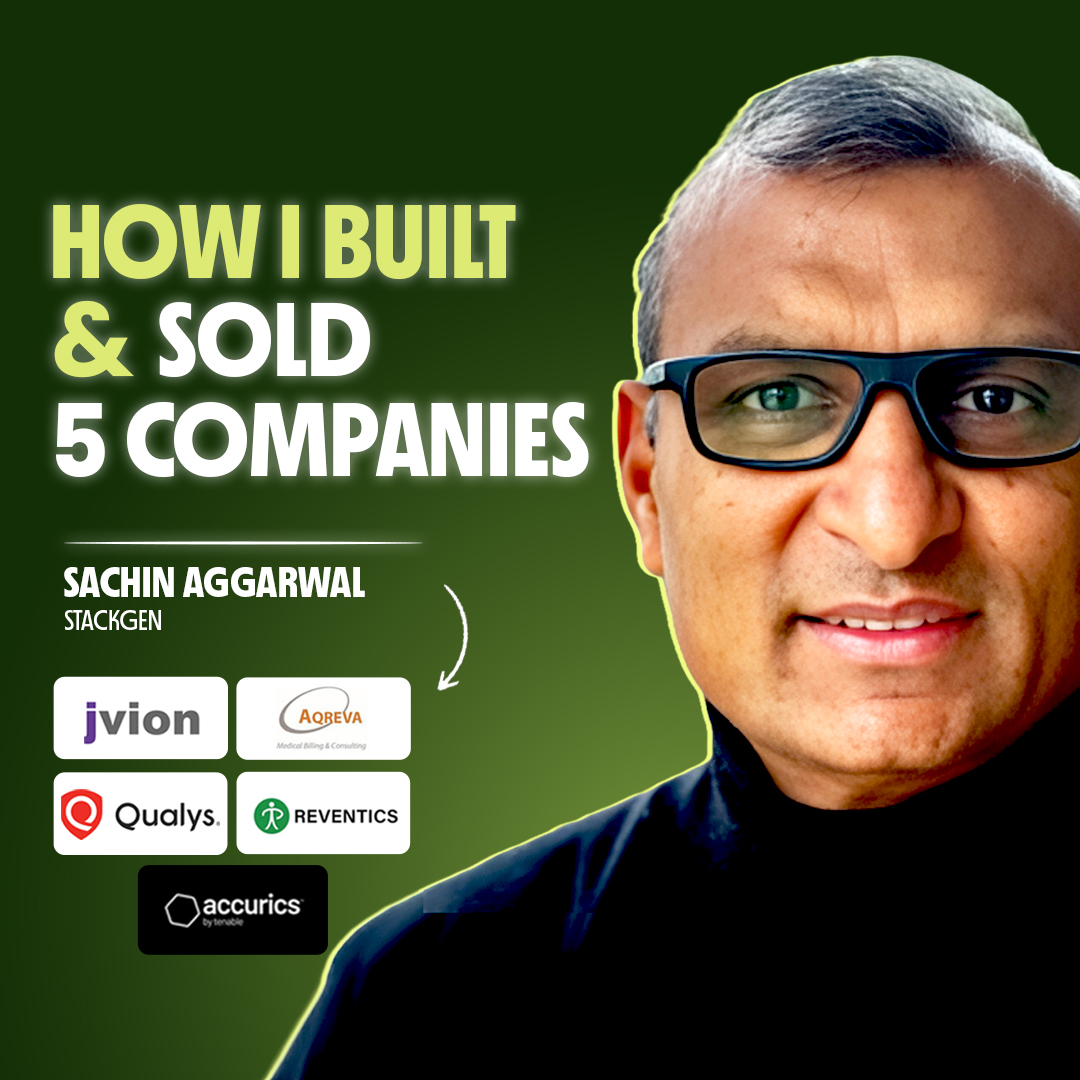
You rarely meet someone who has built and sold five companies. Sachin Aggarwal is now building his sixth, Stackgen.
The depth of lessons from someone who has been through that journey five times and still chooses to build again is simply unmatched. Even after five successful exits, he still builds like a first-time founder. He studies every new domain from scratch, speaks to 60 or 70 people before committing to an idea, and surrounds himself with people who are smarter than him.
What stood out most is his mindset. That is what truly sets him apart. We have always been told that time is money, but he believes timing is money. Founders should time everything, including their exits because the best startups are always bought, not sold.
From building his first company during the Asian Financial Crisis in Indonesia, to creating a healthcare startup that grew with Obamacare, to pioneering cloud security before it became mainstream, Sachin has mastered the art of timing.
Watch all other episodes on The Neon Podcast – Neon
Or view it on our YouTube Channel at The Neon Show – YouTube
Siddhartha Ahluwalia 00:51
Hi, this is Siddhartha Ahluwalia, your host at Neon Show and Managing Partner at Neon Fund, a fund that invests in the best of enterprise AI companies between US-India corridor. Today I have with me Sachin Agarwal, founder of StackGen. The unique thing about Sachin is he has built five companies in the past and all were acquired.
Sachin, welcome to the Neon Show.
Sachin Aggarwal 01:14
So glad to have you. Thanks Siddhartha for having me. It’s my pleasure to be with you here.
Siddhartha Ahluwalia 01:17
Thank you for doing this podcast at your home, right? It’s an amazing setting, you know, and would love to dive into your journeys today as a repeat founder. It’s very unique.
I don’t know how many founders are there across the world who have built five companies in the past and sold all of them.
Sachin Aggarwal 01:37
So, you know, I was not born an entrepreneur, I would say. So, I started my journey with KPMG as a management consultant. I got an opportunity to do a management buyout of a key consulting company that we were setting up and that got me in entrepreneurial work.
And yes, then after that, I started five different companies, sold them to publicly listed companies, each of them successful exits for my shareholders, my employees, created wealth for everybody and I have fun. I’m having fun.
Siddhartha Ahluwalia 02:06
And StackGen is your sixth company, right?
Sachin Aggarwal 02:09
Sixth in tech. The first one was a services company.
Siddhartha Ahluwalia 02:12
So, it’s very unique, right? That you have built and scaled companies. If you can tell us about, you know, your learnings on each of these, you know, patterns on how companies get acquired.
Sachin Aggarwal 02:26
So, I would say each journey is different. If I have to generalize one thing that a good outcome for any startup is that you have to be bought and not sold. I have run parallel process in each of my companies, like a dual track process where we are about to scale.
It’s an inflection point. We’re trying to scale. We’re trying to get to the next sort of financing with a series B, series C, whatever.
In parallel, we are starting the discussions around M&A and then there’s a strategic fit with someone and the M&A happens. So, it’s always been the pattern. I think that one common pattern for us has always been that we are never selling.
We are always sort of building the company and the strategic buyer has come and bought us out.
Siddhartha Ahluwalia 03:10
And can you describe some of the low moments during these previous five companies?
Sachin Aggarwal 03:16
I mean, all five companies have had low moments. Even this one always will have low moments. As a founder, you’re always doubting your idea.
You always want to do more than what you can do. And if I have to pick up one low moment, it would always be that I sometimes feel that I go to a customer and I think there’s a perfect fit for what we’re building. We explain to them our use cases and the pain points that they have.
We think there’s a good fit and we realize that they are not engaging with us. And I think you just start doubting whether we didn’t do well, whether our messaging is not resonating, whether it’s a product. So, I think those are the biggest low moments for any founder when you think you’re building something meaningful and you’re not getting the response you’re looking for.
Siddhartha Ahluwalia 03:59
One of my observations has been, you know, maybe this is attributed to you being a serial entrepreneur is your observations are very, very sharp, right? In all the conversations that we have. How did you build this muscle?
Sachin Aggarwal 04:15
I think it’s probably natural. And I think once you, I think if you start with the basics of what you’re building and building something more meaningful for the community that someone will use at scale, I think things follow.
Siddhartha Ahluwalia 04:31
And what role has luck played out in each of the companies? Because having one successful outcome after the other is no joke, right? People have failed in the next company, even the first was a blockbuster.
So, I’m trying to find out for our listeners, you know, the patterns that you put as inputs in these journeys.
Sachin Aggarwal 04:56
So, I think we are always trying to invest a lot of time before I jump into a startup. So, I do a lot of research on my own. I want to be convinced that if I was an investor, if I was a customer, would I buy it?
Because all my startups, I also do a lot of soul searching whether this is a problem worth solving. I don’t know about the luck factor. I would say it’s the timing.
You know, I know traditionally we have grown up hearing time is money. I think that may be true, but I think timing is money. So, if you time your startups, if you time your stories, I think…
Siddhartha Ahluwalia 05:28
Can you give examples of timing? And, you know, because our listeners would be curious by now. What would be each one of your journeys across your previous journeys?
And how did the timing matter in each of them?
Sachin Aggarwal 05:40
Sure. So, let’s start with the… So, my first tech venture was in healthcare.
Siddhartha Ahluwalia 05:44
Which year?
Sachin Aggarwal 05:45
That was 2008. So, it’s very important that you ask me that question because 2007-2008, we know we all had financial tsunami, the whole subprime crisis.
And Obama became our president. Time to restructure everything. And he dropped his energy bill to healthcare bill.
Of course, we all know Obamacare. I realized that if there’s a good enough mandate from the top about healthcare, then there must be something in it. So, talking about timing, if you want to be successful in healthcare startups, my personal advice is that latch on to some initiative, whether it’s compliance or whether it’s government initiative or somewhere where there’s a wave of creating wealth and solving a problem because otherwise hospitals, doctors don’t buy anything.
You know, everybody knows how healthcare vertical is. So, that is the timing because now if you can latch on to that initiative that Obama was trying to give to the broader community, you latch on to that initiative and you make money. So, I used to say a joke in my investor meetings that our president Obama is my chief marketing officer.
Siddhartha Ahluwalia 06:49
And what was the problem that you were solving in healthcare?
Sachin Aggarwal 06:51
So, the problem that Obama was trying to solve is how do we bring the tertiary health data into mainstream health. So, let’s say someone has an accident on the road, is diabetic, and you do not know that you come to the ER suddenly and the doctor doesn’t know that the patient cannot be given glucose or any sugar, then it could be a risk. So, the way to solve this problem is to give ambulatory or the outpatient EHR or health record systems to your primary care physicians.
And the idea there was that the government will give you $45,000, I forget the amount, but government will give you $45,000 if you are digitizing your medical record inside the physician office. So, all you have to do is just convince the doctor that, you are the best solution and then government is going to fund it anyway to you.
Siddhartha Ahluwalia 07:43
So, basically the EHR which was sitting in hospitals or in central government repository, you bought it into physicians?
Sachin Aggarwal 07:50
Physicians offices and we also created, I mean, in 2009 we created what was then called as, it was not known as Healthcare Information Exchange. So, we sort of pioneered that wave and wrote the wave of Healthcare Information Exchange.
Siddhartha Ahluwalia 08:02
And in that company, if you can share roughly ballpark, how far in revenue did you went to?
Sachin Aggarwal 08:07
By the time we had an exit, we were only $8 million. And it all happened in a year and a half because of the momentum that we created.
Siddhartha Ahluwalia 08:14
And how did the exit happen? Like how did the buyers come to know about you?
Sachin Aggarwal 08:17
So, that was actually a very good question again. I was actually trying to acquire a company in that journey. And that was a company that would do like RCM, like Revenue Cycle Management Services.
Idea was that they will bring 2000 physicians onto our platform. And for that I was raising money from a private equity firm. And they actually made us, they just bought into the vision.
And they bought me out for a price that I could not refuse.
Siddhartha Ahluwalia 08:42
How old were you when you started this company?
Sachin Aggarwal 08:45
This company, I was 35, 36.
Siddhartha Ahluwalia 08:53
And what could made you, because I believe it was a successful exit, right? You could have relaxed.
Sachin Aggarwal 08:59
So, I already had an exit before that from a services company. So, financially actually I was already done.
Siddhartha Ahluwalia 09:04
So, you were already retired?
Sachin Aggarwal 09:05
Already retired.
So, I started the first, if your question was which was our first company, that was in services. We took that global, 1400 people, 14 countries.
Siddhartha Ahluwalia 09:13
Which year did you start the services?
Sachin Aggarwal 09:14
That was 96 and I was 24 years old. So, yeah. And we thought we would conquer the world at that time, yes.
Siddhartha Ahluwalia 09:21
And how far in revenue you went?
Sachin Aggarwal 09:23
That company went all the way up to 50 plus million dollars.
Siddhartha Ahluwalia 09:27
And that company you exited in 2006 timeframe?
Sachin Aggarwal 09:30
Yes, you are right. So, that’s the longest I have run any company for 10 years. But that was global.
So, that’s why that makes me, that’s why I am not afraid to set up offices globally because we ran a global organization across.
Siddhartha Ahluwalia 09:42
It would have been a 500 to a 1000 member company that you ran?
Sachin Aggarwal 09:45
It was 1400 people, yes.
Siddhartha Ahluwalia 09:47
And all the companies that you have built, you have been the CEO?
Sachin Aggarwal 09:50
Yes.
Siddhartha Ahluwalia 09:51
Even the services company?
Sachin Aggarwal 09:52
Yes, yes, yes, yes. There were exceptions when I was sort of, that I would start as a CEO but then I would just hand it over to a CEO and then take a board position if I am already starting to work on a different idea. So, I have had few of those, couple of those in between.
But broadly, I would start with finding the company with the right people, take it to a certain scale and then be a board member because then I am already working on a different idea.
Siddhartha Ahluwalia 10:18
So, in the first company, right, you mentioned earlier that you have been able to figure out timing well as an entrepreneur. What was the timing in the first services company that you?
Sachin Aggarwal 10:28
First services company provided a unique opportunity because I was in Singapore with KPMG and my customer was…
Siddhartha Ahluwalia 10:35
You were 24 years old.
Sachin Aggarwal 10:36
24 years old, yeah. But I was a, you know, graduate trainee, right, how you are. And I realized that, oh, it’s a really long ladder to be a partner, to look at that as what, 40 year journey, okay, who wants to stay here.
But my customer was in Indonesia, Jakarta. It was a large Chinese conglomerate. They liked, they really liked what I was doing for KPMG and they basically made a direct offer to me.
So, they worked out their non-compete or whatever with KPMG at that time. So, I joined them directly and I didn’t know what I was doing but I moved to Indonesia, Jakarta. I worked with them and so the timing there was that Indonesia at that time was like a tiger economy.
96, 97, you know, a lot of money was getting poured in. But the reason I could be an entrepreneur because the timing again played in our favor because a financial tsunami happened in Indonesia. There was a currency, you know, if you remember George Soros, Asian crisis, the Asian, the big Asian crisis because of the currency arbitration and the, you know, the devaluation of the currency, right.
Because of that, because the Chinese group was over leveraged, we did a management buyout of that startup. So, again, it’s the timing, an opportunity presented to ourselves, we took it, we took that, we never looked back. Same year, I moved to Australia, started an office there, grew that to $300 business in like 6 months and then we never looked back.
Siddhartha Ahluwalia 12:00
Okay.
Sachin Aggarwal 12:01
So, yeah, it’s always been timing.
Siddhartha Ahluwalia 12:03
So, this is the first company where the Chinese company got you as a CEO?
Sachin Aggarwal 12:08
No, no, no, no. So, they bought, so Chinese conglomerate brought me as the strategy consultant, strategy consultant. So, I was part of the strategy group.
I convinced them to create it as a profit center. So, we grew that practice to 80 people. Then the financial crisis happened.
Then I said, hey, this 80 people team, can I buy out? And by the time we were already serving Jakarta Stock Exchange, some large banks in Indonesia. So, we were already servicing customers outside the Chinese group.
Siddhartha Ahluwalia 12:36
But back then you were pretty young.
Sachin Aggarwal 12:38
I was 26.
26 by the time this all happened.
Siddhartha Ahluwalia 12:39
To know about the buyouts and stuff.
Sachin Aggarwal 12:42
Yeah, yeah. I may have heard somewhere. Someone would have said you can do that.
Siddhartha Ahluwalia 12:45
I don’t know. So, the first company you ran for 10 years. The second company you ran for 2 years?
Sachin Aggarwal 12:53
2008, 2011. 2 to 3 years. Yes, yes.
Siddhartha Ahluwalia 12:56
3 years. But what’s been the motivation? The first company made you financially retired, right?
So, what’s been the motivation to again build companies one after the other?
Sachin Aggarwal 13:07
I think you always come across a nice problem. You always come across good founders who will bring you good ideas. And then you start falling in love with that idea.
And you start… If the problem is meaningful, I think it doesn’t matter how much money you have in the bank. If you think it’s worth solving, I think you jump onto it.
And when I’m a founder, I’m not really thinking about the money that we have in the bank. I’m just thinking what I’m building. I operate like a scrap.
I will travel economy class. I will just bring… If it’s vacation, of course, I’ll do whatever it takes.
Splurge ourselves and go to 4 seasons or whatever. But when I’m in a startup or company, I will just be as crappy as I was 24 years old. I just want to feel like that I’m a hungry startup founder.
So, that keeps us going.
Siddhartha Ahluwalia 13:56
Wow. And you still are building technically your 7th company and the 6th product company. So, before I move to StackGen, I want to cover each one of your journeys in summary, right?
I think the key thing that I want to pass to the listeners is the thing about timing that you bought.
Sachin Aggarwal 14:18
So, let’s talk about… Let’s start in a reverse order. So, the last one was the company we sold to Tenable, Accurics.
It was… The automation was happening on the infrastructure side.
Siddhartha Ahluwalia 14:29
This is which year if you can…
Sachin Aggarwal 14:30
This was done in 2018-2019. So, 2018-2019, we built a company during COVID actually. So, 2020 is when we started building it.
Siddhartha Ahluwalia 14:38
And what was the name?
Sachin Aggarwal 14:39
Accurics.
Siddhartha Ahluwalia 14:40
Okay.
Sachin Aggarwal 14:41
And that company, we literally… The day we got our series seed funding, the next day we were in lockdown. So, we had to build a culture remotely and everything.
The reason that I would say timing was important in that because it was an idea that was born to say that the cloud is actually being programmatically built using Terraform and using infrastructure as code. But which will also mean that the security of the cloud should not be on the right, it should be on the left.
Siddhartha Ahluwalia 15:10
What do you mean by right and left?
Sachin Aggarwal 15:11
So, what I mean is that if… If your application is already running on the cloud and then you’re doing security, it’s already too late. We’re already exposed to the vulnerabilities.
If you are able to catch those errors early on your pipeline, and that’s what we mean by shift left, then you’re basically avoiding those things to happen in runtime. So, we were the first ones. We and there was another startup of similar size.
We were the two pioneers in that industry, just two companies pretty much who made money and were very successful, who took a view that the cloud security has to be shifted left. So, we basically were the people who created what people now know and call as shift left CSPM as a segment. So, the reason the timing there was good because we saw there was the adoption of infrastructure as code to programmatically develop cloud, which we thought was a good place to now invest into security because you’re securing an asset or securing the pipeline, which is sort of creating the cloud.
Siddhartha Ahluwalia 16:13
So, basically, it was a security company.
Sachin Aggarwal 16:15
It was a security company.
Siddhartha Ahluwalia 16:16
And that helped companies with cloud security on day minus one.
Sachin Aggarwal 16:21
Absolutely. So, we used to say that either you’re born secure or you’re not born at all.
Siddhartha Ahluwalia 16:27
And you were able to prove that if you’re implementing security on day one or day two, then you will always be less secure than day minus one.
Sachin Aggarwal 16:34
That is true. And also more expensive to remediate.
Siddhartha Ahluwalia 16:37
But then in this case, you have to go with companies that are starting from scratch on their cloud journey. You can’t say that if you’re already at 100 million or in your cloud, spending on cloud.
Sachin Aggarwal 16:48
So, this is again the timing thing. So, very good question, actually. Glad you asked because in 2017, 2018, the cloud was just getting adopted.
We would, in fact, ask people, how much workload do you have in cloud? So, it was pretty new. Today, when I’m running an infrastructure company, we don’t even ask that question.
We take it for granted that everybody’s on cloud. In fact, we also take it for granted they may be on multi-cloud. They may be on more than one cloud.
So, in 2017, 2018, I think the adoption was rising. And because the adoption was rising, the security started becoming a concern.
Siddhartha Ahluwalia 17:26
Because currently, if I have the numbers correct, AWS is at 100 plus billion in run rate. And Azure and GCP should combine also be together 100 plus billion. So, you’re saying in 2018, this would be way less number.
Sachin Aggarwal 17:43
It was less number and also, it was mostly lift and shift. It was not cloud-native application. Cloud-native application started happening mostly around 2018 when Kubernetes came.
And actually, that brings me to my startup before that is a company called Laid Insight that we sold to Collis. And again, the timing, the reason I say it was timing that got us to the success that we had is because containers were just becoming a prime thing, a prime way to compute and deploy your applications in 2015, 2016. So, Docker became a unicorn.
At that time, Sakura Capital, some of the big VC firms had invested money in Docker.
Siddhartha Ahluwalia 18:23
Which Docker?
Sachin Aggarwal 18:24
Docker.
And Docker became a unicorn. And Docker brought containers mainstream into the organization. So, we realized that Docker would become a new computer, a new VM in a way.
And again, it has to be, the security paradigm has to shift. The parameter is shifting. So, we were one of the pioneers again in container security.
And so, we realized that there will be no gap as customers are going to adopt containers into their production and into their applications and into their workloads. They will need a new way of securing their workloads. So, again, mostly timing.
We were right in time for the hype of containers and we wrote that way when this came out before it became a mainstream, before it became a common thread.
Siddhartha Ahluwalia 19:09
And this was 2013?
Sachin Aggarwal 19:11
This was 2016 to 2018, 2019 maybe, yeah.
Siddhartha Ahluwalia 19:15
And do you sign agreements during these acquisitions that as soon as acquisitions happen, you are immediately…
Sachin Aggarwal 19:20
I am hoping my buyers are listening. But if they are, actually I have been managed so far to come out of it every time. So, by saying that you need tech teams and you need…
So that I can just have a fresh mind. Actually, even each time I do a startup, I say, okay, this is my last and I am just going to now invest in other founders and funds and work with folks like you to basically brought up the knowledge. But then I start again.
So, yeah.
Siddhartha Ahluwalia 19:44
Yeah. But I think, you know, we have not covered across this critical factor in all our 400 episodes or episodes have been with founders across India, U.S. corridors, with venture capitalists across U.S. and India and also with policy makers like people who are building policies for Indian government, like economic advisor to PM Modi, like Sanjeev Sanyal or if you remember early in 1991, Indian economy, we have hosted Mr. Montek Singh Ahluwalia here, who basically opened the Indian economy along with Manmohan Singh in 1991.
And other RBI governments like D Subbarao, C Rangarajan. But, you know, if a nation… I think timing…
if I have to summarize now as I think through as you spoke, works even for nations.
Sachin Aggarwal 20:28
Yes, true. 100% true.
I think if you take… because opportunity always presents. You have to just open your eyes to that opportunity.
Because it’s knocking your door. Now the question is are you going to welcome it or are you going to ignore it? And I have seen that most people get scared of it or they think it’s too new or too bold and maybe they not do it.
But sometimes you just have to have a mindset to go and…
Siddhartha Ahluwalia 20:52
And again, ties back to my observation about you that your observation skills are amazing. Right? And to have great timing, I think this is a must required skill.
Sachin Aggarwal 21:06
So, going back to your question about luck versus… So, I would say if the founders were able to time their starting the company, solving the right problem, finding the investors and even timing their exit. Because if you hold on to it too long, maybe the valuation will go down.
If you sell it too quick, maybe you are not capitalized enough. So, I think everything becomes a timing.
Siddhartha Ahluwalia 21:28
Yeah. But you are not a technical founder when you started. You were in KPMG as a consultant that you started with.
And now you are talking about Docker, containers, Kubernetes. It’s a vast shift. I understand healthcare because building a services company and then seeing a global…more investment in US healthcare obviously, it’s a first principles jump. But then, this journey in building containers and Kubernetes, these are very unique.
Sachin Aggarwal 21:59
So, each time I would do a startup, you know, we go to first principles. If I don’t have the appreciation for what we are building, you can’t build. So, like I said, I take a lot of time in first understanding the industry, even maybe develop myself.
I have a computer science graduate, so I do have a degree, but that doesn’t mean I am a technical… neurotechnical person. But, I think enough for me to understand what the pain point is, what the technology is supposed to do, what the advancements look like.
That’s important. I think that’s… If you are building a tech company, you know, at the early stage of the founding days, you need to be at least having some technical appreciation.
Siddhartha Ahluwalia 22:38
So, you know, in… particularly in all the… all the journeys, right?
How do you time the exit? Because now, I believe you are… you know how to time both entry and exit.
Sachin Aggarwal 22:52
So, I think a lot of factors go in, right? Each time I start a company, I start with a goal of taking it IPO, actually. And the reason is because if you ask me, you have to start with a problem that is meaningful and large.
I also think, and this is probably important for your audience, is that the problem doesn’t need to be just big and important. It also needs to be urgent. So, I think a good combination of big problem and important problem and urgent will get you success and give you the…the growth that you are looking for. If you start with that mindset, then you look at what you have created let’s say in two years, right? And what the forward market fit looks like.
What happens along the journey then you look at your DNA of your… because I have… usually you would find new founders in each of my journeys because, of course, I am changing my domains.
I need subject matter expertise. I need those people to tell me what they have built in the past. And when you look at them, some of them are actually first-time founders with me.
So, I may be a repeat founder, but, you know, the DNA of a whole… Sometimes it’s not about me. It’s about the company.
How far can they go? Can they really run more? Can they build more?
Do they have capacities? When I reach a conclusion whether I need to replace them or do I… can scale or do we think there is enough strategic interest from someone else?
So, in most of our cases, the timing has been that we are trying to raise new capital and that’s when we… One of our partners said, hey, don’t raise this capital. We’ll give you double the valuation that you’re raising it at and we take an exit.
And we think, yeah, it’ll take us two more years to build… to ease in that valuation. We’re getting it today.
Good returns for our employees. First-time founders. My founders are happy.
We take an exit, yeah. So, that’s how we… it has been.
Siddhartha Ahluwalia 24:27
So, if I have to summarize, first company, IT services, you started… you could do a buyout at the right time. The market was right, Indonesia, right?
The launch was right. You had a lot of money coming in and you ran it for 10 years. I took it to 50 mill ARR.
Second company, a company born out of Obamacare. Yes. Right?
And you scaled it to 10 to 12 million in annual revenues, right? And the insight there was that, you know, physicians are getting paid for… by Obamacare for adopting EHR.
Yes, yes. So, in these journeys, right, the previous six journeys, how many hard pivots would you have done?
Sachin Aggarwal 25:12
So, pivots… So, I wouldn’t… depends on what you mean by hard pivots.
We never shifted industries. So, we always had a thesis. We have always, always done…
I don’t recall any startup where we have not done a GTM pivot. A GTM pivot, we… because I always feel that we have figured out day one because we have very strong theses and everything.
And every time I go to a journey, I say, wait a second, we have not figured out a few things. So, GTM pivot, we have been doing… and what I…
I’ll give you a good example here. We talked about this company, which you just talked about people running in the cloud, their workloads. This is a company called Accurics, again.
It started right before that. Which is a very good example because you did tell me, Sachin, but weren’t people already in cloud? And I said, yeah, they were, but they were not moving as fast, and they were just doing lift and shift.
And the cloud-native applications were just getting built. So, yes, while it looked pretty lucrative to do shift left CSPM, and that time I said, yes, we were the only ones. We raised the money on that concept because VCs always want to invest in the future.
We realized that customers are not ready because they’re already running their applications on cloud. So, we had no option but to go to right and solve that problem. If we didn’t solve that problem, then they are already running another security solution here, another security solution here.
They don’t want that. They wanted… They were waiting for these people like Paulo Alto and all to come in here and solve the problem here.
So, we took a chance. We took the bet that we’ll open-source this on the shift left. We actually completely open-sourced it.
My investors supported it. We took a board decision and pivoted everything and started selling what they were buying, which is on the right. So, we did…
So, I didn’t want to cross… tell you more about… Since we now brought this up, we did solve that problem through GTM where our core IP was still on shift left CSPM.
That’s where we made the money. That’s where the whole story and the fundraise was happening. But actually, what we were selling was really a security on the right because that’s where people were…
We already had existing cloud, to your point. They are already running application and they need security there.
Siddhartha Ahluwalia 27:11
So, if I have to imagine as a third party, right? The first company was services because you are already in a services company. Second company happened because you observed Obamacare.
But after that, how did you observe those changes in the market because healthcare and what you are doing after that was completely different.
Sachin Aggarwal 27:29
So, again, a very good question. Actually, it goes back to how I’m built. So, what happened is I moved to US in 2007 and that’s when 2008 is Obamacare.
I came to California, Silicon Valley and I realized that I’m wasting my time in healthcare. This is all about platform, the core technology, all my friends, all my network was all infra, people who are thinking of next gen, compute and everything. So, when you start working with those, I would say, more intelligent people than I am and you surround yourself with those friends, they start giving you ideas.
And then you say, no, you know, I’ve been missing something in my life. Actually, I should have probably been here 20 years back and starting my journey here but I need to be feeling that I’m part of the Silicon Valley culture and I think that motivated me to step aside, step outside and look into platform like cyber security, cloud security, something which is a lot more meaningful, a lot more broader, a lot more horizontal in nature that every company would buy and when you have those co-founders giving you those ideas, then everything follows from there.
Siddhartha Ahluwalia 28:35
So, and how much time do you spend usually researching a domain before you say, let’s start a company in this domain?
Sachin Aggarwal 28:42
So, there is no, I would say definitely in business startups, before I commit to something, it’s definitely at least a year because I need to talk to at least 60-70 people and usually the way I work is that I decide on a co-founder and then we together brainstorm for almost a year whether it’s a good fit for us to work together, whether we like each other, what’s your working style, we talk to, we pick up an idea, we validate it, we think, no, it’s not big enough or it’s not urgent enough and we come back, we think about it.
So, we keep meeting every two to three times a week over a period of one year and then we figure out, yes, we can work together, then we narrow down on an idea. So, that, that courtship always takes some time because I’m not really waking up one day and saying, okay, I have a brilliant idea, now let me find a co-founder, it’s not that, it’s a reverse process for me. I first find a co-founder whom I want to work with in my next startup and then we figure out what problem we want to solve together.
Siddhartha Ahluwalia 29:37
So, if, this is another important, right, people usually start with their best friends or one of their previous colleagues but in your case, you are starting with a well-known person but in a different domain every time.
Sachin Aggarwal 29:50
Yes. So, yeah, so basically I definitely know that person before I start my journey. So, I’m not meeting him without intention.
Siddhartha Ahluwalia 29:59
So, trust is already there.
Sachin Aggarwal 29:59
Yeah. So, I’m not intentionally saying that no, oh, this person is a VP in Uber and I should probably make a friendship with him because he will be the next co-founder, no, I do not do that way.
If he is already part of my friend circle, we are already socializing, we are meeting, there is already sort of meeting of minds, chemistry, because that’s very important because this startup journey is very hard. You will always have those down, like you talked about the lows and highs, right? So, you need your co-founder to also understand your behavioral thing, when you are high, when you are low and to me, success of a startup is how strong your bond is with your co-founder because it’s like a marriage.
So, I mean, there will be times when you doubt each other and when you are not, you will have difference of opinion but that’s healthy in my view.
Siddhartha Ahluwalia 30:39
But how do you assess because you have known somebody socially but you haven’t worked with them? How do you and how do you then ascertain that they carry the same work ethics as you do?
Sachin Aggarwal 30:50
So, you will know that in one year when you have sort of start to make a soft curve, it’s like an engagement kind of a thing. So you already know that it’s like, that’s why I like the system today versus yesterday’s when people do arranged marriages.
So here we are, like people are dating, they are basically knowing whether they’re compatible. They sometimes even live with each other these days, which is perfectly fine, I think. And I think that’s the journey of learning to work with each other.
You’ll know exactly, you’ll, if your co-founder, your future co-founder is married to an idea, which you think, no, that’s not great, and he’s stuck to it, then you know that the resilience is low, right? He’s not open to ideas, he’s not open to new way of thinking. Or if he talked to 50 prospects of us before we jump into an idea, we are consistently hearing, no, it’s not a good thing, but he’s still married to his idea, then you know, he’s not.
So you will know. I mean, having done it so many times, you also have, of course, also some of it is intuition and your gut feel. So not everything is science here.
Siddhartha Ahluwalia 31:51
I would say you are very humble for somebody who has sold six companies. Does humility play a role in your listening skills and observations?
Sachin Aggarwal 32:00
It does. I think it helps people to build trust and friendship with me because we, when we start this journey, we are starting the journey as if this is my first startup. I mean, if I don’t have that passion and that drive, I think I’m failing my team.
And I think the reason I take it very seriously because when they are trusting me, some people do join your mission because they believe in your mission, but I think early stage hires are really believing in the investors. They do not know what you’re going to build. They know you may pivot, but market fit is not there.
So they’re really investing in you. I think it’s important that you are grounded and feel like a first-time founder because then you’re not really making up anything. You are just your natural self.
Siddhartha Ahluwalia 32:53
And every one of your journeys, you made your investors and teammates money?
Sachin Aggarwal 32:57
100%. And I would not exclude my equity, but I’ll exclude all of my employees because they are not the people who make the decision to sell. We are.
So I make sure that they are definitely taken care of in all my journeys.
Siddhartha Ahluwalia 33:09
I want to stress upon, once you sold two healthcare companies and now you are jumping into cloud companies or infra companies, what was your learning curve like? It was just like talking to people, like 50, 70 people in the infrastructure domain or security domain or cloud domain.
Sachin Aggarwal 33:28
I think it starts with, what are we solving? And it starts with, is the problem worth solving? To me, you must…
Siddhartha Ahluwalia 33:36
You have to discover the problem. So how do you discover the problem?
That’s my question.
Sachin Aggarwal 33:39
So that is where the trend comes in. So let’s say, I’ll give you an example. So let’s say we’re talking about container security.
One of the parties, maybe someone said, hey Sachin, do you know Docker became a unicorn? I said, okay, what’s Docker? Of course, I do not know what’s Docker.
Siddhartha Ahluwalia 33:50
That’s my exact question. Because our audience might not understand what’s Docker, what’s a container, what’s Google.
Sachin Aggarwal 33:55
Yeah. So in fact, when… It’s a joke actually.
It’s a recording. So when my co-founder brought the whole Docker thing to me, and he said containers, I thought he’s talking about container ships. And literally, I’m not kidding.
And I thought he’s talking about saying, hey, can you secure container ships? Because I knew that there’s a lack of China. I mean, 2015, 2016, but there’s a lot of imports from China.
So I thought maybe they’re talking about scanning the containers. They think that I’m coming from a healthcare background, services background. So maybe doing a logistics company, maybe the person is thinking, hey, we’re going to set up a logistics company where we’re going to scan a container and know whether there is anything which is not in part of the packing list or whatever.
So literally, that was a joke that we were making in the party. And then when I went home, I said, okay, let me look what is Docker. I did not sleep that night.
I said, okay, wow, this is interesting. Then I went back to see what is VMware. I went back to see why this makes sense.
I went to understand what is Linux kernels. And so then you start understanding and appreciating the problem and saying why this is a game changer. And I will tell you how the investors at that time, actually, I would name it even Anderson, did not believe in 2015.
I know Sakuya was a big believer that container would become mainstream that quick. But we made that bet. We knew that it was the next compute, it will be the next big thing.
Sometimes that worked. Like I said, timing, it may not have worked because containers would have never become mainstream. And then there is nothing to secure.
So yeah, so it is always learning is always part of, has to be part of your DNA and you just immerse yourself into it.
Siddhartha Ahluwalia 35:29
So let us come to the journey of StackGen. How did you meet your co-founder here? And how did you both decide that StackGen is the right problem to solve?
Sachin Aggarwal 35:37
So StackGen, I am working with a second startup. I am working with a repeat co-founder. So this co-founder of mine, Asif, actually was the co-founder in Layered Insight, the one who told me about Docker containers.
He laughs when he hears this story about ships and containers because that is literally true. And I can tell you how I met him also in a bit. But I met him actually in 2013, or maybe even 2012.
But we started our first company in 2015. So you can see that it is really a three-year relationship that I had before I started the first company. After we sold to Qalis, he was, like I said, I rolled off because I usually do not join the buyer.
But someone like Asif wanted to build his career. He became the cloud CTO for Qalis and stayed there while I moved on and started another company called Accurics. Asif was sort of involved in that company as an advisor, as an investor, but not as a full-time founder because he could not join because of his handcuffs.
So when his handcuffs were over, I sold Accurics. He had another startup in between for machine learning. We started thinking about doing something together again because we thought we should probably do one last thing together, which is what we keep saying each time.
But because this time our funding principles are so tight that both of us are not in a rush to sell, both of us have made money, I think we can take this IPO. Because each time I have realized that we are trying to take the company and the moment we turn to scale, someone will make an offer and the other founder would say, well, it is so good. It is a life-changing event for them.
Not for me, but for them. And I have never been selfish. Because what is the point in breaking the relationship, getting a new executive?
Then it is a new journey. You do not sign up for that. You sign up for having fun and enjoyment building a company together.
So that is what happened with Asif. He is the one who we together based on this idea. So it was a very natural fit for us.
We know each other from past. We have worked together. So we know exactly how each one of us update.
Siddhartha Ahluwalia 37:31
Can you tell more about how the evolution of problem identification happened at StackGen?
Sachin Aggarwal 37:36
Yes. So we decided to work together in 2021, that we will do something together. We went around web 3.0, crypto and you name it, we started researching in every area that we should be spending the time, including security, because that was a domain and solving some AI security problems. In fact, there were two investors who literally knew when I was saying I am going to be back on the block. They told us, we will get a check. Let us do something in security and we can figure out the idea together.
I said, no, I am not doing that because I want to first see what I am getting married to. Funding will come. Some of them are actually your friends and you have interviewed them, by the way, on your channel.
The idea of StackGen was born because what we started understanding is the development of velocity, the age that we are in, the infrastructure is becoming a bottleneck. This whole DevOps is becoming a bottleneck. The question was that can it be solved at scale?
Siddhartha Ahluwalia 38:44
What do you mean by DevOps is becoming a bottleneck? You have to explain.
Sachin Aggarwal 38:48
Technically speaking, the idea of StackGen is stemming out from a learning from Accurics. So, I will explain the bottleneck in the context of Accurics. Again, Accurics for the community sold little less than $200 million to Tenable.
It was, I think for the investors, it was the highest return because literally, our series of investors had a short-term capital gain for 6x or 7x of their investments because suddenly, we timed the exit because that time was COVID and security, there was a lot of money in the market. The problem that we are solving in accuracy, again, just as a reminder was that the cloud is basically built on the left using Terraform and IEC infrastructure as code programmatically to deploy your application on cloud. But when you do that, someone is building the application in Java or Python, then the DevOps person will come and write the code in Terraform or whatever and then deploy the application.
So, there’s a handoff there. And then the security comes in and says, you can’t do that because we need to make sure you are not vulnerable, you are secure by default, you are having the policies, governance, compliance and everything. So, we decided, can this problem be solved?
Can we completely eliminate this whole process? What it means is that there’s a developer whose intent is to build something on the cloud, which means that if I’m the developer, the promise of the and the containers were that you build, you run. But that never happened because it just became good on the captions, okay, you build, you run or you build, you deploy because the idea was that developers do not understand infrastructure and they should not be because they can make mistakes, networking mistakes or whatever.
So, the question was that can the technology, do we have enough advancement in artificial intelligence, in learning models and everything that can we actually automate this whole process where there’s a developer and there is actual hardware, actual cloud? And can we be the whole platform in between? And that’s where the whole concept of StackGen was built.
We used to actually call it AppCD, the company was actually called AppCD, that there’s an app and there’s a cloud. And we changed the name because people started confusing us with Harness and other CDs, like Argo CD, they thought we were another continuous deployment, we were not. For us CD meant cloud deployment, but it’s hard to explain to people what cloud deployment meant.
We changed the name to StackGen.
Siddhartha Ahluwalia 41:16
And what is the problem that you are solving today for largest of your customers?
Sachin Aggarwal 41:21
So, we basically solve, so our ultimate goal is to be an autonomous infrastructure, which means, and again if I want to break it down, the way we see the vision is, can we be full self-driving for infrastructure? So, how you see an autopilot car, where you just sit in a car and it will be self-driving, there’s no driver, you just tell them I want to go from here to there, and they navigate, that’s what we want to be for infrastructure. So, the problem we’re solving, of course, we are not taking, we’re not asking the customers to have a leap of faith that we are there yet, but our idea is that we’re bringing in a platform that customers can truly rely on us for improving their developer velocity, their pipeline velocity, their governance at scale, not just small governance, but really at scale, and also to reduce their cloud cost, optimize, reduce their incidence, production incidence, improve their availability, improve their resiliency. So, it’s actually pretty broad platform, it is not a point solution that one of my previous startups were.
Siddhartha Ahluwalia 42:19
But the argument here can be the cloud providers themselves are so advanced today, that they can build it in-house.
Sachin Aggarwal 42:29
Cloud providers, core business is to provide them the services on the cloud. Can they do it? Yes, everybody, given the amount of money that they can invest, they can do it.
The opportunity is that 90% of the customers that we talk to are enterprises, and they’re multiple, they may not be multi-cloud, but they’re multiple cloud. I think there’s a slight difference, right, which means they’re already betting on more than one cloud. Then question is which stack to pick up?
We are, by design we are multi-cloud, by design we are multiple cloud. So, we don’t care.
Siddhartha Ahluwalia 43:02
What is multi-cloud and multiple cloud?
Sachin Aggarwal 43:04
So, multi-cloud is my definition, I don’t know whether it’s an industry definition. For me, multi-cloud would mean that you’re building a generic cloud native application that can freely be deployed on any cloud without making any single change in the line of code. Multiple cloud is that you have certain applications run on one cloud, certain type of applications run on different cloud.
Most enterprises are not truly cloud native, that they can port their application one cloud to another cloud without any problem. Most organizations are multiple cloud, they run maybe their payment systems on Azure and maybe their human resources on AWS. I’m just making it up, right.
So, that’s multiple cloud in my definition, that you’re betting on two clouds versus a single cloud.
Siddhartha Ahluwalia 43:40
But as the environment is so evolving so fast, right, what are you seeing that are the things to start according to timing today?
Sachin Aggarwal 43:53
I think it’s all about AI. I mean, right now the timing is that if you have domain expertise and you’re solving a problem that is meaningful and has an impact on a business, pick up that problem, use AI to solve the problem. I think that I would say that that was the timing.
I mean, if you are solving a problem, if you’re thinking that you’re solving a problem and you’re putting a wrapper with AI, then you’re not solving the problem. I think you have to think AI native, not like how we used to think cloud native. You really have to think AI native.
I know we’re taking a view about whether this will replace some jobs or something. It will eventually happen. So, the question is, if someone is going to do it, why not you?
So, I think pick up, the right timing is to pick up an area where, and it could be any industry, right.
Siddhartha Ahluwalia 44:44
So, let’s say today you are again the 7th or 8th time founder, what are the top 2-3 areas that you would start today based on what you know already? I agree AI native is one.
Sachin Aggarwal 45:00
but if I were to do by itself, I think it will not be for profit, it’ll be for not for profit. I’m pretty sure about that. And it will be to create a larger impact using artificial intelligence.
It’ll be basically to either to solve education at scale or health, for the healthcare to scale, but something at scale, but using AI. That’ll be my 8th startup if I have to, probably I will do, but it’ll be that area.
Siddhartha Ahluwalia 45:25
Let’s say a better question could be somebody who’s closer to you. Let’s say maybe your son or a founder that you are talking about.
Sachin Aggarwal 45:31
Oh, I see what you’re saying. Okay.
Siddhartha Ahluwalia 45:33
Okay, what would be my advice if someone was to start? Top 3 areas where Sachin would start if Sachin was 5 years old.
Sachin Aggarwal 45:40
I think you have to think of where this whole world is going. And again, you have to think of timing. If I have to bet, I think you have to think what will happen in future is like AGI.
I think AGI will become reality. Again, for your audience, it’s general intelligence, artificial general intelligence, which means the humanoids or the robot or AI would start thinking on their own, which means they’ll make their own decisions. They’ll make decisions on things they’ve not been trained on.
Now, can that be risky? Yes, because now they can be lying to you. They can be basically convincing you to do things that you don’t want to do.
So yeah, that’s possible, but they will also have brain on their own, which means they’ll learn things that you’ve not trained them on. So I think the future of agents would be that agents will create their own agents on the land, which means if an agent thinks that we need some tasks to be done, it’ll think about thinking and it’ll probably create their own. So I think the opportunity is to think in those areas where the future of AI would take us.
So what will be the next generation of applications that will be required? Start thinking of them today because that future is not very far. And the second area would be every area that you think about, move away from automation, where automation is done.
You have to think autonomous, which is self-governing, self-driving, something that is operating on its own.
Siddhartha Ahluwalia 47:09
What is the difference between automation and autonomous?
Sachin Aggarwal 47:11
Automation, you are basically automating a process, right? So basically you’re saying, okay, like a workflow automation. I’m going from point A to point B.
Most of my startups have been automation, right? You’re automating a process, you’re automating something. You’re improving efficiencies.
We are improving efficiency. We are reducing costs. We are improving security.
That’s automation, security automation. Autonomous is something that operates on its own, which means you just tell them the objective, the goal. It figures out its own path and it solves the problem.
It tries to solve it.
Siddhartha Ahluwalia 47:44
So basically the good example to give is once you’re driving a car from A to B, Google maps gives you a path, different path. But in autonomous system, it will say, you don’t have to.
Sachin Aggarwal 47:56
So good example is that car is giving you like a machine, like an automation to go from one place to another place faster. Autonomous would be that it’s just taking you there.
Siddhartha Ahluwalia 48:05
So you’re solving today problems for extremely large customers. For example, InMobi is one of your customers. InMobi is planning to go public soon, right?
And they spend more than $100 million on cloud, let’s say. So for our founders, so how did you first of all discover InMobi, convince InMobi team that StackGen is the right solution for them? And what is the problem that you’re solving today for InMobi?
Sachin Aggarwal 48:33
So like you rightly said, InMobi is going to go public, but I think most importantly, they are spending $100 million plus in the cloud. I don’t know the official numbers, but they have pretty big footprint. They are migrating from AWS to GCP now that’s a public news.
And it’s a strategic move by the company. InMobi, so we first, when we started building a solution, the CTO of InMobi, Mohit was one of the person that we interviewed as part of a journey that, hey, are we solving a problem which is important, significant? Is it something that is worth solving?
Obviously, at that time, we did not know that InMobi would be a customer because as US company, we are not really chasing Indian customers. I still put InMobi as an Indian customer. What happened with InMobi is that because they were going through their transition from one cloud to another cloud, there were opportunities.
They wanted to make sure that now when they build their new cloud, it is built with proper governance, proper controls, as if we are building it with best practices, with least amount of human involvement. So, the concept of building a ground up cloud with automation, with like I said, even though we can talk about autonomous, but right now, people are scared to give you full control of the infrastructure. So, we are thinking more like a co-pilot.
And co-pilot, in my view, is automation. Co-pilot is not autonomous.
Siddhartha Ahluwalia 49:56
Agent is automation.
Sachin Aggarwal 49:58
Agent with the powers to execute is autonomous, which means, as an example, just to complete the story is that if I want to say I want to book a ticket and agent is deciding on my behalf which seat to pick up, then that’s autonomous. But if the agent is only helping me shortlist and then I am using it as a co-pilot to assist me and then I will select them, it’s not autonomous. Then it’s automation.
So, again, our definition. So, in case of InMobi, we think the problem we are solving was very critical to them and the problem was really about how do you improve developer efficiency. Like if there are 200, 300 people writing the code and they are using AI, then why is infrastructure not being built using AI?
And InMobi is a very forward-looking, tech-forward company. They are probably one of the best talent in India that I have seen, extremely bright people that we work with. And they actually help us design our product.
I mean, I don’t treat them as a customer. I treat them as a partner because they actually help. They really bring some of the best knowledge into a product or best feature into a product that our US customers probably have not even thought about.
So, I definitely think they are one of the most progressive companies. And there is a reason why a lot of startups have come out of InMobi because they probably hire very good talent out of India. And that’s the problem we are solving for them at scale.
Siddhartha Ahluwalia 51:17
And go-to-market is always a question for founders. How do you maybe tell about how you are solving that at StackGen?
Sachin Aggarwal 51:24
So, initially for every startup, the discussion starts with understanding the pain point of a customer. Where are you solving the pain? And because of that, I would say founders and your head of product is always involved in the initial discussion.
So, it’s always a founder-led sales. You always have to go talk to the people and see whether they are resonating with the problem that you are solving at scale. So, the initial go-to-market is always that you talk to those people who have early belief in your product and they trust you that you can develop.
And this is where maybe some bit of benefit that we get as VP founders because the trust is sort of implicit because they know that they built it. So, we are not wasting their time. And then you try to get a pattern out of those first 10 customers and say, okay, this is a pattern.
This is a common problem. Can we now scale? So, the go-to-market then you build around that common problem and say, okay, who is your buyer?
Firstly, you say, go by geography. Okay, it’s US. Then you say, within US, do you want to target the large enterprise, mid-enterprise, small enterprise?
Like, what’s your go-to-market? Then within them, who’s a person who’s going to buy?
Sometimes the buyer is not the user of your product. And that’s the hardest sell. By the way, that is the case with StackGen.
It was also the case with security. You know, sometimes the user is different from the buyer. Then you figure that out.
So, now if you have a user, then you get a user adoption motion going so that your user was an influencer to influence the buying decision. So, I think go-to-market is always an experiment in my view. Just put it is still the same, but how you package it and how you go to market is always going to be different.
Siddhartha Ahluwalia 52:58
And AI agents are the rage today. So, what are the agents that you have built at StackGen?
Sachin Aggarwal 53:02
So, because we are going for full autonomous infrastructure, we start with the journey of build. So, where does the infrastructure start? It starts with building the infrastructure.
So, we have agents for building infrastructure. So, we have an agent called StackBuilder, which will actually build your infrastructure again based on…
Siddhartha Ahluwalia 53:20
You can just prompt it and it will build.
Sachin Aggarwal 53:22
You just give your intent. We call it intent to infra. So, your intent is your input.
That’s it. So, that means that I have an application that needs to run this PCI compliance policies because it’s a payment service with the database. Leave it to us.
Then we take that intent. Our agent will take care of your deployment and everything. The second thing comes is…
So, after you build the infrastructure, then it comes continuous governance. So, we have an agent that will keep monitoring your governance while you’re… Because you come from a security background, that comes very naturally to us.
So, that is governing your cloud. Then comes… Once you’re in the cloud, then two things happen.
Either the incident will happen or a drift will happen. So, then we have an agent that basically looks at your incident, looks at the root cause, because we are the ones who built your infrastructure. We actually know what may have gone wrong.
Of course, the incident can also happen because of application error or application gap. So, we have an agent that looks at your application code as well. And then we try that and say, okay, this is why it happened.
And we remediate. And the last thing in the cloud is optimization. Because once everything is running, you have nothing to solve.
What is an agent doing? It’s basically continuously optimizing. And that optimizing is also backed by a learning agent, which then gives a feedback into the building process to make sure that we are actually building an optimized infrastructure.
So, think of this as closing the loop. So, we currently have seven agents today. And yeah, and we are trying to target an end-to-end autonomous infrastructure.
We’re probably the only one that has a full, complete vision of autonomous infrastructure.
Siddhartha Ahluwalia 54:53
And how big do you think this can get today?
Sachin Aggarwal 54:57
To me, this is literally $100 billion plus story. I think the way this… I’m again not trying to take the jobs of DevOps here because I think they are a very important component to this whole thing.
But we are going after the $150 billion time of DevOps. I think my view is that future should be that everything is autonomous and we don’t need that role in an organization.
Siddhartha Ahluwalia 55:17
And why do you think in this case, the timing is right for you again?
Sachin Aggarwal 55:21
Because if AI is writing your code, someone has to write your infrastructure. And so, now the question is whether I build a startup or someone else build a startup. And to your point, will cloud providers do it?
They probably won’t because they’ll stick to their own stack. And they’ll always get limited to what they can do for this stack. They will never do a cross stack.
Plus, they will never go downstream to solve the problem. They’ll rather focus on providing more availability and more reliability, more zones, more GPU. They’ll probably go more hardware direction rather than going downstream here to solve the enterprise problem.
They’ll be biased.
Siddhartha Ahluwalia 55:56
Thank you so much, Sachin. I would love to do an episode two with you in the future. And I have only been able to cover maybe 20% of the points that I have prepared.
But this discussion has been amazing. The most important takeaway for me has been timing. So probably would love to name the episode, the timing is everything.
Sachin Aggarwal 56:15
There you go.
Siddhartha Ahluwalia 56:18
And also, how continuously you are able to learn. I think that’s very important because without that mindset, you can’t have the ability to time things the right way.
Sachin Aggarwal 56:31
Yes.
Thank you. Thank you Siddhartha.
Siddhartha Ahluwalia 56:32
Thank you so much for sharing …
Sachin Aggarwal 56:32
It was so much fun talking to you.


Know when new episodes are released. Subscribe to our newsletter!
Explore Playlist