



342 / November 7, 2025
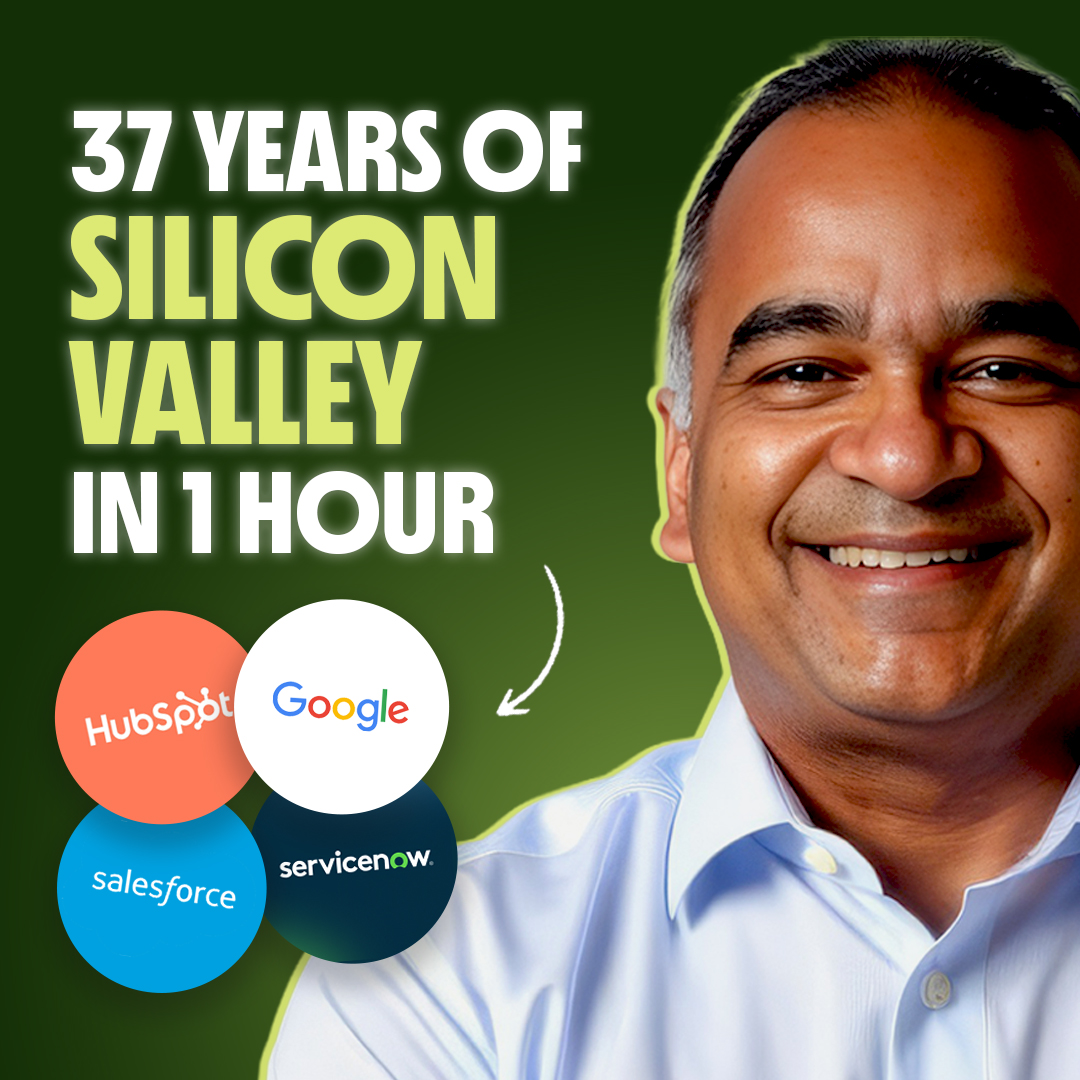
Learn from Silicon Valley’s Best Companies (Hubspot, Google & Salesforce) w/Avanish Sahai
India is the 2nd largest startup ecosystem now. But, can it be at par with Silicon Valley?
With 37 years of experience in the valley, Avanish sahai believes it can. What made Silicon Valley the ultimate startup ecosystem? It was investors, universities and an environment where people dreamed to come live and work. And, in the last 25 years India has been going through the same transformation. And the changes are nothing short of admirable.
Avanish started his career from a Mckinsey office in 1999 which ideated India’s software dream, with policy changes the country needed to lead in Technology. Since then, he’s held senior roles at Oracle, Salesforce, ServiceNow, and Google Cloud, and served on HubSpot’s board through its journey from $500M to $2B.
Avanish talks with great passion about startups that are disrupting the world today, taking lessons from small companies that took over legends who were believed to be indestructible. Even with all the hype around AI, Avanish reminds us that ultimately it’s all about people.
Watch all other episodes on The Neon Podcast – Neon
Or view it on our YouTube Channel at The Neon Show – YouTube
Siddhartha Ahluwalia 1:12
Hi, this is Siddhartha Ahluwalia. Welcome to The Neon Show. I am your host and managing partner at Neon Fund, a fund that invests at the earliest stages in the best of enterprise AI companies between US, India, corridor.
Today I have with me Avanish Sahai. Avanish, welcome to The Neon Show.
Avanish Sahai 1:31
Hey Siddhartha, thank you. Good to see you.
Siddhartha Ahluwalia 1:33
Avanish, you have such an illustrious career, right? You know, for our members, you know, because everybody knows HubSpot, right?
You know, you have been a board member at HubSpot for five years, right? And previously you have been, you know, a senior leader opening new markets or opening partnerships across Google Cloud, Salesforce, ServiceNow and many other companies.
Avanish Sahai 1:57
Look, it’s been a delightful journey and I’ve been very lucky. I’ve been in the Silicon Valley for about 37, 38 years and have seen it evolve from something that was not as well known maybe when I first came here in late 80s to doing Oracle to now it is, you know, a big part of what all of us think about and use, you know, so many technologies that have been born here. So I could not be more humbled and proud of the, you know, the last many years.
Siddhartha Ahluwalia 2:27
Sure. And would love to start a discussion today, you know, with your journey at McKinsey and when you specifically worked, you know, on the McKinsey projects on India, right? And some are part of software industry also and predicting where will India will go in next 20, 30 years, right?
So that’s a very interesting discussion to have.
Avanish Sahai 2:47
Look, Siddhartha, that was one of those moments where when we look back, some of us who worked on that project were still pretty close and we look back at it as one of those things that when we were doing the work, we didn’t quite imagine what it would turn out to be. So the projects were for NASSCOM, National Association of Software and Service Companies in the late 1990s, 98, 99, 2000. This was a pro bono effort by McKinsey globally to help NASSCOM think about working, how to work better and how to really engage with the Indian government and the Prime Minister’s office specifically on what are the things that would need to be changed from a policy perspective to help India become a leader in technology.
Remember late 90s was Y2K. That was a big thing. So all the big Indian and even they were not so big yet.
The Indian firms, whether it was Infosys, whether it was TCS, HCL, etc. They were all, had started, but the big boom in offshoring, outsourcing, etc. hadn’t quite kicked off yet.
So the project was to really bring a bit of McKinsey perspective to what could this be? And it was called Vision 2020. And the idea was let’s identify what are the big challenges?
How could those perhaps be addressed? And then also give a perspective on the sizing of the opportunity by 2020. So the big challenges, it was not easy to start companies in India.
So how do we help make that simpler? Inflow and outflow of capital. Huge, huge, huge problem, right?
Capital reserves are always a challenge. Frankly, the educational infrastructure. How do you make that more prominent, more focused on maybe technology sector?
And then finally the deregulation of telecommunications. Everything until then had been owned by the federal government, the central government. So those are some of the big, I mean these were, as you can tell, each of those was a big thing.
And frankly the government and the NASSCOM collaborated. And most of those changes, in fact all of those changes actually happened. And the, I think the cherry on the cake was we as a team, and I was leading the software and services practice here in, actually very close to where we’re recording, in Palo Alto.
And a number of us were involved in this. And we said look, if all these things happen, in 2020 this could be about a 200 billion U.S. business. And it turns out, some of us were chatting a few, couple of years ago, we think that the actual number based on the data we have was about 220 billion dollars.
So, I mean it is, it is quite spectacular what India has been able to achieve in the last 20 years.
Siddhartha Ahluwalia 5:53
This is the IT services?
Avanish Sahai 5:54
IT services, BPO, IP development, all the aspects of technology, right? Not just services, but we really looked at it across all of those.
Siddhartha Ahluwalia 6:06
And if you can remember some stories from that time, what would they be? You met with Prime Minister Atal Bihari Vajpayee.
Avanish Sahai 6:12
So the presentations were to the PM’s office. And I think one of the big takeaways for me was, frankly these were all multi-departmental, multi-ministry, long-term structural changes. And one thing we always think about is, in a democracy, policies will change from one government to the other, to the other.
Things change. And what one may say, agree with, the next government may come in and disagree with or change. This is one area that the consistency, I think broadly, across government parties, across government leaders, of maintaining this as one of the key elements of the future of India, I think was amazing.
And it could have easily gone, oh, this is too hard, or there’s too many vested interests that don’t want to see this change. But it is, I think, amazing, truly, that even many, many governments later, this has become part of the Indian story and the Indian mindset.
Siddhartha Ahluwalia 7:27
Yeah. So if you can recall from that time, what were the action items suggested by McKinsey to make that happen? Let’s say you mentioned about opening up of deregulation of telecom, more infra for IT services, BPO, right?
Any specific structure that McKinsey had created? And the other part is, what were the tailwinds that supported to make that happen?
Avanish Sahai 7:55
So I think the four or five things I mentioned, I mean, each of those required some dramatic changes to policy, right? So inflow and outflow of funds for India was always a very restrictive time, right? And I think one of the stories a lot of immigrants from India would say is, look, they left India with eight US dollars in their pocket.
That was the limit of what as an individual you could bring out. Now imagine being an investor, imagine being a venture capital firm, or imagine being a large private equity investor who’s looking for the opportunity but saying, look, if I invest there, I cannot bring my money out. That’s a huge problem.
I would still say it’s perhaps not the easiest, but it’s a lot better than it used to be. Second thing, deregulating the telecommunications industry, right? Now you have mega firms like Airtel and Reliance and others who didn’t even exist at that time.
Those came to be because the industry was deregulated, was privatized. Those were again big structural changes that required many different departments to collaborate, to align, to say, hey, look, this actually is different than how we did things before, but now this is the right thing to do, right? So I think all those were pretty big asks.
And if you were to ask me today, 25 years later, did we as a team for McKinsey believe that all those things could happen? We had doubts. And again, we felt that all of those had to happen.
It was not necessarily just one or the other. So it is quite, again, quite admirable that so much change had actually happened.
Siddhartha Ahluwalia 9:47
So would you give credit to policymaking or the Indian entrepreneurial energy or macro tailwinds?
Avanish Sahai 9:54
So you asked about the tailwinds, and I think, frankly, two tailwinds that kicked in. One was certainly Y2K put the Indian firms on the global scene, no doubt. Two, I think the increased focus on education, particularly STEM education.
Those two combined created the powerhouse, right? Where do I give credit? Look, this is the ultimate definition of a flywheel or of an ecosystem.
It’s what’s made Silicon Valley so successful, right? You have investors. You have universities.
You have an environment where people want to come and live. That same thing, I would say, happened in India over the last 25 years. It’s all those things, right?
The entrepreneurial mindset became much more prominent. More and more companies said, hey, yes, we have core businesses in manufacturing or in oil production or automotive. They all branched into technology, right?
When we look at the origin of most of the big firms, whether it’s TCS coming from the Tata company, whether you look at many of the others, their origins were from family businesses saying, we’re going to branch. And then more and more entrepreneurs. So I think it is all of those things.
I think this is how this magic happens, is when things start to align and all the different pieces start to see the value and the differentiation they can create.
Siddhartha Ahluwalia 11:28
So if I have to, you know, you can take some time to give an answer. If I have to tell you to make Vision 2040 or 2050 for India, what would that be?
Avanish Sahai 11:41
Look, I visit India reasonably often and it is very, very visible how much it has already changed. How much, and look, not everybody has to be a programmer or AI engineer or prompt engineer, right? But I think the impact that this type of leadership, this type of openness to the rest of the world has had in the last 20, 25 years, it’s truly phenomenal, right?
What is the opportunity going forward? Well, let’s think about the macro for a minute because we’re in 2025. There are a lot of changes that are happening in the macro geopolitical, macro economic outlook, right?
China has become key manufacturing, but now we have these trade issues between the US and China and the EU and so on. We have, frankly, I think some opportunities to displace some of that, right? China could easily become much more challenging to work with.
So India could become, and I think will become, a major manufacturing center. So that’s one area where it has not historically been for the global market. I think India has one opportunity there.
Two, I’m a believer that some of the things that have been built in India for India, like Aadhaar, like the payment systems, et cetera, frankly a lot of other countries could benefit from those. So could the India’s technology stack become something that becomes a, rather than just the traditional services that we have done for so long, can that become part of what we can bring to emerging countries and bring that as part of our contribution? Again, let’s compare it to China.
China has gone into parts of Africa, into parts of Southeast Asia, into parts of Latin America, so far away, and built all kinds of infrastructure. Transportation infrastructure, warehousing infrastructure, ports, et cetera. Well, maybe in the digital world that we live in, India can bring digital technology infrastructure and be the, how to help modernize these societies.
So that’s number two, I would say. Number three, of course, is the biggest one. We are, all we talk about in this, either as an investor, me as an investor and a board member and so on, right now it’s all about AI.
And I think the big question is, what role does India play? AI has many aspects. I think there’s aspects of sovereignty, there’s aspects of innovation at the deep tech level, there’s aspects of expertise, just like what India did for the last 20 years in cloud computing and software as a service and mobility and so on.
What can India do to become a center of excellence for AI, for within India and maybe for the world? So those are all big, big opportunities. And don’t ask me about sizing, I cannot size those.
Those are big.
Siddhartha Ahluwalia 15:00
Well, imagine if you have to place a number on India-US corridor, how it would grow. And we were discussing a few days back, how Israel-US corridor has grown, right? Israeli for the last 20-25 years have invested so much into building that corridor.
It’s largely led by both private and government with equal partnerships, right? That put Israel on the map. That’s why we see outcomes like this, funds like CyberStarts, right?
So where do you think this India-US corridor is going?
Avanish Sahai 15:32
Look, I think there’s already been, again, I’ve been in Silicon Valley 37 years. And in that time, what used to be a trickle of a few Indian origin people coming in the 70s and 80s and 90s, now has become a major flood. And it’s in both directions.
So I think the corridor is already very strong. I think whether it’s at the investment level, whether it is at trade and government level, whether it is also obviously now there is a reverse diaspora as well with a lot of leaders from here going back to India, leading organizations, leading companies, building businesses, building investment firms, and so on. So I think we are in a new generation of that engagement.
And again, I think India has become much more of a global citizen than, frankly, it used to be 34 years ago. India used to be more insular. I think all of us agree that India was much more insular, was much more somewhat closed on both the economy, from the trade, from even tourism.
India is hot now. India is this place where a lot is happening. Even more can be done.
From the corridor perspective, I like the example you gave of Israel. I think that is a really, really strong example of a very strong bilateral relationship. It’s been historically very strong.
The tech sector and the military sector together, I think, have made it even stronger. I think we could certainly see more structured engagement between India and the US on that front.
Siddhartha Ahluwalia 17:24
So let’s talk about software product and AI companies between this corridor. So, you know, companies that have benefited from this are Zoho, Freshworks, and then the likes of many other companies. But these are the two most known examples, the common company, which is doing well, which is with both are investors in Atomicwork, seems to be on a great path and probably can disrupt one of the companies that you work in, ServiceNow.
Talk about more about that from that lens.
Avanish Sahai 17:58
Yeah, I think, again, just to put a bit of historical context to it, I think the early companies in India were all very services-oriented. Now, what I love seeing in the last 10, 12 years is disruptors who are truly building for the world. They’re building IP.
I think there’s been a huge improvement in things like design. And I do feel like there has been some tailwinds from open source, from cloud and cloud infrastructure, from cloud infrastructure, from certainly more of the as-a-service model, all those things together, and that entrepreneurship mindset that you mentioned earlier. And the combination of that has created a tremendous opportunity.
And I think, you know, you mentioned Zoho and Freshworks, certainly those are the two examples we all give. But, you know, there’s a lot of companies that have been born in India, whether B2B or B2C, that have a global mindset and a global footprint. So I think it is, again, an amazing evolution of the Indian technology, and particularly the software sector, that has gone from being a maintenance and services, and we can do COBOL back in the day, to now saying, look, we can innovate, we can use the latest technologies, latest stacks, and really take it to the next levels.
Siddhartha Ahluwalia 19:28
So your career has spanned like 30 years, you know, McKinsey, Oracle, in Salesforce, you helped create Appexchange, and, you know, took it to more than a billion dollars in ecosystem revenue. At Google Cloud, you, you know, generated more than 1.5 billion in partner revenue. Is that right?
Avanish Sahai 19:52
Yeah.
Siddhartha Ahluwalia 19:52
In a span of two years. And then, you know, at ServiceNow, you know, you’re part of the team of Frank Slootman, that made ServiceNow yesterday.
Tell us some of the learnings that, you know, you had, you know, that, you know, you can reapply to the likes of Atomicworks from those journeys.
Avanish Sahai 20:13
Yeah. Look, there’s a few, again, having been here and seen some of these companies. So just by, again, a bit of context setting, I joined Oracle, Salesforce, and ServiceNow, all were almost identical in terms of size.
Siddhartha Ahluwalia 20:30
How much?
Avanish Sahai 20:31
About 3,500 to 4,000 people, less than a billion dollars in revenue, between 500 million and a billion in revenue. Now, Oracle today is obviously one of the global leaders, and I think it’s 80 billion, 80 billion in revenue.
Salesforce is now 40 billion in revenue and 80,000 employees. ServiceNow is 25,000 employees, 12 billion revenue. So what is, what are some of the common things across all those, right?
And that I feel strongly are good strategic indicators for the opportunity. One, and again, this may sound very simple, but I think it is how Silicon Valley thinks. Think big.
Don’t think small. Think if you have something that you’re passionate about, if it’s a problem that really is broad, you have to think big. You have to think global, right?
And all these companies have that mindset. Second, there’s this concept of fail fast. And we talked when we were, you know, grabbing lunch a few days ago about taking risk.
And one of the things that I still argue is the biggest export and the biggest learning from Silicon Valley is the ability to take risks, to fail, to learn from that, and then do it again. Let’s be honest. I mean, in our cultures, usually failure is not well regarded.
I think entrepreneurship is about learning from failures. And saying, hey, what did I learn? How do I apply that next time?
That, I think, is a big lesson that I keep with myself and I try to share, whether with my family, whether with friends, whether with investors, investing times. It’s okay. It’s part of how this works.
Third one, which is a little bit more technical, but I think is relevant to these examples, is this notion of thinking about being a platform. How do you think about yourself in the context of the customer’s problems? How do you bring other capabilities through a platform strategy and then think about partners who can augment that?
The more you do that, frankly, the more sticky you become, the harder you are to displace. That’s a lot of what we did. I mean, Oracle did that by expanding from database, which is really a platform.
We think of Microsoft as an operating system platform. Oracle is kind of a database platform. It still is, frankly, in most cases.
Then attach to it other applications that did not through acquisitions. But then work with partners, service partners, technology partners, distribution partners, resellers. Build that ecosystem.
As you build that ecosystem, you can create a flywheel and you become more and more sticky. Salesforce did that. We did that at ServiceNow.
Google Cloud actively is doing that right now. It’s grown from 3 billion when I joined to now it’s about 40 billion as well. These are big numbers.
There’s big opportunities. But you have to think along all those dimensions, I think, to make it work.
Siddhartha Ahluwalia 23:51
So when you joined as a board member at HubSpot in 2018, the company was at 500 million in revenue. When you quit, the revenue was more than 2 billion?
Avanish Sahai 24:01
Correct.
Siddhartha Ahluwalia 24:01
Can you tell us more about that journey and what contribution did you as a board member bring on the board?
Avanish Sahai 24:12
So, HubSpot is a SMB focused CRM system. It started out as primarily an inbound marketing solution and frankly became very, very, very successful. As the world was evolving towards digital marketing, blogs, emails, and other forms of communication, how do you help small and medium businesses use those tools?
HubSpot was phenomenal at building content to educate people. Say, this is how you do it. By the way, here’s the technology that can help you.
So marketing, kind of an inbound marketing, and then using Google Ads and so on to help drive traffic to your site and build a site, maintain a site, engage. So HubSpot went from zero to about 500 as a single product company. When I was invited to join the board, it was with the vision that the company had an opportunity to become one, multi-product, and two, a platform.
And the idea was we help companies, customers grow through marketing. But by the way, they also need sales. They need customer service.
They need other capabilities that allows us to become multi-product. And if we, again, have a platform strategy, if we can have the underlying data under all those sales, service, marketing, content, be a common data set, then we become a lot more difficult to displace. So my focus with the HubSpot team, obviously, was helping them think through that journey from single product to multi-product to platform.
And frankly, it’s been an amazing evolution of the company now. They’re about $2.5 billion. Absolutely world-class in terms of thinking about how to innovate, how to create a phenomenal experience.
This has been part of the DNA from the beginning. The argument is HubSpot customers, they tend to be on the smaller side. They don’t have big IT departments.
They don’t have big relations with the large service firms. How can they just sign up, get using it, be very intuitive, be very, very easy to deploy, maintain, etc.? I think that has been one of the mindsets that has allowed HubSpot to get to where it is.
Of course, now the new wave is, how do you bring more and more AI into that?
Siddhartha Ahluwalia 26:55
The companies that you have worked across, there have been a few common things. So Salesforce replaced Siebel. ServiceNow replaced BMC.
And HubSpot started eating the lower end of Salesforce.
Avanish Sahai 27:18
Absolutely.
Siddhartha Ahluwalia 27:19
So what are the opportunities for companies which are getting born today to make these companies dinosaurs of the past?
Avanish Sahai 27:31
Look, there is a saying in Silicon Valley that became a book by Andy Grove, who was one of the leaders of Intel in its payday and one of the founders of Intel, which is only the paranoid survive. And look, there are many examples of companies who people thought were indestructible and over time they became less relevant. Of course, we talk about IBM, HP down the street here.
Many of these companies were the behemoth. Multi tens of billions of dollars in revenue. Everybody’s technology ran on those.
So I think one of the big lessons or opportunities is this mindset that you have to continuously innovate. You have to imagine that someone somewhere in a garage or in whatever we work or whatever it may be, is thinking about how what you do as the incumbent is not good enough. It’s not delivering value to the customer.
It’s not easy to deploy. It’s not easy to use. Those things are, if you go back and look at the history, every time that type of disruption has happened is because someone came, and I think all the examples you gave are perfect to illustrate that, which is, hey, I thought, hey, how could you, Siebel was such a dominant player.
Well, Salesforce had a vision that said, you know what, the process of deploying Siebel, maintaining it, and the amount of complexity that it drives, nobody really wants that. Let’s make it simple. Make it easy.
Make it browser-based. And frankly, Siebel and others thought, this is not going to happen to me. You mentioned BMC and ServiceNow.
There are case studies on this. I spent time when I was running the business for the AppExchange at Salesforce with the BMC team. They’re one of our key early partners for the AppExchange.
We had to educate them at the time. This is 2009 to 2010, that this cloud and software as a service thing was here to stay. They’re like, oh, well, our customers, we sell these multi-million dollar deals.
We don’t think our customers are going to need anything in the cloud. Well, guess what? There was this little company called ServiceNow, founded in 2004, that came and not only ate their lunch, has left them far behind.
And it was not only BMC, it was also CA, it was HP, parts of IBM. So the question now is, hey, is ServiceNow potentially at the same risk? Yeah, possibly, possibly.
Siddhartha Ahluwalia 30:29
Avinash, you mentioned the word platform in your conversation. At earlier stages, the first question is, how would you identify whether the company, any company that you are investing in, can become a platform or not?
Avanish Sahai 30:45
Yeah.
Look, I think it’s a pretty important question. I wish there was a very easy answer. Yeah.
There isn’t. The idea of a platform really is, are you solving a set of problems where by exposing your architecture, your data model, your APIs, your analysis or your models. The more others can access it, the more others can use it, the more value and the more flywheel effect that you can create. So that is something that you have to think about and figure out, right? So let’s use a couple of examples.
I think that’s the best way to illustrate that. When Salesforce created its first application, it was called Sales Cloud. And in that, there were fields for accounts, contacts, leads, opportunities, etc.
That’s all part of the sales process. But when you think about how customers can use accounts, contacts, leads, opportunities, well, that starts again to other workflows. So by exposing that and saying, hey, we are going to use APIs, by the way, Salesforce had APIs from day one, since 1999.
So the mindset was already there, that the data that we had is going to be useful in other applications. So what could those other applications be? Well, if you have sales data, that data may also be important into a contract.
Because once you’ve done the opportunity management, the customer says, yes, I want to buy what you have, now you’re going to go into a contract. You need to put it into a price book, or you need to put it into a proposal that needs prices, that needs configurations. So now you have a new category called configuration, pricing, and quoting.
That Salesforce didn’t do very well. So we had partners that did that, right? So similarly, when ServiceNow came about, ServiceNow said, there is just some huge amount of data about IT and IT assets.
Which computers, which software, which version, where is it? Which data center is it in? That is data that if you can bring all that together, and in the case of ServiceNow, we call it the CMDB, Configuration Management Database.
All the IT folks know what that is. ServiceNow became kind of the canonical definition of a CMDB. And the customer would say, that is my system of record.
That starts to become a platform, right? So that mindset has to be, first of all, think what problems you’re trying to solve. Think what data, and what workflows, and what business processes are tied to that.
And then say, hey, I can identify the things that I am good at, that I’m going to do. But then by exposing that, then I can make it easier to do something. I can make it more valuable for the customer to tie multiple workflows into my data.
Now you have the beginnings of a platform. So a lot of it really, Siddhartha, depends on how much time we can afford to spend going deep into understanding the problem. And I can take these examples I gave about Salesforce and SalesData, ServiceNow and ITData, and run across many different companies.
They could be vertical companies that have deep understanding of, let’s say, pharmaceutical, or manufacturing, or banking, and wealth management. In each of those categories, you’ll find entrepreneurs, and companies, and people saying, hmm, I can think about this in a different way. And I can think about this with a platform mindset, and have that openness to say, I’m not going to do everything.
I’m going to need partners who may tie into my core. And it’s OK, because that makes all of us stickier, frankly. But most importantly, it brings more value to the customer.
So it’s something that I look at when I make investments. I try to assess as best as I can. Is there a platform opportunity?
Can that company grow? And again, have this journey. Single product, multi-product, platform.
If that happens, those are the winning companies out there.
Siddhartha Ahluwalia 35:35
Got it. And how would you interpret this in terms of AI world? Because now we have single product companies becoming as fast as 100 million, or 500 million, or 11 million, right?
Avanish Sahai 35:52
Yeah.
Yeah, so again, we’re at another inflection point, which is the beauty of this industry that I’ve seen now every 7, 8, 10 years. Something new comes up, and frankly, transforms the industry, right? So I’m so old that I came into the industry when it was first generation appliance server, right?
Then 10 years later, it was internet 1.0. Then came mobile. Then came mobile plus as a service and cloud and so on. Now comes AI, right?
All these things give us both an opportunity, and frankly, like we were discussing earlier, may give some companies a challenge of saying, how do I stay relevant? How do I stay, continue to innovate? I think the AI opportunity, however, having said all that, I have never, ever seen something take hold and disrupt and force people to rethink business strategy, investment strategy, positioning, et cetera, as fast as this last two and a half years.
It is absolutely mind blowing, right? So how do I think about it? I think, first of all, there’s some big questions for which I don’t have all the answers.
So I think it’s just important to raise the questions first. One of them is incumbents versus new startups. I don’t know yet, right?
Incumbents have the advantage of a lot of data, right? But they also have the baggage that often the data is not very clean. So as you build your models, as you build your foundation models, et cetera, are you relying on good data or not, right?
Whereas a startup has a clean slate, right? And they don’t have that dependency. So that’s one potential question.
Another question is open source or open versus closed. And this is a debate that many of the big players are actively involved in right now. And I don’t know that there is a perfect answer yet.
Is it the meta model that’s thinking everything is more open and open source, in fact, or is it more of the open AI model, which is no, we’re going to keep things under a certain level of control and close and so on. So I think that’s another example. Third one, frankly, I think as we talk about India and China and the US, I think there’s a big geopolitical angle to this.
There’s a lot of issues around sovereignty and data sovereignty, frankly, security that come into this, right? There’s defense applications. There is citizen services application where you wouldn’t be careful.
Where does that data going? Who has access to it? What can they do with it, right?
I mean, you have facial recognition issues. You have healthcare applications. You have public safety applications.
That is a big question, right? Do I use a model built in a country where I’m not going to trust, perhaps, the regulatory environment? Maybe, maybe not.
Is it better, faster, cheaper? Okay, but do I have other risks I need to measure? So I think it’s a, I am, as you can tell, I am fascinated by the times we live in and the opportunity to play, you know, even a small role in companies and helping them think about business strategy, technology strategy, how to do some of these things.
It’s just phenomenal.
Siddhartha Ahluwalia 39:41
How are you spending your time these days?
Avanish Sahai 39:45
So I am formally retired, right?
So I don’t have a day job anymore, which was part of my design. But as part of my process about thinking about, you know, we call it retirement. My wife and I sometimes call it rewirement.
I’ve built a personal framework, which is my time is going to be allocated to give back. And to me, give back has three, kind of three pillars. One pillar is family.
Spending, you know, I spend a lot of time working, traveling, et cetera. I’ve missed a number of key activities with family and with friends and so on. So part of my time is allocated to spending more time with family.
Like this summer, I’ve traveled with my family, and I’ve been with my family pretty much 10, 11 weeks, and it was just phenomenal, right? So part of that is time, family time. Part of that is what I call giving back to community.
And community for me is things like this. What can I bring from my lessons, from my mistakes that I can help others, right? So whether it is talking to you, whether it’s making some investments, whether it’s being a mentor or a coach or an advisor, whether it’s being a board member, or in fact, I also have a podcast that talks about the platform journey.
All those things are part of my allocation of time to give back to the community. And the community is technologists, it’s platform leaders, it is ecosystem leaders, U.S., abroad, et cetera, right? So that gives me both intellectual stimulation and frankly gives me a sense of accomplishment to help my peers or my colleagues in their journeys, right?
And the third one is what I call giving back to society. And there, there’s a few themes that I’ve been spending. I just did a program at Stanford in the last couple of years called Distinguished Careers Institute.
It was a full-time program where the idea was those of us who are kind of in a phase of life where we say, hey, how can we give back? How can we have more social impact? And I focused on three things there.
One was climate and sustainability. One was AI regulations, not the technology side, but more the policy side. And one was the future of work.
And each of those is kind of complicated. Each of those has many different aspects of opinions, of data, of different approaches, et cetera. So I’ve learned a lot.
I’m doing some work across all three. But the third one, the future of work, is where I’m actually spending more time at Stanford, working with the Stanford Center on Longevity. And we have a project that we’ve been working on with a number of other experts on saying, why longevity?
People are also living longer. The next generation after mine is probably going to live to their 90s or 100s pretty regularly. You have 10, 15, 20 extra years of life.
What do you do? You have to make sure you can make your ends meet. You can pay your bills.
You can stay intellectually engaged. So we’re focusing a lot on how does work need to change? And by the way, there’s this huge change coming from AI.
So someone who did the same thing for maybe 25 years, they could be losing their job or may have to change how they do their job, because now AI is going to play a role. So we are spending a lot of time thinking about what needs to change across companies, across educational systems, schools, universities, training services, et cetera, across public policy. What do governments and government agencies need to do to help support that change?
It’s a big problem. And many of us feel it’s not been fully thought through yet. And again, from the technology sector, we’re saying, hey, AI, AI, AI.
But the social impact of that and how that’s going to change the social fabric. And by the way, that is not just a US problem. It’s going to happen everywhere in the world.
So that’s a big part of my time right now is helping, collaborating with a number of others and trying to come up with some points of view of how we can think about that.
Siddhartha Ahluwalia 44:27
And any specific things that you are doing for India or in India?
Avanish Sahai 44:31
So I have done a few investments. I would call them co-investments in early stage companies in India. I feel like there’s just, you know, there’s a lot of, obviously, activity and so on.
And most of them have been in early stage entrepreneurs that I really liked and that I feel have the opportunity to kind of become disruptive. And I see that as part of my continued engagement. And in that bucket of giving back to community, you know, making some investments, being a mentor, advisor, helping them think about go to market strategy, etc.
So that’s one of the big, big areas that I’m continuing to engage in.
Siddhartha Ahluwalia 45:14
In your career, you have always been able to pick up the right wave and the right player. In the first wave, which was the on-prem wave, you were able to pick up Oracle. In the second wave, you know, you picked up all the right set of companies when the cloud was just starting up.
Salesforce, Google, ServiceNow, right? And then even the board positions like HubSpot. How do you decide the wave and the player?
Avanish Sahai 45:48
I wish… Well, first of all, I will confess, I’ve been very lucky. And I could not be more thankful for the stars and the guidance that I’ve gotten.
I think two or three things come together for that to happen. First of all, and this is a piece of advice I give to all my friends, my mentees, get some mentors, talk to people, look around and say, hey, that person, when they speak, I pay extra attention. I like what they’re saying.
I want to hear more from them. I want to share my journey, my issues, my opportunities. So I have a number of those.
I’ve had some of those along my career. And both as a mentor and a mentee, I learn a lot from them. And again, part of my time has always been allocated to that, whether they’re professionals in my team, whether they were friends, et cetera.
I think having a network of mentors and mentees is absolutely fundamental. And I do worry, Siddharth, that as we’ve gone into this phase, everybody’s always on their phone and always WhatsApping and so on, that sometimes you miss the opportunity to grab a coffee, sit down with someone, have a lunch or dinner, have a breakfast. One of my mentors said this to me years ago.
He would never eat dinner alone. Even if he was traveling, he would always try to find someone that he could have dinner with. That’s an example of something you have to consciously do.
I think that’s one factor. Two, be curious. I think part of what allowed me to have these transitions was, hey, it’s not just right time, right place, but keep tracking what’s going on.
When I mentioned Salesforce, when I joined Salesforce, I’d been a customer. I’d known the founder. It was a 10-year-old company.
But I was tracking a bit of this change and this shift and saying, hey, how we’ve done enterprise software for many, many, many years may not be the way it’s going to be done in the future. So when Salesforce called me and said, hey, we have this role to figure out our platform and ecosystem strategy, my curiosity perked up. I was like, huh.
And by the way, at that time, I was planning on taking six months off. I had just sold the company and so on. And when they called, I said, huh, this is something that I don’t know where it’s going to go, but my curiosity was perked up.
So I think being curious is a huge, huge, huge part of that. And third, which we spoke briefly before, but I do think it’s important. Is willingness to take some risks.
Willingness to have, we call it the growth mindset, right? Hey, be curious. Not all of it is going to work out.
When I joined those companies, I wasn’t sure that they were going to be on this trajectory. But there was some risk involved, but it paid off. And sometimes it won’t.
But again, did you learn? However, the most, most, most important, all those things are good. Mentorships, having the ability to be curious, take some risks.
But the most important, by any stretch, is the people. I have been blessed, and I think that is the only word I can use, to have been found to, you know, opportunity to work with people where you learn, you enjoy each other, you know, you work long hours. You know, whether it was Oracle, whether it was McKinsey, whether it was these companies, whether it was startups.
Every time there was a good team, things worked out well. Every time there was issues in the team, you could tell that things were not going to work out well. And by the way, we talked about the successes, but I’ve also had failures.
I’ve had startups that went under.
Siddhartha Ahluwalia 50:21
Tell us about that.
Avanish Sahai 50:22
Yeah, so, you know, one of the companies that I joined, frankly, it was the wrong time, wrong place.
And we, those of us who joined it said, hmm, this is not, I’m not going to name names, but it was not the right environment. In other words, an AI company, too soon. And once we were there, we’re like, we don’t think as a leadership team, we didn’t think that this was going to go anywhere.
So we said, okay, let’s, we learned. There’s nothing that’s going to come out of it. On to the next.
So again, took a risk. The people we thought, we had the right people. We didn’t have all the right people.
And then we learned that this was probably not going to go, go that far, right? So that ability to, you know, be curious, question things, but at the end of the day, and again, I speak this in the heart of Silicon Valley, as a technologist, AI, AI, AI is all we talk about. At the end of the day, even with AI, it’s going to be about the people.
So you have to choose well and choose carefully.
Siddhartha Ahluwalia 51:38
So this is my last question to you. If you were not retired and, you know, and you were looking to spend your next 10 years, which company would you join?
Avanish Sahai 51:48
Oh, man. You know, today, I’m not sure I would name a single company, but I’m very passionate about vertical solutions.
Siddhartha Ahluwalia 52:00
Why?
Avanish Sahai 52:01
Because I think a lot, there’s been a lot of great horizontal solutions, but there are a lot of industries that frankly should be disrupted with better technology, with better innovation, where the data has existed, but hasn’t proven to be very well used. You know, and I can name a few, right? I think travel and tourism, I think we could do a much better job, right?
There is a bunch of engines out there. They can do a very good job of really helping you plan, you know, plan a real trip. I think there’s opportunities to create a much better, you know, perfect trip, for example.
There’s companies in, you know, the legal process is a pain. The citizen services process for when you need to deal with government, I don’t know a single person who enjoys that in any country, right? If you have to deal with a government agency, you kind of prepare yourself, you take an aspirin first, and then you go into it.
Paperwork, bureaucracy, poorly designed workflows. You go back and forth, you don’t know what’s coming up next. That’s another one.
Construction, how much of construction happens on a bunch of WhatsApp messages with your contractor who then sends something? Oh, make that a better experience. So I would, again, I’m not going to do it, but I would probably pick something in a vertical, AI-driven vertical SaaS, and just go deep.
Siddhartha Ahluwalia 53:41
And what revenue scale would you join then?
Avanish Sahai 53:44
I mean, I love the early, early stage. So, you know, I’ve done early stage, I’ve done middle stage, I’ve done late stage. At this point, if I were to do something, I’d probably do early stage and kind of help build it out.
Siddhartha Ahluwalia 53:59
Got it. Thank you so much. What a pleasure.
Avanish Sahai 54:00
Thank you. Really, really enjoyed it. Thank you.


Know when new episodes are released. Subscribe to our newsletter!
Explore Playlist
Anthropic, Sequoia Investor: 55x Returns in 18 Months, Is Anthropic Worth Trillions? | Vishal Verma