



393 / September 16, 2026
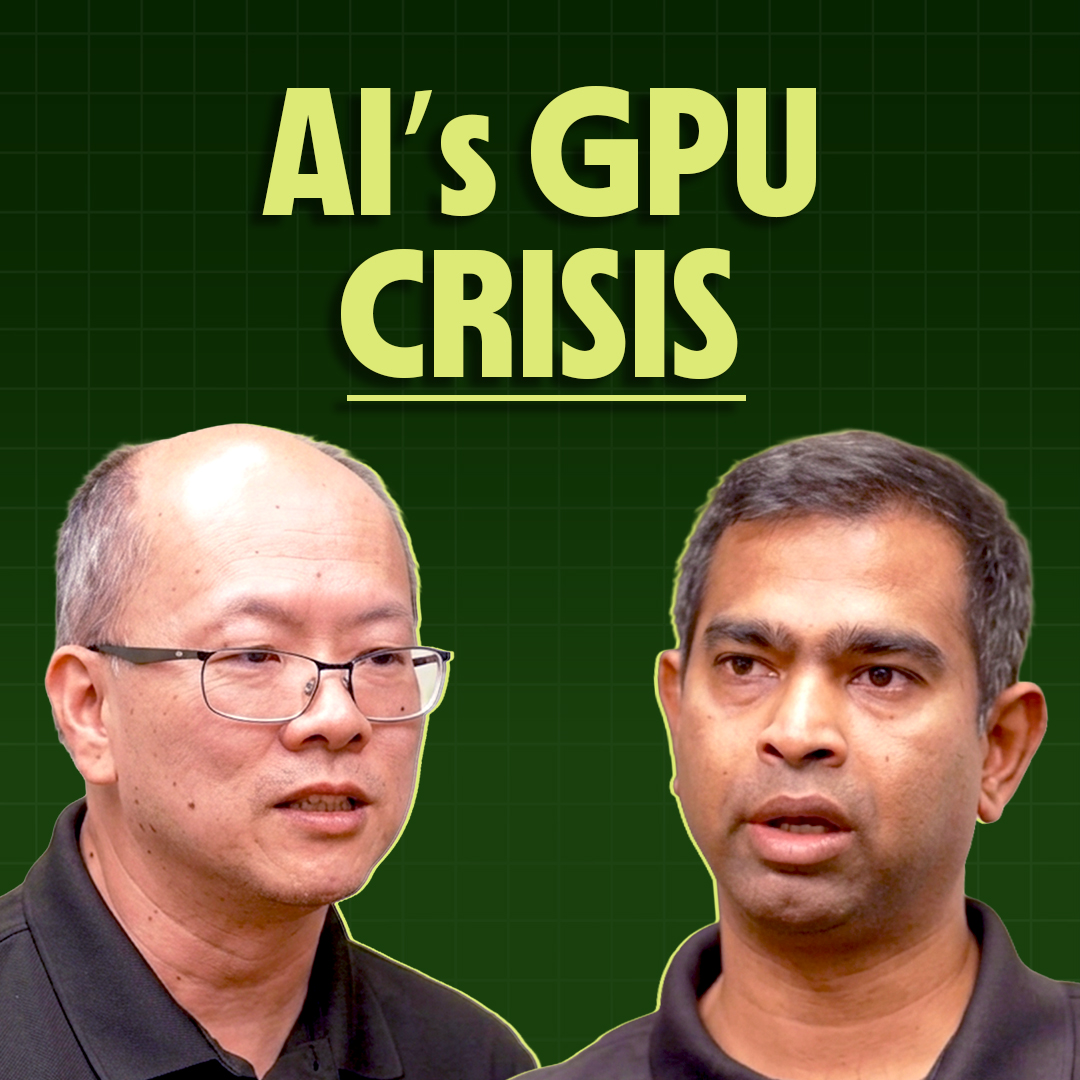
The Big Problem with GPUs and How To Solve It | Randolph and Kandan, MantisGrid AI
We don’t want the industry to fall apart, that’s why we started this company.
6 months ago, everyone was talking about model deployment. Now everyone has moved on to agentic AI deployment and autonomous agent swarms. But all of this is running on an infrastructure that itself is not automated.
And this underlying infrastructure has massive GPU cluster systems. If even one GPU fails the whole training workload fails. You can’t have 100,000 employees managing 100,000 GPUs. But LLMs are not the right solution for managing the infrastructure.
Kandan and Randolph have spent decades operating large-scale telecom and cloud infrastructure, in a world where pagers used to run lives of people managing it. With MantisGrid they have come together to build ‘The’ model for AI infrastructure.
Watch the episode to understand why making AI infrastructure autonomous is so important, why LLMs are not the answer, and what it takes to build the systems that will keep millions of agents running.
Watch all other episodes on The Neon Podcast – Neon
Or view it on our YouTube Channel at The Neon Show – YouTube
Siddhartha Ahluwalia 0:41
Kandan and Randolph, excited to be doing this podcast for you today. And I’m so glad that NEON could lead the pre-seed round in MantisGrid. You guys are veterans in AI infrastructure space in Bay Area. Right. And people don’t realize when we talk about infrastructure, that how important is, when we are talking about AI, the rails and the roads on which is built today and what it takes to keep reliable. And Kandan, you have worked in AT&T for 15 years. You were handling telecom and Randolph, you worked at Google for almost a decade. Right. So welcome to the NEON show, first of all. And let’s start with, if Kandan, you can share the history of AI infrastructure to our audience. Why does it become so important today?
Gnanavelkandan Kathirvel 1:37
Thank you, Siddhartha. First of all, appreciate for interviewing us today. And thanks for leading the round as well. And I think there used to be time that people, they don’t speak about infrastructure. And people who carried the pager know about the infrastructure. I carried the pager for a very long time and almost like I would say decades.
Siddhartha Ahluwalia 1:58
So you should tell our audience what does carrying the pager mean?
Gnanavelkandan Kathirvel 2:01
Yeah. So carrying a pager is like, you are on call support engineer or a manager supporting an operational team. And when you support an operational team, and there’s hundreds of people that are supporting the production, it could be any type of production, it could be a telecom, it could be a cloud, it could be any enterprise application. And when these are hosted in any data centers, the problems can happen at any time. And the problems can come in many ways. And the unpredictable situation of these problems are the major hurdle for a lot of this operational team. Especially when people, you know, now we have a smartphone, we can look at some status, actually a smartphone, but those days, like people used to carry the pager, you just get an alert, that alert says that, hey, the production is outage, and you need to join a call. And it doesn’t matter where you are. And it doesn’t matter what you do. And you have to immediately join the call. And usually these calls are escalated to the managers every one hour or two hour, depending upon the severity of the problem, like it can actually go to a higher officials. So when you join the call, you have to double shoot it and you have to solve it within the timeframe without impacting your customer, maybe most of the problems are already impacting your customer. Carrying a pager is not a fun activity. And when pager rings, like you have to join, like I’ll give you my story of the pain that I went through, is that when my son was born, like I received a pager, I thought it was from hospital, but it was from a production outage. And I had to attend this call. And this outage went for almost three days. And on those three days, like instead of spending time with my son, I spent time in really troubleshooting this problem and troubleshooting coordinating with other engineers as well. So it is not a really, really, you know, like a fruitful experience, I would say for many of the engineers who are supporting SRE or operational team. The fundamentals of supporting any production has not really changed. And the technology may have evolved. And we probably have seen a different version of like the hardware servers and you know, like any operating system or any of the top player that supports AI. The fundamentals of data center fundamentals of how do we run the software has not primarily changed over even a decade. The tools have definitely changed. The people has definitely changed. But the fundamentals how we support it is not really changed. It is creating enormous pain. And we talk about the CPU, then now we talk about the GPU. Now we also talk about other type of processors. The problems can happen with the GPU as well. And what people have not realized is that there are more problems happening with the GPU than CPU. And, and people have to address these issues. We talk about agentic AI world now everybody’s talk about agentic AI and every enterprise want to resolve this issue for, you know, an autonomous way. The agents are supposed to go resolve things without a human help or with a human assistant. That is helping on the application layer, but of the underlying infrastructure, which actually runs this agent, it’s completely non-autonomous. It’s still dashboard that I used to see 10 years ago, 20 years ago, it’s still the same pager alerts instead of like coming in a pager it coming in actually in the iPhone. So the world itself is like evolved on the technology. And we talk about AI, but unfortunately the technology that manages this infrastructure has to evolve. And that’s why we started this company. We are happy to share more with you.
Siddhartha Ahluwalia 5:51
So, so let’s go back to, you know, you have seen many cycles, you have been an industry for two and a half decades. How does this infrastructure evolve firstly on the, on the cloud side, right. And then on the AI side and my question would be further why it has become so important now.
Randolph Chung 6:13
Sure. So first of all, again, thank you so much Sid for having us on the show. So I started my career working in building telecom networks. And, you know, back in the day, the systems were about these monolithic systems that have to be highly available, a 5969 availability. And so a lot of focus was, Hey, like, how do I take these systems that are super expensive, right. And make them super reliable, right. So a lot of engineering hardware software went into it. Right. So that was, I would say like the first, first phase. And then later on, these hyperscalers kind of came in, right. And then, so the hyperscalers push this idea that, Hey, instead of having, you know, one super expensive server that can do everything and be super reliable, how do you have infrastructure that is itself maybe not reliable, that can go down, right. But you design your software and your hardware systems to be able to deal with those failures, right. So you say, Hey, I focus a lot on making it easy for systems to fail, but easy for systems to recover, right. Make everything very stateless. So that has been the kind of architecture pattern I would say for the last decade, right. But then now when the AI workloads come in, right, they have some different characteristics, right. So the GPUs themselves are, of course, very expensive, but the workloads are also now very stateful, right. So, you know, if I’m running a training workload, it runs across many GPUs. If any one of the GPU fails, the whole training workload fails, right. If I’m running an agentic workload that’s touching some kind of factory process, I mean, there’s again, a very stateful process, right. And if I have to restart that, it becomes very expensive. So now, you know, we’re kind of back to a little bit of the very stateful process of, you know, maybe when I started my career, but the systems have become infinitely more complex and large. And so, you know, again, the tools have, as kind mentioned, have not really kept up with that, right. Like we’ve evolved the tools to deal with maybe the previous generation of hyperscaler infrastructure, right. Now we have to evolve the infrastructure to also be able to support this new style of GPU stateless, massively distributed architecture.
Siddhartha Ahluwalia 8:24
So how has the observability changed across cloud and AI and then also across infra?
Randolph Chung 8:30
Yeah, no, great question, right. So the observability, you know, we were at KubeCon last year, and a lot of the discussion about observability was about how do you collect more data? How do you make it automatically collect data, right? And so I feel like a lot of the technology has been around that, right? Like how do you, observability seems to be how do I instrument every part of my system and get as much of the data as possible. And while the data is important, right, it’s really only the first step, right? If you just get this data, and you have so much of it, how is it possible for any one SRE engineer, or even a team of SRE engineers to be able to deal with it, right? Like you really need to evolve the tools to be able to understand what these data signals mean, right? And how are they related to each other? Because at the end of the day, what you’re interested in is not the data, right? What you’re interested in is the outcome, right? What happened to your system? You know, what happened to your, maybe, you know, your, whether it’s your application, or, you know, some process you’re trying to run, and the tools that understand the signals that can do the reasoning, right, to find the root cause, those have not really kind of kept up, right? And so this is why observability is not enough. Observability is kind of a read-only process, right? What you need to be able to do is to take action, and you need to act on those signals, to be able to close the loop and say, you know, how do I fix the problem? How do I observe what has happened? How do I improve the process automatically so that these problems don’t happen again?
Siddhartha Ahluwalia 10:06
And then, Randolph, and your vision for MantisGrid is Waymo for AI infrastructure. If you have to distill it down to a layman, how would you explain it?
Gnanavelkandan Kathirvel 10:17
I think there is a tension in the industry today. The cloud providers who are building the cloud, this could be a new cloud, this could be any hyperscalers, or it could be the data center people building on edge deployments. They want to sell more, and they want to sell very quickly, because the hardware, they struggle a lot to get this memory and GPU and all this stuff, because it’s a very scarce commodity right now. And once they get it, they invest billions of millions of dollars into building these data centers, and they want to quickly sell it. And they want to sell as much as possible. They want to oversubscribe as much as possible.
But what they actually run into is so many issues with respect to this infrastructure, and mostly underutilization, because the tools don’t allow them the complete visibility of what goes on. Then the other major issue is that failures happen, and they have to bring back these servers back again. Sometimes they forget to bring back these servers, they bring back like it takes time. So the money that whatever they have invested in this hardware, they really want to make money out of it. And if there is an amount of failure of this system, and the hardware is pretty high, then they want to pass this cost to the users who are enterprises. And the enterprises, the tension there is like they want to reduce the money, and they don’t want to spend more money, and they want to make everything agentic AI, and they want to deploy a lot of AI. Their attention is like, how do I not to pay this Neo cloud? How do I not to pay this thing? So there is a tension there. Everybody believes that the model cost is going to go down, and I do believe that model cost will go down. But whether the overall cost is going to go down, it’s really based on the effectiveness of running this hardware, running this data centers, running this models, and running this software, and the entire stack of it. Without that efficiency built in, neither the Neo cloud providers, or the cloud providers, nor the enterprise really going to see the benefit. So we feel as a MantisGrid AI, that solving this tension is super important in the industry. So helping the Neo clouds, helping the data center people increase the utilization, because end of the day, it’s all business outcome. Somebody spend a billion, they’re not doing in a charity job. So they just want to make a multi-billion, or multi-million. So they want to sell more, and our intention here is like, how do I optimize this hardware? How do I reduce the infrastructure failures? How do I bring back as much as possible to give them the efficiency that the business outcome that what they are looking for? The business outcome could be the utilization, the performance, and the uptime that is needed, because when you reduce the infrastructure tooling and the cost, then if a performance and the uptime goes down, they will really upset the enterprise and the user, and it will create a problem. So we are here to help the Neo cloud, the data center people, to make sure that they are keeping their customer happy, and they’re keeping the cost down, so that they don’t pass it on to the enterprise, but they make the profit as well. On the enterprise side, we help them actually to maximize the reliability of their agentic AI, because everybody is deploying agentic AI, and this is evolving very fast. Six months ago, everybody talked about model deployment. Now, everybody talks about the agentic AI deployment, and efficiency of reliability, uptime, and cost for that particular layer is super important. So we are working with both the side of the equation, both the enterprises, as well as the Neo cloud providers, which is actually on the bottom layer, on the top layer. If an enterprise wants to deploy the entire stack, and this could be a FinTech, or a banking, or a government, we can actually support the entire layer as well. So our goal here is that, very simple, you asked a great question to Randolph, like, what is the difference between us and observability? Observability is telling someone once it’s happened, and that is not the era that we are in. We are in AI era, and we should be resolving the problem before it happens. We should be autonomously resolving this problem, so that the number of humans needed to keep up this large number of fleet, and we are talking about 10,000, 20,000, or even actually in hundreds of thousands of GPU, you can’t have 100,000 employees managing 100,000 GPU, that is not efficient. So our goal here is like, how do I help the Neo cloud? How do I help the enterprises to really reduce the cost, increase the performance, and increase the uptime, so that they can be all happy? And this is super important in the industry, and in the AI era, everything is automated using agentic AI, but the underlying infrastructure is not automated. Then this is like, you put an engine on a car without any bolts and nuts onto it, and basically it’s falling apart, right? So we don’t want the industry to fall apart, that’s why we started this company, and we help the Neo cloud and enterprise to run their AI very efficiently.
Siddhartha Ahluwalia 15:38
So Randolph, how can you share, now we discuss about the why, can you share the how of how you do this?
Randolph Chung 15:45
Just like in the Waymo, right? You have to have sensors, right? But then you have to have a way to understand what is the world around you, so that you can drive and take, you know, go from kind of point A to point B, right? So in a very similar way, you know, think of what we do as having these sensors that understand, that are collecting the signals on the infrastructure, but what we have built are models, right? A collection of models that understands different aspects of this infrastructure, that understands the relationship between the different components of the infrastructure, so that it can reason about them, it understands that, hey, like when this part of the signal behaves, or this part of the system behaves in one way, this will affect this other part of the system in a certain way, so that it can, you know, predict issues, when something happens, it can do root cause analysis and say, hey, this problem happened, right? Because, you know, maybe let’s say your latency for your LLM is spiking, because you have this problem with something in your disk or your GPU or something like this. And because it can do that root cause analysis, then they can also recommend the remediation actions, right? That you can say, now I need to resolve this problem by, you know, changing some parameters, maybe I need to scale up my infrastructure, right? So all these pieces are tied together, right? You need to have the signals, you need to have the model, and you have to have the reasoning so that you can take the action.
Siddhartha Ahluwalia 17:11
So for Waymo, Kandan there are people sitting in Philippines managing, do you also have this?
Gnanavelkandan Kathirvel 17:20
We would prefer AI agents sit in, you know, like in data center managing this thing, we would definitely would like to take less human effort to run this infrastructure. As I discussed, cost is one problem, and the number of issues that can happen, and the time that takes to for a human to react to a particular problem is pretty high now. And it usually takes about like, you know, depending upon the problem, like, you know, minimum hour for a customer for an SRE person to understand the problem, then it takes like two hours to really triage the problem. Because in the entire stack that there could be millions of signal, because people do not realize like, we’re not talking about one signal to signal, each of this layer, any hardware layer, GPU layer, CPU, and everything actually on the top of it, Kubernetes, VM, collectively, the model, the agents and the service itself, like if we combine it, like we’re talking about a million sub signal, even if there is a dashboard, hundreds of dashboard, a person looking at it is not fair, and it is not scalable. So we do believe that having agents think of our infrastructure super-agent, and we call them kai. And kai manages this particular infrastructure in a very effective way. That is, that is what we actually envision. So to your question, like, do we need anybody in pipelines to manage this particular agent? I we do believe that we do need to have a people. Because every decision cannot be taken by AI, and somebody has to validate it. There are some action AI cannot perform today. But in the future, he has, for example, somebody want to migrate a database, for example, like, you know, can you give everything to AI to take care of it, especially the planning and scheduling and all the stuff that is not possible. So I think there isn’t a human element to it. Our goal is to reduce that human element and keep the humans in the governance part. So they can actually judge what they need to do. And then they I do the action instead of like a person who was supposed to spend some time with their family, a birthday party, or like a marriage, don’t need to take the pager and just get into the call. So that is where we are pushing the industry forward is that we definitely would like to have like a less human intervention, but more human governance than AI manage the infrastructure, not only the infrastructure, but also the AI agents themselves.
Siddhartha Ahluwalia 19:53
So as Mantis scales, you will reduce the pages.
Gnanavelkandan Kathirvel 19:58
We are already and we are not only reducing the pager, we are actually reducing the chunk that is happening in the operation team, because this is super important. So we support two type of users. One is the CFO, the CFO, when he looks at the balance sheet, all he want to see the profit. And we wanted to really optimize the hardware, optimize the agent for the enterprises, and give that the balance sheet in such a way that he feels happy. So he can spend time with his family. And the infrastructure people when they look at the number of issues that is happening, if they see that AI agent went and actually resolved almost like 99% of the problem, they will feel happy and the CFO that impacts to the CFO as well that you know, the cost wise like it is better. So our two major users in any company is the CFO organization, who look at the entire picture and say like, hey, am I making profit with this particular implementation cloud or deployments? And SRE people and operational people, AI deployment people, do they actually really feel that they are ready for scaling the agents and the workloads, AI workloads primarily across like a larger fleet.
Siddhartha Ahluwalia 21:13
So Randolph, then with AI, the biggest fear for the people in an enterprise is, would AI take their jobs? So would MantisGrid take the job of an AI infra person who is managing a pager or the CFO?
Randolph Chung 21:27
So I would say this, if you look in any organization and like a SRE team, especially, right, they their mandate is actually not so much about carrying the pager, but how are they kind of helping the business improve to become more reliable, to be able to build kind of new capabilities, and so on. And so what the tool we are building, right, will help them is to remove the toil, right, the part that is that nobody’s really interested in, so that they can contribute to building more value for the company. So I don’t see that these engineers will be displaced, right, like, but the work that they’re going to be doing, we’re kind of empowering these engineers to do the work that is more towards the top line of the company, right, versus just kind of maintaining the system. So that’s kind of how I would characterize it.
Siddhartha Ahluwalia 22:21
So you are enabling the AI infra people, which both of you have sold as, you know, telecom infra and AI infra in your life, to have more meaningful work.
Randolph Chung 22:31
Exactly. Absolutely. I mean, the reality is, you know, when, you know, the last, I don’t know, maybe five years, right, people have talked a lot about this idea of DevOps, and what is DevOps? DevOps is saying that, hey, the engineers who are building the product also need to operate it, right? And the reason why they do it is the infrastructure is becoming more complex, right? And so you need the engineers who understand it to operate it, right? But ultimately, what you would rather do is those engineers are building the product, right, then kind of shipping the solution, right? So I think it’s the same here, it’s becoming very, very difficult to find people who really understand, right, all the layers of the stack to be able to build these products, right? And so I think those engineers are very much still in need to be able to build products, right, rather than just figuring out, you know, why is this GPU not working, right, and so on.
Siddhartha Ahluwalia 23:24
And Kandan, you have to build your own models. Why couldn’t you use the models provided by large labs?
Gnanavelkandan Kathirvel 23:33
We started with using the large labs model. And very, within a month, we sort of understood that there are three or four important problems. Number one is like, we really realized that LLMs are not the right solution for managing the infrastructure. This is a fundamental misunderstanding in the industry that people think that LLM is an answer for everything. The LLMs are, in my opinion, they are probability engine, and I’m pretty sure that industry would agree on that. This probability engine is primarily good in handling the language, and good in handling like a certain task that, for example, coding, you know, definitely the LLMs are doing a fantastic job. But LLM understanding the infrastructure context, and understanding the entirety of what’s happening in the infrastructure, and then being very deterministically operating on that infrastructure, the word deterministic is very important, because you don’t want a system that is undeterministic, touching a deterministic production system, and then screw up the deterministic production system. That is not something that we want. So imagine like, we built an autonomous car, and it goes and crush everybody on the road, that is not what something we want. And we realized that LLMs are hallucinating, they are not deterministic, and they are not very good for handling very deterministic production work, especially figuring out like, for example, I want to like handle production issues, can LLM can handle it? There are companies that are went in a path of like creating an SRE agent. And what they have done is like basically collecting all the logs and metrics, and then they basically create a report. And some of the time that report is also hallucinated. And they confidently give this report to the SRE engineer who was troubleshooting, the SRE engineer believes that this is a real report, and sometime it can be hallucinated, then the SRE engineer take an action, and it creates a problem. That’s one issue. The other issue is also that it is good in summarization, it doesn’t understand like the entirety of the infrastructure. So we saw that is the one fundamental problem. The other fundamental problem is that the token economics is not going to work for us. Because the token economy, if you really think about it, like the cost is going up in the token, I’m pretty sure that there’s going to be a code, and then it’s going to come down at some point. But it is not right now, like every time, like I look at the price, like it’s keep going up. And if I charge a customer $100, and I need to send all those logs and everything to processing for a particular instance of a customer, if the labs companies charge me like $200, it is not something that profitable for me in any way. That’s the second problem. The third problem is that most of the enterprises, they do not want us to send the data, everything to a labs company. The biggest issue is that the privacy problem, right? If an enterprise directly send this to a labs company, that is a different story. The foundational models, of course, like they are secure, that’s what the people claim, but enterprises are still not there to trust these models. And especially we sitting in the middle and sharing the data with enterprises is not great. The other fourth issue that we saw with respect to these models are they are very, very centralized in only in particular location. So if a customer workloads are in a very remote location, we are basically sending over a wire in an instruction set like all over the place to bring it back in. The efficiency or the latency of like a particular application that is relying on this particular thing is not really very good in our opinion. Most overly, these foundation models, like if you look at the availability of this foundation model, it is only three nines. We would expect at least three nines, but it’s right now like it’s only two nines. And this information is very public and anybody can Google it. And you can actually see from the top foundation models, they only give you about double nine.
Siddhartha Ahluwalia 27:58
What is double nine?
Gnanavelkandan Kathirvel 28:00
Think of like an outage that is happening every month, like at least 20, 30 minutes. And that is 20, 30 minutes of production issues when I definitely need it. And the system is down. I cannot really have like my, I cannot use this because I need to support a four nine system, which is actually only two, three minutes outage per month. And our three nines, you know, in this case, like I have like, you know, there’s no guarantee on the So we saw all this shortcoming of the foundational model and LLM itself. So we decided that is not the right approach for this particular problem. We do know that some companies went on the path and they are actually bleeding for sure. All because of all this reason that we talked about. So we developed our own models and this is a collection of different varieties of causal model and the graph neural network models, and then some secret models as well. We did actually file a couple of patents on them. The intention here is that the, how do I bring this trust and the reliability aspect, because we are a reliability company and we want to be our solution to be very reliable. So our models are very reliable and we are very confident that it can actually operate on a production network, which we can stand by. The other aspect is that we can also bring this model at, you know, like any time and bring down any time when it is not needed. So it is extremely cost efficient. So there is no token tension with respect to this model for us. Like we know how much capacity is needed and it is vertically and horizontally scalable. So we don’t need to worry about this token problems in the industry. So I think we believe that we, there’s more to that what we created. It is definitely standing out in the industry. So all of our customers who are already using from Neo cloud, as well as the enterprise, they already see the benefit of those particular models. And we are planning to push this more in terms of making this as the infrastructure model for the industry.
Siddhartha Ahluwalia 30:03
Randolph, for MantisGrid to become a, let’s say, a billion dollar revenue company, what is required to make it happen?
Randolph Chung 30:11
There are a few things here, right? One is about the scale of these deployments, right, as right now we’re talking about, let’s say, AI infrastructure, right, which is certainly kind of one big piece of it. But another big trend that is coming are these agents, right? And, you know, when maybe consumers think about agents, they might be thinking about, you know, I’m using a chatbot to do certain things. But actually, in the industry, these agents are being used. Millions of agents are being deployed in everything from maybe your kind of fintech, right, to kind of factory floors and to retail and other places. And so the kind of scale of the problem is kind of rapidly increasing, right? And so as this infrastructure becomes kind of more and more complex, right, like then the solution that we’re building will become kind of more and more kind of important, right? So we are looking a lot at those problems around kind of scale and complexity, where it really has become impossible for humans to kind of manage this problem, right? And so this is where we see kind of a lot of kind of opportunity for growth. And then beyond that, these models that Kandan was just talking about, right, they have, we see a lot more opportunity for them to do additional things, right, like where they can help customers with analysis of, hey, like, this is not just about what I have deployed and what is happening, but I can kind of predict, right, and say, hey, if I were to make this change, what would happen? And this not only helps the SRE engineers, right, but it helps businesses think about their kind of financial planning, right? How can I, maybe to give a concrete example, we are working with Neo Cloud companies who are looking at how they can optimize their infrastructure to make more money, right? And so the tension there is, it’s not that they don’t have GPUs, but the GPU utilization is often very low, right? And so they need to kind of come up with a model to understand the GPU utilization to fully utilize it so that they can sell more of it, right, impact more of it. So having models that can kind of predict, do this, whatever analysis, right, I think will enable a lot of additional kind of value for customers. And that will kind of, again, increase the value of both kind of their product, right, but also the value of our solution.
Siddhartha Ahluwalia 32:44
Kandan, you have day zero hyperscaler partnerships, whereas these hyperscalers could choose to build it themselves. So why aren’t they building themselves and choosing to partner with you?
Gnanavelkandan Kathirvel 32:56
This is a great question. And we asked the same question to the hyperscalers as well. I think it’s really come down to a couple of key aspects. Hyperscalers cannot build everything themselves, and including more of a multi-cloud solutions. And I will share one very concrete example that we are working with one of the hyperscalers. Their customers are, the hyperscaler customers are deploying a large amount of agents and to manage the factory floors. And these agents runs on this hyperscaler throughout multi-regions. And the hyperscaler has an observability, but they don’t have a way to close the loop in terms of the performance, in terms of the cost, in terms of the uptime. And this has to be done in a large scale. And that’s where our AI models and our system really comes in and bridge that gap. So you may ask the question, like, can they build this exactly thing? Is that anybody with the money and cost, they can build it. But we assembled a fantastic team and we are operators ourselves for a very long time. And being in this particular part is that we bring our knowledge, we bring our thing to the industry to help out. I think the key aspect is that addressing that gap that hyperscalers are not willing to go into. That is a gap that we picked in and we are helping them. It’s not an observability. We sit on top of the observability and top of the cloud and provide that what is missing for the enterprises.
Randolph Chung 34:36
Let me just add a quick point to that. One of the things that all of these cloud providers have is that because they are an infrastructure provider, so they are not allowed to look into the customer’s workloads. So they cannot see, actually, they’re not supposed to see what is running in the customer’s workload. And because of that, they are kind of inherently constrained in what they can do. They can only provide the tools for the customers to do it, but they cannot do this kind of closed loop thing that I mentioned. They cannot also see that. So that’s why we say that, hey, we also provide tools for the enterprise customers because they own the workloads. And ultimately, they are the ones who need to understand that full loop and how things work together. So that’s also another reason why the hyperscalers themselves cannot solve this problem.
Siddhartha Ahluwalia 35:26
So what you are providing is a mechanism for hyperscalers also to understand customer’s entire infrastructure.
Randolph Chung 35:36
So we have definitely had conversations with some of these providers about them, let’s say, offering our solution in conjunction with them to their customers because they see this as a gap. So one problem we’ve heard again and again from these cloud providers, for example, is that right now they are handling a lot of customer calls because their customers say, hey, my application is not running. But it’s unclear whether it is a problem in the application layer or in the infrastructure layer and so on. And so the hyperscalers are kind of incentivized to provide these tools to the customer, to help customers with this problem so that they don’t have to deal with these kind of customer calls, their customers are happier and so on. But of course, the enterprise customers want to have these because they want their application to work well.
Gnanavelkandan Kathirvel 36:28
One more point to add is we are also pushing the technology far enough to really benefit the enterprise customer. Primarily, this closing the loop, it may look very simple. That means that processing millions of signals, integrating with the cloud provider, integrating with all the agents that is running, thousands of agents that customer is trying to run. And also understand the business context of that enterprise. I think I talked about the tension that the enterprise has is that reduce the money versus the cloud provider want to sell more. And there’s a reliability and other areas that they basically want to make sure that both of them are satisfied. So we basically bridging that gap in terms of what that enterprise need, what does this cloud provider need and helping them to bridge that gap. From a business perspective, it benefits both of them. It benefits us as well. So that’s a part and from a technology perspective, I think we are taking the industry forward in really making this AI agents reliability taken into nth degree of support. And that’s primarily the thing that we are pushing in the industry. So there is a gap that we addressed clearly. And that has been very reflective of a lot of enterprises.
Siddhartha Ahluwalia 37:41
Randolph, autonomous action need user trust. How are you achieving it?
Randolph Chung 37:47
Sure. So let’s use the Waymo cars as an example, right? So when Waymo first started, they first did a lot of work to look at how do they consistently recognize different patterns that are happening in the world, right? So if you think about, let’s say, a stop sign, that a human can easily recognize a stop sign, whether it’s on the right side of the road, on the side of a school bus or in different places, so they have to build that. So similarly, in infrastructure, when we say, hey, there is an AI workload, there are many different kinds of AI workloads. How do you recognize that consistently? And then it is about being visible out there. So here in Palo Alto, in Silicon Valley, the Waymo cars drove around for a long time, or many different neighborhoods where people are able to see it. And then you gradually believe that, or you see that it’s working, and you believe it will work. And it’s also about that interaction with the human, where you can give that feedback, and you can see, hey, is it working or not? So when we talk about building an autonomous system for AI infrastructure, similarly, it’s about those kinds of ingredients. It’s about being able to work consistently in different kinds of situations, being able to show the user what is happening. So we talked about LLMs, for example. One of the challenges of LLMs is that it’s a little bit of a black box. And so the approach we have taken with our models is that any time any action is taken, we explain to the user, this is why a certain kind of conclusion was met, or was reached. What are the signals that tell us that this is the right kind of conclusion? And therefore, what actions will be taken? And it’s up to the user to say, hey, do I allow this action to be taken or not? Because you cannot expect to go into an enterprise in day one and say, hey, hand over the keys to your infrastructure, and then you automatically manage it, right? That just is not realistic, right? And so it is this kind of building of trust that needs to happen over time that we demonstrate that the solution actually works consistently, right? And that is what enables that trust and that kind of autonomous behavior to happen. So it’s very much about understanding that kind of mindset, right? As much as this is a technology problem, it is also a human problem, right? How do we work with the engineers, the operators who are managing this infrastructure to adopt this tool, right? So this is kind of how we think about this.
Siddhartha Ahluwalia 40:37
How do you envision MantisGrid in next 12 months, 24 months, and 60 months?
Gnanavelkandan Kathirvel 40:44
This is a great question. And we would like to see this autonomous way of managing the AI infrastructure, AI agent. This is the only way. There is no way to scale so many SRE engineers and operational people and monitoring them with so many dashboards and so many alerts. And we want to create this efficiency in the industry. And we wanted to help our customers. And we feel like this autonomous way of handling the infrastructure has to become more practical. And as Randolph pointed out, we would like to see this more adopted by the users. And even if it is not 100%, we would like to see 99.9% adopted so that we can take the industry forward. So we see ourselves that supporting this AI agent use case and the AI infrastructure use case very well with autonomous functionality so that the agents can run this infrastructure. Agents can run the agents. And this is a vision that everybody has it in the industry. But we are making it happen. And we would like to see more it happens in the five-year timeframe. But again, we are not waiting for five years. We are already making it happen. And we are already in production in some of the customer environments. And we wanted to scale. And we want to help this industry. And we want to put this model that what we are developing as the deep model for AI infrastructure and really be the pilot for this particular area.
Siddhartha Ahluwalia 42:19
Thank you so much, Kandan. Thank you, Randolph. Thank you. We are very privileged to be part of the journey as Neon Fund.
Randolph Chung 42:26
Thank you. Really appreciate it. And looking forward to it.


Know when new episodes are released. Subscribe to our newsletter!
Explore Playlist
“Yes.” Building Claude Code for Marketing | Kashish, Hightouch
Why OpenAI Has No Moat & LLM Prices Will Collapse |Avinash Lakshman,Weilliptic
Why Even a $100 Billion Company Wouldn’t Be Big Enough | Tanay Tandon