



341 / November 4, 2025
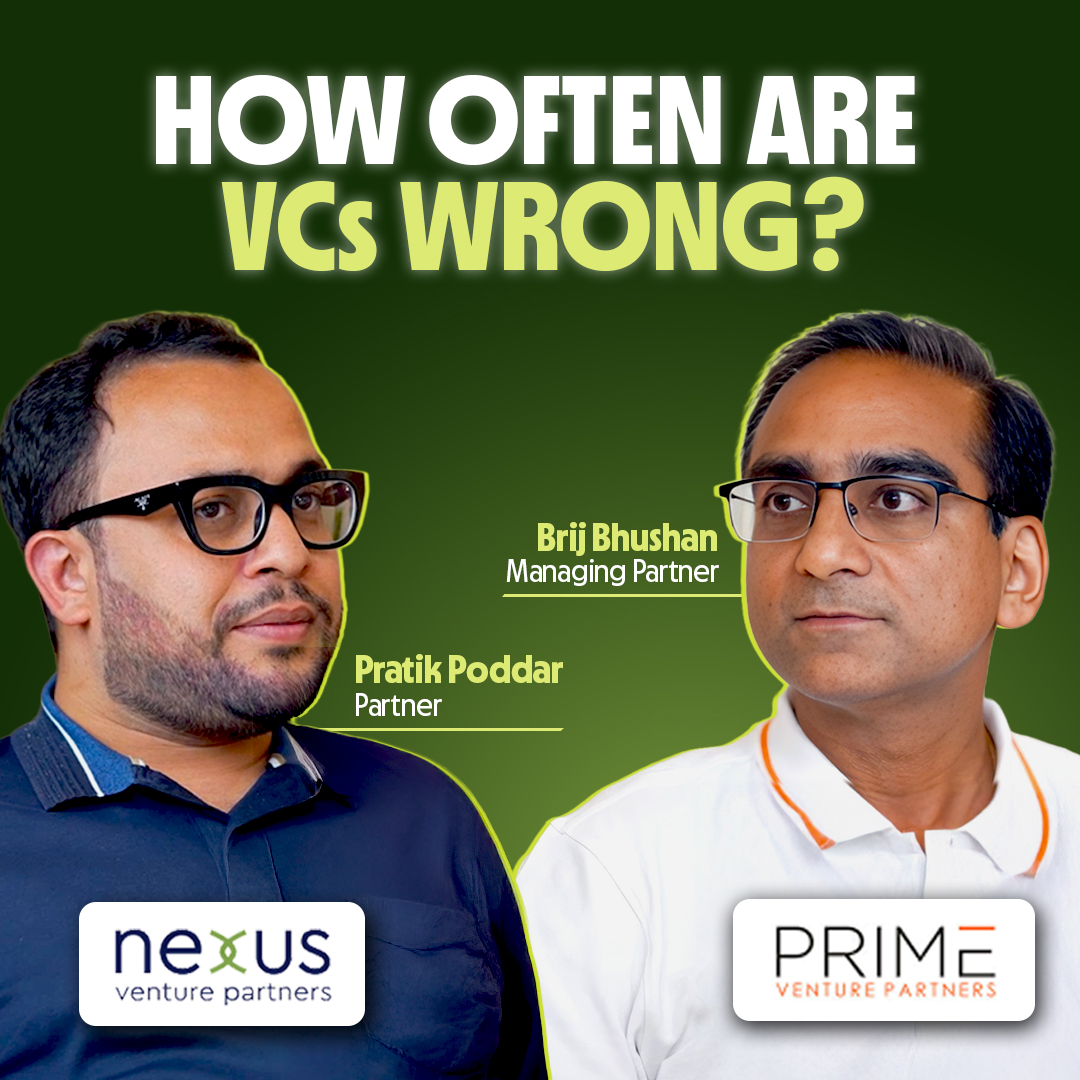
The Game VCs Play and Win | How VCs Spot and Back Exceptional Founders with Pratik Poddar (Nexus VP) & Brij Bhushan (Prime VP)
What makes a great venture capitalist — luck, timing, or the ability to see what others miss?
Brij Bhushan (Prime Venture Partners) and Pratik Poddar (Nexus Venture Partners) talk about the long game of venture capital; the waiting, the lessons hidden in mistakes, and the emotional ride of backing founders through years of uncertainty.
With Pratik, we dive into some of the biggest names in the Nexus portfolio: his first meeting with Rapido’s founder before he even joined Nexus, the Meesho pitch that became a big miss, and his first call with Zepto’s founders. Nexus was one of Zepto’s earliest investors and has backed the company in every round since. Pratik speaks with great clarity about conviction, timing, and what truly defines great investing.
Brij reflects on his decade of building Magicpin, what it means to “build the same company three times,” and how that journey reshaped the way he now works with founders. Having lived through the chaos of scaling, near-failure, and reinvention, he brings the founder’s perspective back into venture capital.
Together, Brij and Pratik capture the essence of the VC game — how the industry is evolving, why consensus rarely creates outliers, how real decisions are made inside funds, and why the best founders often seem “too early” rather than too late.
We talk about everything that shapes a VC’s everyday life, and above all why Brij and Pratik believe it’s still the best job in the world.
Watch all other episodes on The Neon Podcast – Neon
Or view it on our YouTube Channel at The Neon Show – YouTube
Siddhartha Ahluwalia 00:49
Hi, this is Siddhartha Ahluwalia, your host at Neon Show and also Managing Partner at Neon Fund, a fund that invests in the best of enterprise SaaS companies and enterprise AI companies starting from India for the globe like Atomicwork, SpotDraft. Today, I have a very dear friend with me, Pratik and Brij, who is Venture Partner at Prime Venture Partners. Pratik, your journey has been inspirational.
You have been a founder, you know, and then like you are the one of the very few people that saw a journey but a very large fund from associate to a partner. So, you know, I talked to you when I was starting Neon, you know, you helped so much during the starting of the Neon journey, right? And, you know, Prime is a fund that I worked at, Brij for some period of time and Prime is like family to me.
Brij Bhushan 01:32
Correct
Siddhartha Ahluwalia 01:33
So, very excited for this conversation today. And the goal of this conversation is, you know, for founders to know what goes behind the mind of VCs, for people who want to join VC, want to know how does a fund work, right? And how does the Indian ecosystem is shaping up right now with the people who are curious.
So, Pratik, I want to start with you, right? What have you learned in the last 10 years?
Pratik Poddar 02:00
Wow, good question. What have I learned in the last 10 years? So, long list.
So, I think when I started, first of all, I thought that VCs are, I started after being an entrepreneur for three years and nothing was working out for me. And when I was pitching to VCs, I always thought that the answers were very, very simple and dry, market size is small, or why would you win, there’s no fight to win for you and so on. And that did not, I did not understand what that meant.
But now I understand what VCs meant when they said it. So, when I joined, I thought, it’s an easy job, by the way, because all you need to do is meet people and things get done. But it’s a very, very difficult job.
You are working hard every day, meeting lots of entrepreneurs, learning from every entrepreneur and making sure that you are making sure that every conversation is exciting and insightful, both for you and the entrepreneur. And it’s not easy that way. And nothing happens for years.
You just meet and maybe one deal happens in one year, two deals happen in one year, and then you’re working with that company. It’s just a very long process. But thankfully, I have enjoyed that thoroughly.
I get energy by meeting smart people. I don’t get tired at the end of the day. I’m actually more tired at the beginning of the day and happier at the end of the day because the day is actually very exciting.
So, I’m happy that I was lucky to be a part of this small community. And Nexus has been a good firm for me. When I joined the firm, they were, Brij was the only known-partner in the firm. And Brij was about to leave.
I was practically the only non-partner in the firm. So that meant I got to do everything. I got to see everything.
I got to learn from everyone. And it was an exciting journey. The biggest learning I would have had in the last 10 years of VC is that I thought that large companies can do a lot.
And so startups, this startup will fail, that startup will fail. And that was a stupid mistake that I did for many companies. I think large companies move at their own pace.
And that’s why entrepreneurial energy is important. And that’s why entrepreneurs are able to create what they are able to create. That is perhaps the biggest mistake I did.
The second learning was market size matters a lot more than people. Then at least as an entrepreneur, I gave importance to. You can change everything, but you cannot change the market size really.
Best entrepreneurs can create the market, but still market size has to be there. There has to be profit pools. And these two are the biggest learnings slash mistakes in my 10 years.
And of course, I’m still learning and hopefully, I’ll not repeat those mistakes in the future.
Siddhartha Ahluwalia 04:56
And if you can share, what have been your biggest successes that you sourced and what have been some of the failures on the journey that humbled you?
Pratik Poddar 05:05
So maybe I’ll share Rapido’s example. So I met Rapido Aravind for the first time the week I got offered from Nexus. I had not even joined Nexus.
And that was that he was building theKarrier then. And I liked him then as well. Then that business model did not seem right, but he evolved into a bike taxi company.
That was also, at the end of the day, felt a challenging, debatable idea. Why should Ola and Uber not be able to do it? It’s very competitive.
Every investor is in either Ola or Uber, how would you raise capital in the industry? But thankfully, we stayed in touch and the company evolved. And when the traction was there, when some sort of network which was being proven, when the market had opened up, and there was more access to capital in the Indian ecosystem, it felt the right time to invest.
Brij Bhushan 06:07
But still at that time, also Rapido was a very counterintuitive bet.
Pratik Poddar 06:10
Yeah, but I would argue looking back, I still don’t think we could have taken that bet in 2015.
Brij Bhushan 06:16
That is true. 2017-18 was still better. You know, at least Ola, Uber had sort of reached a stage.
Pratik Poddar 06:21
They reached a stage. Uber CEO.
Brij Bhushan 06:23
There is new capital now in the market.
Pratik Poddar 06:24
A lot of those things.
Brij Bhushan 06:25
And bike was a different station also. The other guys don’t have.
Pratik Poddar 06:28
So things were changing by 2017-18 time frame.
Brij Bhushan 06:32
This is how you have to wait for the VC to strike at the right time.
Pratik Poddar 06:36
We were lucky that we could find that at that right time. It landed there.
Siddhartha Ahluwalia 06:40
And you got the meeting with the Rapido founder with Suvir.
Pratik Poddar 06:44
Yeah.
Siddhartha Ahluwalia 06:45
And finally it got done. And what have been the other companies that you would say?
Pratik Poddar 06:49
Yeah, mistakes I would argue. I think Meesho was a big miss. And I think the reason was the same.
I assumed that this would be a feature on Flipkart or Snapdeal or Amazon. Because they have logistics, they have payments, they have supply base, they have user base. What do you need?
And of course, it was a stupid mistake looking back.
Siddhartha Ahluwalia 07:10
And the companies that you backed, but they didn’t work out. What have been some of them?
Pratik Poddar 07:17
Maybe I’ll take Mitron as an example. So I think the founders were deep tech founders. And we did not back the company.
So Mitron was a short mobile video app. We backed the company before TikTok ban happened. So we backed a team that would iterate on new content formats, and then figure out which vertical would work.
And our hypothesis was maybe it will be short mobile video for news. Maybe it will be short mobile video for jokes or something like that. It will be a verticalized content format, content company with some new innovative format that they will figure out.
But the day we invested, TikTok ban happened. And then the world changed. And of course, then when everyone is throwing money at the creators and the consumers, then it just became too difficult to handle.
Founders still tried. But I think too many things happened in six months against the company for the company to be successful. So looking back, maybe it was not the right strategic answer.
But it’s okay. You made some mistakes.
Siddhartha Ahluwalia 08:34
And Brij, you have been VC before for two years, then you were a founder for almost 10 year period at Magicpin. You created a new category, which was very different from the food delivery category, and you were able to establish Magicpin. Then how did you make the decision to come back into VC?
Brij Bhushan 08:52
Long story. But I’ll give you a snapshot of it. So when I was at Nexus and I met Pratik, at that time, I remember telling him, I can’t think of doing VC for a long time.
In my 30s, I need to build a company. There was a strong itch. And Jeff Bezos has this great minimization framework.
And I had read about it. I thought this is perfect principle for life. I need to minimize the grid.
I need to build a company. And the thing about company building is the moment you start, you just don’t know when it will stop. So Magicpin was that.
And I say that quite often, that it was like building one company three times. When initially Anshoo and I started, it was all about building a product. Let’s get customers.
Let’s get customers. Because we used to think like, VCs, your retention curves have to be up and towards the right. Then you realize retention curves don’t matter.
Finally, you need to make money. You start building business models on top of the retention curves. Then you realize retention curves will drop the moment you put money on top of it.
By the time you figured it out, COVID came. So you have to make the same company three times, which is the reality of a founder’s life. So this journey was almost at a stage when we were thinking of an IPO.
And I thought that was the time for me to take a step back. Because I am also a person who enjoys more the 0 to 1, 1 to 10 journey. And Magicpin at that time was almost 50 million ARR scale.
And fingers crossed, we’ll likely do an IPO. But at that stage, that was the right time for me to think what else to do. And because the regret was already solved, I built a company for 10 years.
So the next best thing was to do a job where I can learn a lot more. And as Pratik so beautifully articulated, VC is one of the best jobs if you have just curiosity to learn. You have exceptional founders who will come, spend enormous amount of free time with you, teach you things.
And if you are gracious enough to reciprocate that and you are respectful to them, then this is an amazing profession to be part of. Now, unlike founder’s life, this is not a place where you can say that what I launched this month. You don’t know what happened for years.
You don’t know about your companies for 10 years. But there is inherited pleasure in being with a founder, going through the ups and downs with the founders. So because I felt that when I was at Nexus, I felt that this is the right place for me to spend the rest of my professional life.
And that’s how Prime happened.
Siddhartha Ahluwalia 11:11
And you are I assume 43-44 right now?
Brij Bhushan 11:13
Yes. Right.
Siddhartha Ahluwalia 11:15
Very interesting.
You were a VC in your early 30s. At that point of time when in India, there were hardly any VCs and it was so difficult to get into. He still is.
But at that time of time, it was impossible because there were no openings.
Brij Bhushan 11:28
Yeah, but I will tell you a small story. So my co-founder Anshoo had, I told him before that I’m thinking of leaving Nexus. And he said, are you mad? One and a half years you are at Nexus.
You should spend time. And Anshoo was at Lightspeed for many years. So he said, I’m going to this China trip with Rajan Anandan.
He used to take VCs from India and some founders from India to China for a week or so. And I’ll come back and I will, we will chat about it. So he comes back and says, yeah, you’re right.
Why? What am I doing? We should be starting company together.
Because if what’s happening in China, even a tenth of that happens in India, we should be in the fence and playing the game instead of watching it from the sideline. So for me, actually, that incident was also reaffirmation of what I wanted to do. But I would say if I look back, if that had not happened, and if I didn’t have this strong desire, I probably would not have started.
Because you have to also remember the VC is a job that once you get in, and you keep spending time, it is so enjoyable, right? Of course, it comes with ups and downs that you can spend your life doing it and still be learning.
Siddhartha Ahluwalia 12:33
So Pratik, what are the things that makes a VC anxious on a day to day basis?
Pratik Poddar 12:39
Yeah, so different aspects of job, different parts make me anxious. So, you know, that every meeting you are having, this could be the career creating meeting, or career killing meeting for you. I remember, like that I was there when I had that meeting with that founder.
And I said, yes, or I was there when I had the meeting with that founder, I said no. And like those memories are completely etched in your mind. So every meeting could be life changing in many ways.
And so of course, it brings excitement and anxiousness. Second, I would argue, when companies are going through tough times, it’s easy to argue that no, you have many companies, how does it matter? But it does not help.
You actually are emotional about every company, you lose sleep. Like I have, I’ve cried in my sleep. And, and it’s painful.
So, you get, you get anxious and you get emotional about every company as well. And it’s hard.
Brij Bhushan 13:47
The thing is, you can’t even do much except to be with the founder. But it’s not like like if you’re building a company, if you know this product is not working, revenue is not coming, you can do something and ship it. You work 24 hours, you work day and night, you’ll get up at night, you’ll make something.
Pratik Poddar 13:59
Nothing can be done here. So, perhaps that adds to the anxiety even more. That’s second.
And third, I think, founders, of course, know more and understand the business more. But a lot of times, you know that the founder is looking at you for that last push. And then, then you feel responsible for that last decision.
That should this line be shut down. The founder is just looking for some help or someone to say, yes, you’re right. And that would mean that 100 people will be fired.
And you know that you are responsible. You feel for that. So, that creates some anxiety in me.
I think these are the three places where it happens. Otherwise, every day is a lot of fun.
Siddhartha Ahluwalia 14:52
Brij, What about you? You have you’re seeing the second innings on the journey.
Brij Bhushan 14:56
Yeah, I think the biggest thing is to know that you are not in the operating role now.
Siddhartha Ahluwalia 15:01
Right. And that’s very hard for you because you were…
Brij Bhushan 15:03
That is hard. So, but because I was also at Nexus, I have some sort of old muscle memory of knowing that that is not my job.
But it is it is tough. Right. And but it’s important to not do it also, because eventually the founder is in command of the ship.
Right. And if there are more than one commanders, you will likely end up having an accident. So, you need to step away.
But that’s part of like my transitioning also to make sure that I’m not stepping into the shoes of the founder. And I’m there more to bounce off ideas, advice, debate, probe and question and improve the thinking of the founder and his decision making. But I’m not the one who is going to operate.
So, that’s definitely one. I mean, there are things that I I happily sometimes miss, for example, the point you talked about. Right.
This is then you have to let go of people as a founder. Brutal experience. And we were hit on our face by Covid.
Right. So, we had almost 300, 400 people being let go in a week. And so I had to do that on phone calls, asking people to go, people who have I have hired like three months before saying that Ajo bahot badi company ban rahi hai, bada paisa aa raha hai.
You know, we’ll make a life changing company for all of us. And then you go back to them in three months and say nahi nahi sorry and apologize for this. It’s brutally tough.
So, I have a lot of respect for founders, because it is probably the toughest thing you can do in life. Just in terms of the shares up and down, everything being linked on just one thing working out. It’s just so tough.
So, those are the things I I don’t miss. But I can understand when a founder goes through. So, that anxiety is not on me, but a derived anxiety, because if you back the founder, you want them to succeed.
All your companies, you want them to succeed. But the reality is not all of them will. Three out of those 10 will actually become successful.
The rest will go through the tough stages.
Siddhartha Ahluwalia 16:52
And when as VC you are backing, you’re making assumptions on time, the TAM is not really there, right? It’s calculated or you are taking some hypothesis, right? How often you are wrong on TAM?
Pratik Poddar 17:07
I think being wrong on TAM when the market size was small is perhaps okay.
Brij Bhushan 17:13
Yeah.
Pratik Poddar 17:13
Because sometimes you’re wrong and because you thought the market will increase. But being wrong on TAM when the market size was large, and you were wrong about it, that is, that is a big, big mistake. And, for example, for example, I would argue most, many, many VCs said could not invest in Groww because of India wealthtech market was not large.
Brij Bhushan 17:40
Not a large market. Yeah.
Pratik Poddar 17:41
But then, no, it can become large.
And when it becomes large, then you become a 5-10 billion dollar company.
Siddhartha Ahluwalia 17:48
Zerodha was not large.
Pratik Poddar 17:49
Zerodha was not, exactly.
Brij Bhushan 17:50
But the thing was, there was a tailwind. And at least that’s how we think of it now that TAM is part of the puzzle.
The bigger thing is, is there a tailwind macro shift happening that will make this market work? So, if there is a macro tailwind that India will have retail trading participation or equity investments will happen, then it may not happen in five years, maybe 10 years, but eventually something large will get formed.
Pratik Poddar 18:13
I think someone said this to me when I was building, which was very smart, that Pratik you have to be just behind the wave.
Brij Bhushan 18:20
Very hard to time the wave.
Pratik Poddar 18:21
If you are very behind the wave, then you need more perseverance. If you are after the wave, then you are done.
Brij Bhushan 18:27
Then you are done.
Pratik Poddar 18:28
You have to be just, just behind the wave and then move up.
Brij Bhushan 18:31
But is there a formula for being on the wave? Luck.
Pratik Poddar 18:33
Luck. You have to be lucky.
Brij Bhushan 18:33
You have to be lucky.
Pratik Poddar 18:34
And working hard every day.
Brij Bhushan 18:36
Same thing for VC, right?
You have to be lucky to catch that wave. Many VCs have invested in wealth management, for example, 10-12 years ago, right? Multiple companies, premium funds also, right?
And today the same market looks far more attractive because you can see the tailwinds clearly emerged and founders are more mature.
Siddhartha Ahluwalia 18:55
So what are the tailwinds that you are seeing in consumer right now because you are both investing in consumer companies?
Brij Bhushan 19:01
Yeah, one thing is clear about the premiumization part, right? Again, I don’t know how far ahead or behind we are on that inflection point, but there is clearly Indians are spending more money. Just macro level people, we Indians used to save a lot.
Now we are spending a lot. When I was running my company, I would see employees at entry level salaries carrying iPhones and I used to be shocked. If I would do that, my dad would actually say, what is happening?
Why are you spending money? But these kids are and they are spending on themselves rightly so because they want to enjoy life, right? But that is happening as a trait amongst the Indian.
So India consuming opportunity is clearly there. So that is something that I feel there is a macro tailwind. And with AI, there is a macro tailwind also on small businesses in India.
I built a company trying to help small retailers and it was very hard. But now if I have to build the same company again with AI available, it is actually easier. Because you can actually give them low cost tools and your cost of distribution is also lower.
So India, businesses built for Indian businesses, small and medium sized businesses, there might be opportunity.
Siddhartha Ahluwalia 20:03
But there have been investments like Khatabook, which are yet to take off, right? And have been there for such a long period of time.
Brij Bhushan 20:09
Again, I think specifically that company, if we talk about that space, generally, the tools are useful for the merchants. The problem is merchants have the bigger pain point of demand generation. So if you do not generate demand, and if you say I will give you a tool, it is an operational improvement tool.
Most of the Indian businesses are anyways very tightly run. They are not having large manpower that they will need to cut people. One person with two people are running a shop, usually a single person is running a shop.
So even if you give them a tool, if it does not increase the business, the person will not pay for it. So not paying for it is the thing. But for the same business, now if you think, he does because of GST, now he has to spend money on tax consultancy.
He has to file the returns, right? Now because of tax compliances, you no longer can do Kaccha Bills. There are only Pakka bills. Now can you create a solution that is very easy to use?
And he might actually pay for it. So there are things that change over a period of time and suddenly change. I think Indian small merchants are now an opportunity where you might certainly find good companies getting built.
Pratik Poddar 21:20
If I might add for other waves, one wave that I am definitely excited about is the customer behavior has changed, customer expectation has changed around speed of delivery for everything. So we are of course, big investors in Zepto, Snabbit, Slick. I think that is a clear trend that the world has changed around us.
And in India is a unique market where this is happening because customer expectations are high. And because of density and availability of labor force, it is just possible to do quick commerce in India right. So that is definitely a tailwind that I would think that investors and entrepreneurs will capture.
The second tailwind I would argue is the customer behavior has changed around payment. Till few years back, because of lack of ease of payment and because of lack of intent of payment, the content companies, the utility companies were not making as much money. But now suddenly, it is so easy to get money from people just because the payment form has changed and because the intent has changed.
In fact, I am told that in China, the audio, the music apps out there, they were stable for many years and revenues were not growing. But suddenly one year, they saw revenue growing very fast. And they could not know why that was happening.
And the underlying reason was that WeChat pay penetration has increased. And because of that, everyone was just willing to pay more.
Brij Bhushan 22:54
India, UPI, similar story.
Pratik Poddar 22:55
Yeah, UPI similar story.
And UPI auto pay may be similar story. And this behavior change happens with platform change and intent change. And maybe this is the inflection point when this will happen in India.
And it is exciting.
Siddhartha Ahluwalia 23:10
And you are also big in gaming, right?
Pratik Poddar 23:11
Yes. And I can imagine that lots of people will start paying for gaming in India now. It is just till a few years back, the largest monetized game was 20 million dollar revenue.
Largest non-RMG, non-shooting game monetized in India was 20 million dollar revenue.
Siddhartha Ahluwalia 23:29
Today what is it?
Pratik Poddar 23:30
Today is 65-70 million dollar revenue.
Siddhartha Ahluwalia 23:33
Which game is that?
…
Okay, we will skip that.
Brij Bhushan 23:36
Trade secret. Can’t be disclosed.
Siddhartha Ahluwalia 23:43
So few companies that became big from India, Zomato, Swiggy, Zepto, right? Especially Zepto became large in the last 4-5 years.
And it took like Zomato, Swiggy 10-15 years to become big. But are you seeing in the last 5-6 years, lack of innovation in consumer tech? Or lack of imagination in consumer tech?
Quick commerce is one way. Let’s keep that aside.
Pratik Poddar 24:20
I would argue inflection point is happening in quick commerce, inflection point is happening in content. So inflection point is happening in gaming. Education, of course, after COVID went through its own cycle.
But I would argue in most categories, it is actually happening now. So I would not be negative about it. In fact, when there is no obvious wave, there was obvious waves of mobile phone penetration till few years back.
There was obvious wave of Jio penetration. There was obvious wave of payment penetration. So new companies were getting created.
But now there is no obvious wave. But that is okay. That does not mean new companies will not get created.
In fact, I can bet that when those questions are being asked, that is the time when best companies are under the way. And maybe 5 years from now, we will look at this period as the best time to create interesting companies. We are not talking about consumer cross AI right now because there is nothing obvious right now.
But 5 years from now, maybe that is what is happening right now outside this room. And all we had to do was be on top of that wave right away.
Brij Bhushan 25:31
And also the first, like the last 10 years were all about building, and I am talking about consumer, building the infrastructure part. And those companies are more obvious to think like Delivery for Logistics or Amazon Flipkart, Meesho for example, or Zomato Swiggy. But they were building the first principle companies of let me enable transactions for customers by using internet.
Now that foundation is built, there will be more innovative models like content for example. I remember 10 years back, if a content company would have come when I was at Nexus, we would have not even had a 5-minute discussion. But today it is actually possible because the first level foundation has been built.
But these business models are not very obvious. So it is not like what has happened in US and China, you can copy paste. This is more for India companies that will get built out.
But I am with Pratik, 5 years from now, you will find, if you want to do this podcast again, you will say, oh wow, this was an interesting company that today we cannot talk about.
Pratik Poddar 26:24
And I would argue as a consumer, VC you are betting on behavioural changes. Looking back, I can bet 5 years back, we were chatting about Zepto as well.
Brij Bhushan 25:33
Most people would have dismissed it.
Pratik Poddar 26:34
Hey, why would we need 10-minute grocery delivery?
Siddhartha Ahluwalia 26:38
When you backed Zepto, it was not a 10-minute delivery.
Pratik Poddar 26:41
Well, it became 10-minute delivery very soon. The point is, even then, would you say that there was need of another new grocery company? The reality is no.
Brij Bhushan 26:55
By that time, a lot of money had gone into Big Basket.
Pratik Poddar 26:57
Big Basket and a lot of companies have, yeah.
Brij Bhushan 26:59
Grofers.
Pratik Poddar 26:59
Grofers was there. So a lot of experiments had already happened. But that is the beautiful part about consumers, that behaviour changes happen faster than you imagine.
In fact, one hypothesis I have, which might be counterintuitive today, is that all the commerce companies have been built for people of our age. But people 15 years younger to us, 20 years younger to us, don’t think like we do. They need something different.
Maybe they need newer products. They need edgier products. They need products that help them tell their stories better.
They are not people who are going on a website and saying add to cart and then buy. They need something different. And maybe their purchase behaviour will be very different.
And maybe we will see a completely new paradigm of commerce for that user base a few years from now. This happened in the US in different ways. When I first read about this sneaker craze, I was like, what are people doing?
Why are people paying so much money for sneakers? But when you go deeper into this, you realize this is the behaviour change that has happened in the generation. And that will happen for us as well.
We just need to figure out when, where, how, and then back the right company and the right sector. So this behaviour change will happen every 5-7 years. And that is why as a consumer, VC a job that will be exciting forever.
Brij Bhushan 28:26
Forever.
And you have to hope that the founders come and pitch you because it’s very hard to predict this. It’s very hard. You can probably top down guess estimate that this is the change that is happening.
But frankly, the founders are the ones who will come back and say, I am building a sneaker brand for example, right? That a founder only will come and say. Then you will understand, okay, Gen Z or this generation actually needs this kind of a product.
Pratik Poddar 28:46
A biggest mistake you can do is, we think we know. Because every 5 years, you don’t know. It will, the market will change completely.
And just being young and curious at that point of time is actually very critical.
Siddhartha Ahluwalia 29:03
And one way to figure out market change is to talk to a lot of people or what do you do that, like to catch the wave?
Pratik Poddar 29:09
Yeah, I actually take, look at data. But whenever I meet a younger person, I actually look at his phone. Look at his or her phone.
I look at everything that those guys do. Some people hate me for it. But if you, like if I meet your niece or someone like that right now..
Siddhartha Ahluwalia 30:23
They will call you Pokey uncle.
Pratik Poddar 29:24
I’ll actually take the phone and just see which apps are people using.
For example, I came to know about Musical.ly like that. Musical.ly, of course, was a Chinese company. But I came to know about Musical.ly because a lot of younger people in my generation, in my surroundings were using that. And it was exciting.
Brij Bhushan 29:51
It’s a bit serendipity also. I mean, you have to just be out there, experiment, meet people. And basically, don’t let what you have seen so far influence what is likely to happen.
I think if that principle is in the back of the mind, you’ll be more open to new opportunities.
Siddhartha Ahluwalia 30:05
But let’s say you backed Mitron content play five years ago, right, during COVID time, and Mitron didn’t work out because of XYZ reasons. Now, that bias will always play that, you’ll be super careful backing another content play.
Pratik Poddar 30:23
Bias should remain, will remain, where that is part of learning, but should not remain, because that is how you become a better investor. So we have to be mindful of that. In fact, the mistake I did in say Meesho, where I thought a larger company would do it, I did not do in Rapido and Slick, where the obvious answer is that the larger company might do it.
And maybe that was a learning from the mistake earlier. And we all evolve over time, that’s okay.
Siddhartha Ahluwalia 30:58
But as a VC, if you see a 10-year career for any VC, they’ll only be known because of one or two companies that widely worked out. For example, let’s say, if I talk to anyone in the startup ecosystem about Jishnu, one name they’ll recall is Postman, right? Let’s say, or if I talk about Sanjay from Prime, they’ll recall names like Reko, Happay, right?
So nobody counts your failure, it’s only you are yourself judging. Or maybe I don’t know how does a firm work, like Neon, we have built it like a startup only, right? So right now, and we are very early, we have six, seven-year-old, 60 companies, so time will tell, but you can tell me because you both have, that how does the internal judging within a firm work based on your failure or based on your success?
Brij Bhushan 31:54
The success-failure just takes too long, especially success, right?
Siddhartha Ahluwalia 31:58
But what about failure then?
Brij Bhushan 31:59
Failures are many a times very quickly apparent, like within two, three years, you will know with reasonable confidence, and not so high confidence that this is unlikely to be the blockbuster return company in your portfolio.
That doesn’t mean it is a bad company or it doesn’t mean it will not create any returns for the fund, but it’s unlikely to be, let’s say, a Meesho or a Zepto, right? So you know that is not going to happen. So failures are easy, relatively easier to discover.
Successes are the ones that are hard because successes can also come from company that in the first three years you have in your mind, assumed will not be a great outcome. I saw it in my founder journey, but I am pretty sure if you look at any VC’s portfolio, there will be companies which are today unicorns or celebrated, but at some point of time, people would have said, this company is not going to work out, it is going through a tough time. So I think it is important as a VC and as a fund to remain circumspect about your ability to know what is likely to be good in future, and just focus on the craft.
The craft is actually saying what decision I’d made, why did I made, and what did I learn from it? And as a result, can I make the decision better next time? In fact, when I was re-entering VC, Bejul, who is also on our board, I asked him that what would be your one advice?
Actually, I asked him two advices, but one of the things he said was that companies becoming successful or non-successful will be too late, something which I was just talking about. But how you took the decision, and were you able to at least in your investment memo, the document that you write, were you at least able to articulate why this company will not be succeeding? So that at least in your best of the abilities, you have articulated the failure modes, because at least that is your bare minimum job.
Now, if you discover a new failure, let’s say in future, it’s a learning for you. And if you discover multiple failures, it’s a learning for you because you didn’t do proper diligence on the market and the founder. But if you keep doing it in all your memos, over 10 year period, you will realize your decision making has improved.
And it is a multi-decade game. I think even 10 years is not enough to say that I’ve done well as a VC.
Pratik Poddar 34:07
So, 100% agree with you, and I would just articulate slightly differently, that cost of omission in VC is very high, cost of commission is low. So, some companies failing, of course, teaches you, but some companies you missed that became large, perhaps teach you more. And around every mistake you do, both missing good companies or investing in companies that did not work out, like you mentioned, it is about learning the craft every day and improving every day.
And good firms have processes to ensure that people are learning, people are being not penalized for few early failures, because it takes time to get successful anyways. And if you had one success, it could have been luck. So, repeated success is what is real proof point of being a good VC.
And it just takes a lot of time to be that. And good firms have processes to ensure that you are learning every time, and every mistake makes you a better VC, and eventually it will all work out.
Brij Bhushan 35:20
In fact, one of the, I met a very reputed LPs, in a global LP, and I asked him this question, like, how do you know if a VC is doing well or not? He said, not by the quality of the companies, but the quality of the decision making. Then I asked him, how do you know decision making process?
He said, I look at the firm’s decision making process. Like when you are writing the memo, the quality of the memo, in the investment committee, who is playing the red hat equivalent, like basically saying that, I don’t believe this company is worth investing, who is pushing back on your decision? And then, how often do you go back on your memo and check if your quality of, if your decision process was actually reasonably accurate on what actually happened with the company?
So even like LPs who have seen probably hundreds of funds, who have probably deployed billions of dollars, they also know that eventually, it’s not about that blockbuster company, because that, if you invest in 10 companies, if you’re not silly, you will likely end up with one such company, but it’s about what can you do to minimize failure, and what can you learn from the failures? And thus, hopefully, instead of one out of 10, you will have three out of 10, four out of 10. You’re never going to have nine out of 10 anyway, so it’s futile to chase that.
Siddhartha Ahluwalia 36:33
And Brij, have you looked at your memo during the Nexus days that you built? Four or five?
Brij Bhushan 36:17
Actually, I never wrote memos in Nexus.
But I remember the one two-page document on delivery, right? And I remember there was only one thing that, Suvir and Naren sort of, we pushed clearly that, if this company has to be successful, e-commerce has to be successful, very simple thesis. If e-commerce becomes large in India, because e-commerce supply chain is new, and existing vendors like Blue Dart or Safe Express do not serve parcel with COD, or they do not have boxes as a part of their supply chain, a company will get formed, no-brainer.
So do we believe e-commerce will become large or not? We had ShopClues, we had Snapdeal, and other investments, so no-brainer. And so the rest all was about what price are we investing in, what ownership, which was very simple decision-making, and that’s the only reason why the company became large.
I’m not discounting the founder’s effort, because it’s a brutally tough business. But finally, that was the simplest memo, in fact, I remember. Now, actually, at least I make an effort to write multiple pages.
But yeah.
Siddhartha Ahluwalia 37:43
And how do your memos look like now?
Brij Bhushan 37:46
Very different, very different. If I send it to Pratik, he’ll say, you’re doing a lot of work. Very different.
Now we have to write, because the way, at least, Prime works is, we have, we take, we invest as a fund. We don’t invest as individuals, right? So it’s not like I’m leading the deal, so I have a pod, and I have allocation, and I will invest in this company.
Prime is a $120 million fund, so as a partnership, we’ll invest. So founders will meet all the partners. And as one of the partners, my job is to actually explain to the rest of the partner, and get their buy-in on why I believe this company will be successful.
So that forces you to write, articulate, debate, sometimes very intense debates, right? But you have to debate it out, for yourself, and for the rest of the partnership, to finally build conviction, this is worth backing. Because once we back, we are not investing in a lot of companies, 15 companies out of that fund, right?
So at least when we are getting in, we want to feel happy with our decision-making process, and feel good about the fact that we are backing the right team, and the rest we’ll see.
Pratik Poddar 38:48
Interestingly, our process is similar, but different, in the sense that hardly any good deal has happened, where there was complete consensus. So, because outlier outcomes will only come when there’s no consensus. So one person has to truly, truly, strongly believe in it, and then of course debate, fight it out, get other people feedback, but it has to be one or two people liking it much more, and others actually not liking it a lot, where the best outcomes have come.
Brij Bhushan 39:23
The same is with us also, it’s not that you need to get all votes. But it’s the same part, right? You need to convince at least two other people, that yes, it is worth backing.
But this outlier point, do you actually believe that outliers, like the non-consensus model, is the model to go for VC funds?
Pratik Poddar 39:38
Yeah, because-
Brij Bhushan 39:39
At a certain size or all sizes?
Pratik Poddar 39:41
I would, I think it’s more about, it is more about portfolio construction. So if your portfolio construction is about getting, if you want to have a portfolio construction where you want very, very large outcomes, and truly category-creating companies, truly amongst the largest companies in the country, then it has to be no consensus-based.
Brij Bhushan 40:05
I would say there is also an element of fund size, right? So let’s say a fund like us, $120 million, we don’t need multiple blockbusters to generate returns, right?
Pratik Poddar 40:16
So- Yeah, it is a portfolio construction strategy.
Brij Bhushan 40:18
Exactly, so different portfolio construction strategy might lead to slightly different decision-making process. And I think it’s important for holders also to know when you are reaching out to a fund, right?
Siddhartha Ahluwalia 40:28
Yeah. Can you share, if you remember during the Zepto days, what was the consensus, non-consensus like, in the first..
Brij Bhushan 40:32
I would also love to know what was happening inside.
Pratik Poddar 40:39
Actually, it was funny. So we got on the first call, and the call was scheduled for, the call was scheduled to be an hour call, in evening sometime. I had a dinner planned after the call, that it will get finished in one hour, and then we’ll go for dinner.
So the call went for three and a half hours. And the call was mostly like, hey, if you do this, this is a challenge, yes, this is a challenge, then what would you do? Well, I would do this, but hey, this is a challenge.
Yes, then what would you do? You would do this. The call was more around, that the mindset is mind-blowingly iterative.
And the fund, Aadit and KV are crazily ambitious. And the sector is very large. But at the end of the call, it was more like you have to have to back these guys.
And by the way, no call can run for three and a half hours if it is not exciting enough. The call was supremely exciting. I would argue, after the call, the end state was, this can happen, this can happen, or this can happen.
And we’ll figure out what will be the path.
Siddhartha Ahluwalia 41:48
And this was an IC call?
Pratik Poddar 41:49
This was the first call, just the three of us.
So, and that meant that something exciting is there. And again, this is less, you can build all the thesis of, I think this will happen in groceries, I think this will happen in new retail. But it all is about the founder.
And now it’s of course obvious, but when you talk to Aadit and KV, you know that they are once in a generation entrepreneurs.
Brij Bhushan 42:11
Yeah, I think with some founders you just don’t, you just know, right? And then you have to suspend disbelief, right? If the market is large, we’ll figure it out.
Siddhartha Ahluwalia 42:20
The other approaches, right? We talked about TAM, target addressable market, market size, wave, timing. But interesting point you Pratik, you simply brought about is, about the founders, right?
And three and a half hour discussion with Zepto founders. How often do you see that? That, hey, whatever this team is building, we are going to back it.
For you, Same for you?
Brij Bhushan 42:46
Not that often, but it happens. So as I was saying, right? If that happens, it’s a strong instinctive call.
That at that stage, you have to just say the founder is someone special and he will figure it out. But very, I have not at least come across many instances of this, but it happens. And I think if it is happening, you should probably strike while the iron is hot.
Pratik Poddar 43:06
I would argue it happens a lot. And I would articulate this way that sometimes very good founders, when they are operating in bad spaces, that bias comes in. That why is this founder operating in this space?
And that is why the judgment on the founder becomes mixed. But the reality is, almost surely whenever we have, we should have backed a company, whatever the category, the founder bar should have met. So every founder, we should, would have backed.
At least our thinking is that whatever he would have done, we should have backed it.
Brij Bhushan 43:48
But would you discount the TAM or the market issue because the founder is exceptional? So there would be some situations, right? Where you will say, okay, fine.
Like Zepto example, groceries.
Pratik Poddar 43:58
Large market.
Brij Bhushan 43:59
Large market, but highly competitive. Lot of people lost money.
Pratik Poddar 44:01
And that is why small TAM is a signal to judge the founder better.
Brij Bhushan 44:08
Why are you picking a B market if you’re an A market founder, right? Fair enough.
Siddhartha Ahluwalia 44:13
But then you can also argue at that point that you are judging the founder in their early journeys of iteration. Because they’re still iterating on the market side.
Brij Bhushan 44:22
Absolutely right.
Pratik Poddar 44:22
And that’s why a lot of mistakes have happened.
Brij Bhushan 44:24
Lot of mistakes happened because of that.
Pratik Poddar 44:26
Where actually founders pivot. So you meet the founder for something else and one year later, the founder is doing something completely different. And yes, you missed, but that misses a part of the job.
You cannot do anything about it. Then the right process as a VC firm is, if you like the founder, then you have to track the pivots as well.
Brij Bhushan 44:44
Correct, you have to follow the founder.
Pratik Poddar 44:46
That is the job. But we cannot be thinking we should have done it. We could not have done it at that time because at that time, the market was completely different.
Siddhartha Ahluwalia 44:55
Yeah. I think one difference that I find between US and India based VC firms, again, coming to the point, your failures are easily written off. Like nobody discusses about your failures and thereby you can take as many number of bets as you can like, because again, you could say point of finger that this founder I’m ready to bet my savings on or my career on.
And if you are sitting at, let’s say, right place, right time, let’s say, for example, AI wave, right? Hypothetically, the best of founders would be building in the AI wave, right? Putting up the jobs in the same media, right?
So as a VC, then, let’s say, your thesis is I’ll take only two bets a year. But here is this unusual year where it needs to be 10 bets need to be taken. I think that doesn’t happen often in India.
That’s my view.
Pratik Poddar 45:53
No, so strong disagree on both. So on the second part, we actually are very flexible, saying that this year, we would have done more AI deals. While two years back, we deployed a lot of money on Zepto.
And that is totally fine. You have to invest with the demand supply of the ecosystem. And that, I think, does not happen at all.
No one is blocked to say you have to do two deals. Neither, zero deals are also okay, and five deals are also okay. So that is definitely not happening.
Brij Bhushan 46:32
That’s true for most founders.
Pratik Poddar 46:33
That’s true for almost everyone.
Brij Bhushan 46:34
You have to react, right? If the market is like that you have to do six AI deals because AI is the thing that you have to do, then you will do it. You’ll do it.
Pratik Poddar 46:43
And the first aspect as well, see, it’s a function of success. I have seen this journey in 10 years as well, that earlier, the cost of failure was very high for founders in the ecosystem, for VCs in the ecosystem, just because the ecosystem did not have successes. As people become more successful, people have confidence to experiment more, people have confidence to fail more.
My Chinese VC friends, I could see that they were more experimental with capital because they had seen very large successes. And as India has also seen successes, we are also becoming bolder. The things that all of us are doing last two years, I could not have imagined any of us doing seven, eight years back.
Brij Bhushan 47:25
Absolutely.
Pratik Poddar 47:25
And that is the evolution of the ecosystem. So comparing with US is wrong because US is 15 years ahead of us.
And when you have $100 billion company being created, then for the next 10 years, that firm is very, very aggressive.
Brij Bhushan 47:38
And those exits feed the VC ecosystem, right? Because that’s what gives the risk capital more ability to take more risks. If you hadn’t seen exits, then how can you do more riskier investments?
So it’s part of maturing of the ecosystem.
Siddhartha Ahluwalia 47:51
One thing that, like 10 years ago, I was a founder, right? That’s how I came to know Pratik. I pitched to Pratik at that point in time.
I think usual founder would then take three to six months or at least any amount of capital, like minimum, right? Today, what I find in the ecosystem and which has turned in favor of founders, now the market, like the best founders are getting chased, right? So for a VC, that kind of three to six months period is usually reduced to maybe a week.
I’m talking about 0.1% of the companies, right?
Brij Bhushan 48:24
Yeah, I think Pratik might be a better place to answer that.
Pratik Poddar 48:27
No, but I actually, I hear stories that 14 or 15 years back, when my friends were analysts in VC firms, analysts will graduate every two years. And analysts will actually give notes to the next two-year analyst of the companies they have been tracking. Because firms will be tracking companies for four years, five years, and then investing in companies.
Brij Bhushan 48:47
But a bit of that happened even in 2012, 2013.
Pratik Poddar 48:50
I’m talking about that time frame, 13, 14 years back.
Brij Bhushan 48:52
No, I’m referring to deals happening very fast.
Pratik Poddar 48:56
Deals happening very fast, okay.
Brij Bhushan 48:57
I think it has happened multiple times. So every two, three years, you’ll find this inflection of sorts where suddenly a lot of deals are happening, happening in a week, two weeks, sometimes even a few days. I think that’s just part and parcel of venture capital.
Because the counter of that is there were periods for the last two years when not many investments were happening. I think if your point is about top-tier founders attracting capital quickly, I think that was true even 10 years back. It’s just that the number of top-tier founders, the pool itself has increased.
Siddhartha Ahluwalia 49:30
The effect, I think that is 10 years ago, you would see one or two companies raising that amount of capital very quickly. In 2025, you would see 20 of those companies raising that kind of capital.
Pratik Poddar 49:42
The number of VCs have increased, the number of capital pool has increased, the number of founders have increased.
Brij Bhushan 49:45
Raising an angel round of 3-4 crores is far easier now than 10-12 years ago. There was no concept of an angel round of 4 crores. You will straightaway go to a VC and say, give me 500K.
And you’ll take 20% ownership of 500K. That has dramatically changed because the ecosystem has changed.
Pratik Poddar 50:00
Angel rounds then was 50 lakh rupees, 60 lakh.
Siddhartha Ahluwalia 50:03
Let’s say you have come after 10 years in a VC and your muscle memory was that, okay, any deal likes to happen in one or two months. And now…
Brij Bhushan 50:14
No, Nexus, the muscle memory was very different. There was a deal.
I remember the last deal that I was part of, and this I’m talking about the last hype, previous to previous hype cycle, 2014. The hype cycle that time was hyperlocal, online to offline. So there was a company, Suvir and I were in the meeting, so the founder pitched.
And he said, after 30 minutes pitch, I have a term sheet of $5 million and I’ll give you time till end of day to decide. And I was glad that I’m no longer doing this, building a company, because how do you react, right? So I think that used to happen there and it still happens.
So from that point of view, it is not very different. But the fund where I’m part of now, actually because we don’t do a lot of investments every year, and we take more measured approach to investing, we need four to five weeks. And I think four to five weeks in most deals you will get, unless you change what we internally call trophy founders.
There, the deals will go in like four days, five days, six days. But that we don’t compete in. We believe there are enough founders outside, where we will get four to five weeks.
Well, they will also get four to five weeks to judge us as a fund. And I, at least having seen both sides, believe that you need to be cautious of who you are getting on your cap table, especially a professional fund. Because that guy, you like it or not, you are going to spend 10 years of your life.
Pratik Poddar 51:32
Yeah.
Actually, I would argue in many cases, I have made up my mind to invest in first meeting, but I don’t think any deal happens in first meeting.
Brij Bhushan 51:42
Never, very rarely.
Pratik Poddar 51:43
So deal happens in, good deals, real deals only happen after continuous engagement, because that’s when the founder also knows you.
Brij Bhushan 51:50
Lot of debates internally.
Pratik Poddar 51:51
That’s the only time.
Brij Bhushan 51:52
Founders also ask you a lot of questions.
Pratik Poddar 51:53
Otherwise, it’s a FOMO investment. And I don’t think that ever happens.
Siddhartha Ahluwalia 51:58
The counter to that is, in a founders, now founders have become more structured, right? So for example, they are running a fundraise process. So they’ll open a fundraise process on, let’s say day zero, and they want to conclude it on day 30 or day 45 maximum.
Or some founders have seen run a fundraise process for two weeks and they’re able to do it within two weeks. So to that, right, how are you building that muscle?
Pratik Poddar 52:25
I should have been in touch with the founder before he was starting the fundraise process, and he should have been engaged and he should have known me well enough anyways. And of course, he will share numbers and he will run the process only when he’s starting, and that’s completely fine and I would respect that.
But the relationship and the, some level of understanding of each other should have happened before he started the formal fundraise process.
Brij Bhushan 52:47
That is what we VCs do most of the time, right? So, we have to try and meet the founders before their fundraiser. So that you at least have some relationship pattern to judge on.
It’s very difficult, it will only be a FOMO investment if you’re writing a check in one week of meeting a guy. It’s a FOMO investment which I think is best avoided.
Pratik Poddar 53:05
And it’s not just for us, right? The founder also gets to know you better. The founder also gets to hear your stories, understand what you did in that situation.
It’s good for the founder as well. For some people you like, you should engage more. In fact, the advice I give to founders is you should meet everyone once and then select some people you don’t want to meet and avoid them.
And meet other people as well. So, you should have your pipeline of four or five people you like before you start the formal fundraise process. That way you are actually getting the chance to pick the right partner for you.
And as VC, I’m also getting the chance to not do a FOMO investment and actually work with the founder that I really wanted to work with anyways.
Siddhartha Ahluwalia 53:45
Yes, but you were describing post-YC with the companies that are part of the YC batch, right? There’s a time to respond because now you’re competing with the global pool.
Pratik Poddar 53:55
Well, you have to be engaged with the company before their YC, after their acceptance, before the demo day, and then the transplant.
Siddhartha Ahluwalia 54:07
So, if I have to say that 10 years ago when you joined NNOW, like the amount of, you were rewarded as a VC, how early you can engage with the founder, is that true? Like 10 years ago, you know founder would run a fundraise process for three to six months, right? So, you have long enough time to build a conviction.
But now as we are speaking, right, you have to engage much, much before the fundraise process has officially started.
Pratik Poddar 54:35
I think this all anyways happens. It’s not as difficult as you think it is because founders also incentivize to do it. It’s actually very mutual.
Best founders will anyways engage with you.
Brij Bhushan 54:46
A lot of times the founders are even engaging with you before they’re even thinking of quitting. Yeah. Right, and then once they’re quitting, they’re bouncing off ideas with you.
Right, so that is part of the journey, I think, because the founder side, as Pratik said, has also matured a lot. Raising the first check is not a process, actually, I would say. It’s become more organic now.
Siddhartha Ahluwalia 55:07
Okay.
Pratik Poddar 55:07
Actually, 50% of the founders that I have invested in perhaps have been talking before they quit.
Okay. And then you are brainstorming on different ideas. You are actually giving feedback on problem statements.
Sometimes the founder comes back to you and says, no, you were wrong, which is also good. But then the founder also practically made sure that I am learning with him. Otherwise, when he would have pitched directly, I would have had a point of view on the category and then maybe I would not have invested.
But because we could engage at a time when it was not transactional, it actually landed right better.
Siddhartha Ahluwalia 55:40
My next, you know, the thing that I want to discuss is India right now, right, India has given exits, companies have gone public, right. The promise of a very large company, let’s say a $10 billion company, we have seven Deca Cons in India right now. Would you see that changing rapidly over the next few years because fund sizes are increasing in India, right.
And for a fund, for example, a 600, 700 million fund, a Unicorn is not the great outcome. A Deca Con makes a great outcome. But have the ecosystem matured to give you regular Deca Con outcomes?
I know, Brij, you have a different point of view.
Brij Bhushan 56:28
I have let Pratik go first because of his, the question is more from his perspective.
Pratik Poddar 56:33
Yeah, I actually think that markets are becoming more real now and markets are expanding. And we are, I would argue, I would be surprised if in the next 10 years, we don’t have 40, 50 more Deca Cons being created.
Siddhartha Ahluwalia 56:49
That’s a large number, like today we are sitting at 7.
Pratik Poddar 56:52
It will happen. And maybe not 10 years, maybe 15 years, but it will happen. And so it’s actually a great time to be an investor in India.
So I would not be as worried about it.
Brij Bhushan 57:03
And our point of view, as we mentioned, it’s different because we believe that the best way to venture cap, play the VC business is to have the right size fund, right? Because at the core of a VC, our first job is to be money managers, which is that we take money from someone and our obligation is to return multiple of that in 10 to 12 years. So if you are playing that game, you have to design the game such that your odds of returning five to six X net fund is high.
And thus, in our prime journey, we have realized that 100 to $200 million is the range in which you should operate as a fund in India where you have reasonable probability of generating a multiple bagging return fund, right? And that’s how we have always remained honest to 100 to $120 million fund. And we believe as, we totally agree with Pratik, right?
That will be multiple Deca Cons, many more than what we have today. But for a fund like Prime, it increases the odds of actually doing the job of being a money manager. It increases the odds of doing the job well, right?
So when we are underwriting, we are not looking for a Deca Con because we don’t need. Unicorn, Deca Con is all a bonus. What we are fundamentally looking for is, is this a great company that will get built out?
And is there a way in which we will also make money when the company becomes successful? And I personally specifically look for, is this a founder I can spend 10 years with through good and bad times? As much as I can judge, I’ll want to judge that because that’s the part that leads will not give me sleepless night because there are a lot of ways there’ll be anxiety in this job.
Pratik Poddar 58:35
But I would argue it’s a function of portfolio construction again. So different funds would have different portfolio construction. Of course, Deca Con, you cannot underwrite in most cases.
What you underwrite is, is it a large enough outcome? And large enough outcome for different fund structures, it’s different. And in our case, in general, we argue that given the 700 million dollar fund size, good companies should return an order of the money, order of that fund.
Order of that fund would be 150, 200, 300, 400 million dollars in a good case scenario, 2 billion, 3 billion, 4 billion dollars. But that is the amount of money that is returned. And that is an exceptional company from a fund return perspective.
And again, if that fund size is 100 million dollars, then the number reduces and their mindset is different. But Deca Con is not really required then.
Brij Bhushan 59:29
Actually, nobody probably is underwriting for a Deca Con.
It just happens.
Pratik Poddar 59:32
But you have to underwrite for a 600, 700, 800 million dollar outcome, so that you get 150, 200, 250 million dollars from it, and then everything else beyond that is a function of how the market evolves or the company evolves.
Siddhartha Ahluwalia 59:45
What are some things that your internal team discussions that you say that I don’t know about it?
Brij Bhushan 59:51
A lot of things.
AI today, I don’t know enough about it. Consumer trends. I think, honestly, every time we meet a consumer company, we just start by saying we don’t know.
Pratik Poddar 01:00:02
Yeah.
Brij Bhushan 01:00:02
Right? So, not knowing is actually, I would say prerequisite of even attempting to being a VC. Forget about being successful or not.
You have to start by saying, I just don’t know. But I’m willing to listen to this founder and to the rest of my teammates. And then convince myself logically that they might be right.
Pratik Poddar 01:00:21
I think a better question is, what do you know? And based on that, how are you following the decision-making process?
Brij Bhushan 01:00:27
Yeah.
Siddhartha Ahluwalia 01:00:28
What about you, Pratik?
Pratik Poddar 01:00:29
Yeah, like Brij mentioned, most things I don’t think, you start, you hold all your opinions are loosely held. Because you are willing to change them very easily. And like I mentioned, I would have a point of view on every sector but then the founder when the founder challenges me I am very easily willing to change that because that’s when the best companies are getting rated. If I knew the answer for any of those questions then I should have been building that in that sector. I am not building that sector because I am willing to learn from the founder.
The best founders will eventually give me an answer on how I should be thinking about that topic.
Brij Bhushan 01:01:11
And by the way founders also exceptional founders have this trait on the other side right which is that you sort of have to have the beginner’s mind saying I don’t know many part of company building and no founder when they start know every part of company building.
Siddhartha Ahluwalia 01:01:25
Even second time founders.
Brij Bhushan 01:01:26
Even second time founders. Even building companies across stages is different from 0 to 1, 1 to 10, 10 to 100, taking the company to public and after running the company after it becoming public. They’re all different skills.
So you just have to assume you don’t know and you will figure out the right team and structure to get to that answer and I think Pratik is referring to that’s a good way to judge the founder also right.
Pratik Poddar 01:01:49
By the way some of the recent investments I have done I started I have met like I had a negative point of view in the sector I met a few companies and I said this sector does not make sense for me and very happy to pass on the sector but then you meet one founder and then you say this is shit. I was looking at it wrongly.
Brij Bhushan 01:02:10
And it happened with my first investment so the guy I met in biotech he I passed him I said look sorry I didn’t understand this.
Siddhartha Ahluwalia 01:02:16
This was at prime?
Brij Bhushan 01:02:17
At prime.
I didn’t understand this. He said that you will understand it, give it to me once in 6 weeks. And then I actually spent 6 weeks and I realized holy shit this is actually making sense.
It’s just that I was coming with a preconceived notion and to the credit of the founder. Founder said you should take your time because I am also not in a rush. I want you to study all this material, there are PhD papers, speak to 5 people. And then you logically deduce and realize it is correct. And so I just only thing I want to remember is that you have to discard your preconceived notions and that’s your best bet of finding a good company.
Pratik Poddar 01:02:51
Yeah otherwise like for example when when we were doing Slick before that it was so obvious for me that’s a difficult space and there are so many questions and and and anyone I would meet I would say I don’t know why people are excited about this category it does not they are so these are the questions in this category and then when you meet the founder you are like holy shit you have to invest and that that happens.
Similarly when we did Liquidnitro the category is really gaming live ops and there are so many questions in the category and when you meet the founder and the founder shows you the category you’re like this is it you have to have to invest. So all all the preconceived notions you have it’s very easily dismissed when that happens.
Brij Bhushan 01:03:43
And when that happens like that is a sign of a good founder actually in my view like you being able to have that debate very soon in a very civil manner over a period of time being patient enough to answer your questions acknowledging that the person is actually not as aware of what you are seeing in the market right that’s the superpower of a founder exceptional founders usually will have that superpower that I will convince enough people to then back me with their money and then I will actually convince enough employees to join me even though I don’t have the money and enough customers who will pay me money and then eventually I’ll build a great company.
Siddhartha Ahluwalia 01:04:15
And how large has seen the storytelling ability of a founder to be able to influence you be the judge of investment division?
Pratik Poddar 01:04:24
I think storytelling is important trait of the founder it is a part of the job he has to convince investors he has to convince employees so storytelling is important. Storytelling is more important in categories where fundraising is important in future as well. So there have been many good founders who have good been good execution guys but they have not been able to raise capital later and so the company has not done very well.
So storytelling I would not want to dismiss that is let’s be very pure about it and storytelling is not important. Storytelling is important in categories where fundraising is very important. If your numbers can speak and you don’t are not storytelling well that is sometimes okay but sometimes numbers take time to be proven and there will be a competition that might that might raise more and then hurt you more.
So storytelling is important in categories where money is important. In categories where it is money is not as important and and customers give you enough money that the company can grow, there storytelling is not as important.
Siddhartha Ahluwalia 01:05:22
What’s your opinion, Brij?
Brij Bhushan 01:05:24
Very similar I would just say that if storytelling is defined as being ability the ability to convince others to see your vision that I think it is required for every space. In some spaces as Pratik mentioned where it is winner takes all or winner takes most of the market and thus you need to attract capital. It is probably the most important spike you need as a founder because the reality is you will need to sell the story and the vision of the company before the company is matured.
So very unlikely you will have numbers to speak for yourself for your business. So that rate becomes super critical but that rate is required for the founder even if he is not going after let’s say trying to build a Zepto. Even if you’re building an enterprise SaaS company you do need the sales, selling, communication skills so that you can at least get the product out by convincing your team and then have customers buy the product and pay you ideally more than what they are paying to the market.
So I think that skill we try and judge in every founder that we meet. Very hard to judge because there is no science it’s an art and you form pattern over a period of time. It’s a necessary skill and I think founders should regard it as the most important thing that they should have in the arsenal.
Sometimes they’ll be using it all the time, sometimes they’ll be using it once in a while when they need to.
Siddhartha Ahluwalia 01:06:46
So right now in the firm and you both are doing as a firm are doing enterprise software and AI. Where do you think India has an edge in and where do you think our founders are lacking behind in the Bay Area?
Pratik Poddar 01:07:01
I think we are hungry. The founders are actually willing to do a lot and willing to go to a lot more extent than an average founder I meet in US.
Siddhartha Ahluwalia 01:07:15
What do you mean by that?
Pratik Poddar 01:07:16
I think most people have come up from backgrounds where there was more scarcity and when you come from scarcity you end up wanting it more. So that is a good part about Indian founders and we have technical talent because of good engineering colleges, we have good role models from Flipkart and Swiggy and Zepto and Zomato and so on. So the system is working.
I think the biggest, the two things that I think are somewhat lacking. One is because we have less research experience in the country. So then the cutting-edge work on research side which leads to startups is not happening as much and then it feeds to investors not investing and then founders not building and that is not a positive flywheel that we are operating on.
And second I think I just think that I just think that we can we can all be more ambitious and the challenge the reason for that is again we have we have grown up with some level of scarcity so being ambitious requires being ambitious requires you to be beyond that and that is why perhaps people are not as ambitious but I find the average ambition in a lot of US founders higher than Indian founders.
Siddhartha Ahluwalia 01:08:40
Brij what was your learning?
Brij Bhushan 01:08:42
So specifically about AI if you are asking then I think to be fair for everyone in the Indian ecosystem it’s a tough time both for founders as well as VC at least in my limited opinion because it’s a technology shift right. SAAS previously was built on technology cloud mobile etc which was known established so it was about product and go-to-market where India had sufficient talent and cost advantage to compete with global guys. Today because the technology shift is happening it is about core foundational stuff and also core insights around what applications you can build on it it’s a very tough time to be but it is also the time where you will find incredible companies because due to AI the your cost of building a company is lower and the market is global.
So I think probably for a few more months we will see this messy sort of situation where VCs are also not sure Indian founders are also not sure but a year from now you will suddenly find a wave of companies because as Pratik said finally Indians are very hungry right and raw hunger the Indian techies cannot be competed with and I hope it remains like that. In a year you will find suddenly find a lot of high-quality AI companies coming out of the country. Today it feels very foggy.
Pratik Poddar 01:09:58
I’m sorry I missed that it was an AI question but but I would I would add that on Silicon Valley had like a lot of people left Silicon Valley last for five years and went to the other parts of the world as well but AI actually has gotten them back. All they are coming back. Indian VCs are also going back.
Because Silicon Valley has actually become the center of AI innovation again yeah and that is actually so it is not India problem it is actually it is just the greatness of Silicon Valley in some ways that so much innovation is happening in AI and there is local talent network effects when and that is why it perhaps works for now in Silicon Valley. Over time it will get dispersed and over time we’ll see a lot of lot of high-quality Indian companies as well but that would require one or two role models and once a couple of people become successful then we’ll see local networks also being created.
Siddhartha Ahluwalia 01:10:57
I think the next one here is a little messy middle for the Indians working in AI in India.
Brij Bhushan 01:11:03
Yeah I think most of them are anyways also going now to the Silicon Valley. If you have to build a company in AI it’s very difficult to build out of India because you are constantly not sure if you are in the local maxima or the global maxima right are you at the cutting edge of tech understanding implementation so you have to be in US.
Pratik Poddar 01:11:20
Our advice to founders by the way who are operating in that India US corridor and selling to US is good to start from India, good to build in India to begin with but one founder has to move to US.
Brij Bhushan 01:11:30
One founder is mandatory and I’m hearing some funds are saying both founders have to be in US. That is also starting to happen.
Siddhartha Ahluwalia 01:11:38
But then let’s say if Indian VCs want to invest in the best of AI talent right how do they get access because it’s a Indian founder who can already spot that they’ll move to Bay Area much sooner than expected to be like we are talking about 0.1% or top 1% of the founders and because they sit in the center where the gravity is they should be able to raise from the best of VCs sitting there.
Pratik Poddar 01:12:09
Yeah I think you’re right and and that is why it’s our job to be finding these founders before they have before it’s visible that they are successful and before it’s visible that they are moving they are on to it and by the way this was true this was true even with 10 years back 15 years back with SAAS.
Brij Bhushan 01:12:31
That’s right.
Pratik Poddar 01:12:32
The best founders which we invested in would eventually go to US and the follow-on rounds would happen in the US market.
But we were the found we were the..
Siddhartha Ahluwalia 01:12:41
Postman for example got incubated out of their office
Pratik Poddar 01:12:44
Yeah and a lot of them we could identify before they were in US and when those founders went to the US and and you are you there was some role to play because of the because of the India US team that we have we have that it was easier for them to transition from you India office to US office and then expand in the US so it was just I think it it will happen in AI as well and that is okay.
In fact many companies that we have invested in US where there was limited India angle there as well just helping them build the India team helping them get India distribution for a lot of companies that are that need to sell to Indian enterprises doing selling setting up that motion that has also worked well for us so that India US pipe will continue and this is the way it will happen that guy starts in India you help him move to US that starts in US you help him build stuff in India as well.
Brij Bhushan 01:13:39
Job of the VC is to catch them before and be in the consideration set in some ways right that if they’re thinking of capital is they do reach out to you.
Siddhartha Ahluwalia 01:13:47
But but again right we were discussing about ambition like for example recent deals like you know Windsurf are getting bought by Google for 2.4 billion with getting bought for 32 billion by Google right and bunch of other acquisitions the company is getting created.
Do you think India’s India’s playing enough role in that like are we seeing Indian companies being evaluated for getting bought out by billions of dollars or Indians who are creating companies like Anthropic because one can argue right even for Windsurf the founder Varun Mohan he is a second-generation American. His parents migrated.
Brij Bhushan 01:14:31
Look I would say I as a believer in India story I would be more excited to know when will Indian companies buy out Indian companies for billions of dollars.
Siddhartha Ahluwalia 01:14:42
I don’t think that’s happening.
Brij Bhushan 01:14:44
It will happen. But I am more keen and excited about that prospect versus second third generation in Indian Indians in US starting companies and be bought by US companies. So the Indian economy and the ecosystem has to mature for that.
But I generally believe it will happen like you have companies like Zepto Swiggy with that a public so many more companies that are going public. They will have liquid stock to offer right. And once that liquid stock is available as a prospect you will have companies willing to take and investors willing to take crazier investment, riskier investments they’ll be bought out.
Because you know there is a backup in some ways that the company will not completely blow up it will find a safe home I think that’s the only part in the Indian easy ecosystem or the startup ecosystem that is missing today. So I am more excited and hopeful that that will happen in India and you will find Indian company bought by another large Indian company for billions of dollars. That is when I will say Indian startup ecosystem has truly arrived.
Siddhartha Ahluwalia 01:15:40
Yeah because till now the wave has been like the larger groups like Reliance, Tata. They have been the M&A prospects and that has not resulted in the biggest of the outcomes.
Brij Bhushan 01:15:49
It has not. It has not.
Siddhartha Ahluwalia 01:15:50.
The Walmart Flipkart was once in 10 year deal.
Brij Bhushan 01:15:56
Correct yes.
Siddhartha Ahluwalia 01:15:57
And still not nothing has happened like that again.
Brij Bhushan 01:15:59
But hopefully two, three of this should happen in the next 10 years. And I’m guessing that one of the Indian companies that are going public or have gone public would be the ones leading the charge. Because there is definitely, it’s a natural side product of large tech-enabled companies getting created because you have distribution and you have most of these companies now have very solid business models.
They have access to cash.
Pratik Poddar 01:16:22
I think this is just evolution of the ecosystem, nothing else. Like you and I don’t have to do anything about it, it will just happen. It happened in China as well.
Once Alibaba, Tencent and Baidu became large companies, they had enough cash, enough valuation and enough distribution that they could acquire companies and create value out of thin air. This would happen in India as well eventually.
Siddhartha Ahluwalia 01:16:43
I believe so, because I can think Zomato could become a $100 billion company, not very far away in the future. And if India has to mimic some part of what happened in consumer across China and the US.
Brij Bhushan 01:17:00
Then you would assume Deepinder or Harsha from Swiggy would be looking at what is next happening in consumer and it will be very tough for them to create it in-house. Because as we were just talking about, consumer waves are so hard to predict and they will be looking at buying companies.
Siddhartha Ahluwalia 01:17:13
And these companies are not willing to be classified into consumer. For example, Zomato has a SaaS solution also.
Brij Bhushan 01:17:24
Very ambitious. Both these companies that we took as example, the founders are super ambitious and they are long-term thinkers. So it’s a matter of time when they will create potentially, I think 50 years from now, we will not talk about Reliance Tata, we will probably talk about Deepinder and Harsha.
I hope that happens, but they would be the next role model.
Siddhartha Ahluwalia 01:17:40
But probably India at some point of time will see the India top 10 companies by public market cap, Zomato and Swiggy enter into that.
Brij Bhushan 01:17:49
More VC backed companies. I think all 10 of them should be VC backed companies and not the legacy companies.
Siddhartha Ahluwalia 01:17:57
Exactly what happened in the US.
Brij Bhushan 01:17:54
Exactly.
Siddhartha Ahluwalia 01:18:00
But it’s been an amazing conversation, debating with you, disagreeing with you, still coming to a point of view that, you know, you both are extremely bullish right now that, hey, the next many, many years, India will continue producing large outcomes, Deca Cons, public companies, like even billion dollar M&As, which are not yet happened in India, but seem to be happening in the future.
Brij Bhushan 01:18:28
US and China, Will happen in India happening in the next 10 years.
Siddhartha Ahluwalia 01:18:31
But amazing. Thank you so Brij.
Brij Bhushan 01:18:33
Likewise. Thank you so much.
Pratik Poddar 01:18:34
Thank you Siddhartha. Thank you Brij.
Siddhartha Ahluwalia 01:18:35
Thank You. Love your insights.
Brij Bhushan 01:18:37
Yes. Thank you.


Know when new episodes are released. Subscribe to our newsletter!
Explore Playlist
Anthropic, Sequoia Investor: 55x Returns in 18 Months, Is Anthropic Worth Trillions? | Vishal Verma