




356 / February 8, 2026
When Founders Should Quit Their Startups with Matt MacInnis | COO Rippling
Matt MacInnis spent 6 years as COO at Rippling and now leads as CPO. He joined Rippling in 2019, when there were only 70 people, and has led the company across multiple stages.
Matt was a founder for 9 years, building Inkling after 7 years at Apple. These three chapters of his career shape this conversation. We focus on how to build and operate teams as a company scales.
He shares how he decided when to introduce processes at Rippling, when to keep things informal, and how to recognize when a process that once helped the company had started to slow it down.
We discuss how his role changed as Rippling grew from 70 employees to 3000+. He explains what he paid attention to at each stage and which metrics he deliberately did not obsess over.
These are practical lessons for founders, from the earliest days of a startup to the challenges of scaling a company.
Watch all other episodes on The Neon Podcast – Neon
Or view it on our YouTube Channel at The Neon Show – YouTube
Nansi Mishra 1:11
So, hey Matt, welcome to The Neon Show.
Matt MacInnis 1:14
Thank you for having me.
Nansi Mishra 1:15
What’s that one thing that you strongly believe about building business that you feel most other people can’t still get it?
Matt MacInnis 1:25
I think the struggle of being a startup founder. I say startup founder. I mean, anybody starting any kind of business where they have like really high expectations of themselves and of their business.
They believe that they can will their way to success. That success is to a large degree a function of effort. And I don’t agree with that.
I don’t think that success is actually to a large degree a function of effort. I think it’s much more about what I’ll call luck, but I have a much more nuanced definition of the word luck, because it’s also not random. And this is a very crude analogy that I’ve never used before.
So bear with me as I form it live in front of you right now. But it’s like you put a marble on a surface, and if there’s a divot in that surface, the marble just naturally wants to roll into the hole. And you think about like the deeper the hole, the bigger the outcome for the company in a positive way.
If you place that marble anywhere near like a big curved hole, the marble is going to immediately find its way in and roll down and like you’re going to have a big outcome. But if you put that marble on a flat surface and there’s no holes for miles, like the marble is not going to go anywhere. And no matter how you adjust the marble where it is, push it, pull it, whatever, it’s just going to sit there.
It’s not going to go anywhere. And to me like the search for a big outcome in startup land is like the search for that big deep hole that the marble can roll into. And like no matter how hard you try, if you have picked the wrong market, if you have built the wrong product, there’s no amount of hard work that’s going to change the fact that the market doesn’t want what you have.
And so I think people are conditioned by the messaging around startups to believe that if you only persist, that if you only work hard enough, you will find success. And that is just obviously not true. If you look in the rear view mirror, if you look at the data, many, many, many, many people, the vast majority of people who failed worked super hard.
So I just think like there’s a whole bunch of implications to this realization when you sort of come to it. But the idea that the outcome of your company is probably predetermined at the outset on the basis of your choice of market and roughly what product you build and that it is an immutable outcome. You can’t change the outcome because it’s a dynamic of the marble and the hole in the table.
It’s like very, very different than what people talk about in startups around like effort and outcomes.
Nansi Mishra 4:02
You talk about market and people say that great founders build a market.
Matt MacInnis 4:08
That’s just, I mean, it’s just like not true. I just don’t, great founders don’t build markets. They find markets that exist and then they quickly raid those markets.
And so like, don’t let my statement about effort be mistaken as a statement that effort is not correlated with outcome. For sure, if the condition is met that you’re in a market that’s interesting and that your product meets the needs of that market, then by all means, like effort is an absolutely wildly important input. It is necessary.
It’s just not sufficient. And so, you know, like the idea that founders build or create markets, I think there’s a bit of sort of semantic difficulty here. Like if you define a market as something that people already know about, then sure, like great founders create markets because they discover latent demand for something for the first time.
Like Airbnb is a good example of this. Like nobody knew that people wanted to rent out their homes to strangers. It just wasn’t, it was of course not a market.
The market there was hospitality. The angle they had to go and create a two-sided market that didn’t exist between people who wanted to rent their homes and people who wanted to go sleep on mattresses and get free breakfast. I mean, sure, great founders created that market, but in my view, the latent demand for that service already existed.
They were just the first to discover it. And then the Airbnb team was one of the hardest working dog fighting teams on the planet that, you know, hit a vein and then mined the shit out of that vein for years and years and years. So that’s how I think about it.
I just, the problem is you pick a bad market or a market that doesn’t exist. I mean, it’s so hard to know at the outset what that’s going to be, like air beds and breakfast, like what? Like that’s, you know, but a bunch of top tier investors took the bet.
So obviously to people who are skilled in the art of detecting the existence of an unmet need in a giant market, there are people who can do that.
Nansi Mishra 6:25
And the second question that I have is that you worked with Apple for seven years and you talk about death march.
Matt MacInnis 6:32
The death march. You heard me talk about this on another podcast or what? Death march.
Yeah, it was a term we used.
Nansi Mishra 6:39
Yeah. So we wanted to explain that term and then do you still feel that the great products are still built like that?
Matt MacInnis 6:48
The death march term was used at Apple to describe sort of the constant battle to, you know, you ship product A and in the minute you ship product A, you’re on to product B and it’s a mad rush to build product B. And the minute you finish product B, you’re on to product C. And you never get a break.
It never gets easy. There’s never any sort of relaxation of the urgency to build the next thing. And when I was at Apple, I thought this was sort of maybe idiosyncratic or unique to Apple.
I no longer think it is unique to Apple. I think it’s actually very common to great companies. And it gets back to this bigger issue of like speed and urgency are in themselves competitive strengths or competitive differentiators.
There’s a really good quote that I’m going to butcher, but it’s from this women’s basketball coach for a team in the U.S. university team where he said that the difference between the good players and the great players is that when the good players get tired, the great players kick their ass. And it makes a lot of sense. It’s like a good player goes all the way to 80%, maybe even 90%.
But the difference between the player that can go to 90% and all the way to 99% is massive. It’s like the power law distribution. You have sort of an X axis that chugs along the Y axis is flat for a long time.
And then at the end, it spikes suddenly and goes through the roof. And I think like this concept of always, always pushing or squeezing the last bit out of a product, a technology, an opportunity or a team is a hallmark of the highest performing teams and companies. And so death march is a term that would only be used from the perspective of the employee who’s tired.
I don’t think the executive would use the term death march, but it is how it tends to feel. And I would say even at Rippling, which has had by I think most measures wild success as a company, we have a dynamic where people do feel exhausted when they get to the end of product launch number two or product launch number three and we’re on to the next escalation or issue or new build. And my job as an executive is to do two things, is to recognize that pain and to express heartfelt and genuine gratitude to everyone who’s working as hard as I am.
And then to turn around and also make sure we keep that intensity. Not at any cost, but at almost any cost and within the boundaries of reasonableness. Because the minute we let our foot off the accelerator, the minute the pressure comes off teams to perform at their highest possible level, our competitor will step into that space.
And that’s where the great teams are differentiated from the good.
Nansi Mishra 10:02
So this is for the founders who are watching this conversation. How to spot these great A players? What are the common characteristics they share?
What separates great players from good players?
Matt MacInnis 10:19
It depends on the function, but I do think that the very simple unsatisfactory answer to this question is that you always know them when you see them.
Nansi Mishra 10:30
Any framework you want to share? Because for an early stage company startup, it’s really, really important that you have only A players in the team, right?
Matt MacInnis 10:42
Yeah, I think it’s important to have A players, but I actually have a slightly different assertion to make there, which is I think what matters for early teams is that you have a high level of trust among the early employees. And even the word trust is actually kind of wrong here. It’s like you have to have a high level, a high bandwidth for communication.
So let’s take like you put together a team of people, the cliche is like, hey, they were all college roommates and they started a company together. And why is that a cliche? It’s a cliche, like any cliche, like tends to be true.
It’s like lots of examples in history of high performing teams that if they weren’t college roommates, they at least knew each other for a very long time before they started a company together. And like I do my own fair share of investing when I see people who come together and say, we’re going to start a company. And I asked them about their histories and they think I’m making sort of nice talk, you know, as I asked them about how they got to know each other.
But actually I’m really interested in the meat of that conversation, because if the answer is what we met in the incubator six months ago and we decided to start a company together, I’m like, like yellow flag, because you guys don’t have high trust yet. You haven’t spent enough time living life together. You don’t have shorthands and having spent two, five, eight, whatever the number is, years together in life, living life where there’s just such a foundational level of trust between those two people that the wink or the grunt or like the shorthand that these two people have is unintelligible to other people around them.
To me, that’s a sign that people are actually super high performance as a group. How that maps to frameworks, I have no idea. I don’t remember how that maps to frameworks.
So I’m just trying to get myself rebooted here.
Nansi Mishra 12:23
No worries, we’ll start with another question. So after Apple, you started your own company, Inkling. So any, like how Apple shaped the founding, anything that you took from Apple that you followed?
Matt MacInnis 12:36
I mean, mostly the Apple story versus the Inkling story is that I spent the first few years of my time at Inkling untraining myself on a bunch of weird stuff that I had acquired at Apple. I talked earlier about this idea that you can’t change the market, you can’t change whether the market wants the product that you are offering. I didn’t say this, but it’s sort of the idea that you’re going to run a test and you’re going to get a result for running that test, and then you have to respond to the result.
It’s like, I’m going to build a product, I’m going to put the product into the market, and then if the market likes it, that’s a positive result, and if the market doesn’t like it or if there’s no market for it, then that’s a negative result. But whether the market existed is not something I can market my way out of. It’s like, it’s just sort of, you’re just, it’s a read-only process at some level.
You’re just running an experiment. And so when I think about my time at Inkling, in hindsight I learned that a company needs to be the most authentic expression of itself that it can possibly be so that you get a true positive or a true negative in that test that you run in the universe, in the market. And when you spend your time trying to do what you think is right, what other people tell you is right, if you spend your time worrying about whether you’re doing the right things as opposed to just going with the flow of things and expressing what comes to you as a founder, then you’re going to waste a ton of calories trying to be somebody you are not.
And that’s not, you’re not looking for an answer from the universe as to whether the results are going to be great if you act like this other person, if you adapt your strategy to what other people tell you they think it should be. What you want is an answer to the question, hey, if I show up and follow my heart and follow my ideas and build the product I think is right, how will the universe respond to that? That’s the test you want to run when you start a company.
Apple was Apple. Like, Apple was hyper-confidential. You weren’t allowed to talk to anybody about anything in public.
Apple was this massive machine of software and hardware engineering and marketing and go-to-market. As a founder, like, you don’t have any of that going for you. Apple was bureaucratic, not in a negative way, but as any larger company would be.
And so, like, I remember spending time establishing sort of those same frameworks for my company early on, which in hindsight is bonkers because you didn’t need any of that. But that’s what you do. You know, people follow the patterns that have gotten them to this point in their lives.
And then the wisdom is to know, or maybe the intelligence actually, is to know when to discard those patterns and develop new ones in response to the current situation. And so for me, Inkling suffered at the hands of certain aspects of my Apple experience because those were patterns that I hadn’t yet recognized I needed to shed or weren’t going to work for the company that I was building. And I would say that in years two, three, and four of building Inkling, I got into more of a groove where I recognized that I needed to just follow my own instincts, be who I was going to be, and let that play out.
Now, what did that give me? It gave me a company that I plowed into the side of a mountain. But…
Nansi Mishra 16:03
I see most of these founders who have worked with large companies like Apple starting their own companies. So there’s this very blurred line between what they should be taking from that company and what they should not be. But I think it takes time to understand.
Matt MacInnis 16:19
It takes time to understand. And it’s different in every case. And I think it’s obviously very difficult to draw really broad conclusions about whether someone coming out of a large company should start a company.
But I can say this, that if you have never taken something from zero to one, and you’ve only ever actually worked in large companies, then you are at a disadvantage in trying to navigate the early years of your own company. It’s just way harder to know what good looks like. And I think if I were to give a single piece of advice, and I don’t like giving advice broadly, but one thing I believe to be true is that your odds are improved, whether it’s about starting a company later in your life or whether it’s about being a part of high growth companies, is that your odds are improved when you spend time seeing high growth companies from the inside.
Seeing them go from zero to 100, zero to 1,000, whatever metric you want, but watching the chaos and the insanity and the intensity that exists only in hyper growth companies. You have to see that from the inside. Once you’ve seen it, you can’t unsee it.
You’ll know what it looks like. And then there’ll never be any confusion when you start your company as to whether you have product market fit, because you know what it looks like for a company to have incredible product market fit. And so you want to start a company, but you don’t have a burning passion to do something specific right now, sign up for a rough ride at a crazy high intensity, high growth company.
It’s the most important thing you can do. It also exposes you to the frontier of a lot of technologies that’s going to open up opportunities for you in terms of spotting cracks in markets that you can drive wedges into.
Nansi Mishra 17:59
Can we talk about some of these processes that founders start too early and then regret? Because now that you have been leading Rippling from the front, so it’s not just advice, it’s the experience that you will be sharing. So what are the processes startup founders start too early?
Matt MacInnis 18:16
Okay, so you’re a founder, you start a company, who are you exposed to? You’re exposed to other entrepreneurs for sure, but you’re also exposed to lawyers and you’re to venture capitalists. You’re exposed to all these people who like by themselves, by the way, have never started anything in their lives, have never built something from zero to a thousand in their lives, but they’re very, very willing to give you lots of advice.
And you just can be super skeptical of all of that stuff. Like, you know, it’s really, really dangerous to take the advice because it tends to over rotate on things that reduce risk. So one example, a basic example is like, oh, you need employment agreements, you need intellectual property agreements, you need to make sure everybody you hire, all this stuff is paperwork that you got to do to protect your company from whatever, you know, sort of distant possible thing might threaten you when you’re at a hundred billion in revenue or whatever.
These kinds of things are just wild distractions. Like founders who are spending time on HR issues, on trying to make sure that the legal scaffolding is set up correctly around their company to a degree, of course, like make sure your company’s incorporated, make sure that like the basic structure is in place to protect your business, but then get busy building a product and trying to figure out how this experiment that we talked about is going to run in the universe.
It’s the only thing that matters. When I joined Rippling, we were at something like four and a half million bucks in revenue, which by itself is a very exciting number, I think going from zero to something. But in hindsight, obviously it was very, very early in the company’s development.
And I remember very clearly saying to Parker, our CEO, like, hey dude, where’s the P&L? And he laughed. He’s like, the P&L?
He’s like, this is a great time for me to hire you. Because like they were four and a half million bucks into this business. They had never generated an income statement.
They had no P&L. They had no financial records to speak of beyond what was in the bank account. Just the cash flow, you know, money coming in from customers, money paid out via payroll to employees.
But like Parker was like, I am going to defer the bullshit as far into the future as I can possibly defer it. Because the only thing I’m going to do right now is make sure that I’m building the product as quickly and aggressively as possible to capture this moment, this opportunity. And that is like lived experience that I am willing to proffer as advice to every founder.
It’s like if you find any Modic in the product market fit, you should be so absolutely insanely terrified that someone else is going to discover that same opportunity right now and build that inevitable competitor that’s going to come up and try to steal this from you. And do you want to be spending your time building that product now, urgently, Friday night, all night to get this thing into the market by Monday? Or do you want to spend Friday night, you know, making sure that your HR policies are buttoned up or that, you know, you got clarity about your hiring procedures or making sure that your income statement is perfect and clean at the end?
It’s like, I know it also, but you should do an income statement. That’s like the instinct I’m sure a lot of people would have in response. I’m like, no, don’t do the income statement if there is work to do over here on the product, because you can always clean the income statement up later, but the minute you leave a crack for a competitor to come in and steal your lunch, your lunch is gone.
And you just have to have that mindset. And I do think it’s like any of the accoutrements that people pursue early in the company’s existence, those are calories that could have been spent on something that had a much higher impact on the outcome of your business.
Nansi Mishra 21:44
Makes so much sense.
Matt MacInnis 21:47
I think YC does a good job of trying to beat this into people’s heads.
Nansi Mishra 21:51
They should do that.
Matt MacInnis 21:53
With some success.
Nansi Mishra 21:54
The kind of, the number of founders they work with should do that. So were you surprised when Parker said that you don’t have any P&L?
Matt MacInnis 22:03
Yeah, I was surprised. And I think, you know, a couple of hindsight reflections on that moment. I mean, one was, I probably in the moment thought that that was a mistake or like a bad sign for the company.
I now think that conclusion was wrong. And then the other reflection on that moment is that my instincts as an early member of the team were to constantly move from each problem to the next as quickly as possible in series. And so when I came in and I looked at that problem, I also looked at the fact that we didn’t have product managers yet.
I looked at the fact that our product design was outsourced to an agency and wasn’t very good and we didn’t have any good designers on staff. I looked at the fact that we, I mean, there’s so many different things that when I came in, I was like, okay, problem, problem, problem, problem, problem. I mean, the word problem is itself problematic here.
They weren’t problems. They were just like, okay, thing to solve, thing to fix, thing to solve, thing to change. And I just got busy doing it and not thinking too hard about how to do any of those things I just told you.
I just got busy doing whatever my instincts told me I should do. And I think the, again, the hindsight on the sort of, oh, you don’t have a P&L was like, okay, let’s build a P&L. And great, we have one of those, onto the next problem, onto the next problem, onto the next problem.
And every founder needs to have a co-pilot in their business who has that personality, like not every founder, but you know what I mean? It’s just generally you want the archetype of the person whose instinct is to just do surgery after surgery after surgery all day, all night to, and not sort of zoom out and build some massive roadmap of things to do, but just to like to take the next proximal problem, beat it down until it’s no longer, not perfect, but beat it down until it’s no longer the most important problem in business. And then turn your attention to what has emerged next as the most important problem in the business, which by the way, is almost never knowable in advance.
You don’t know when you beat down problem A, what problem will emerge as the next most important problem. And so the only thing you can do is work in series as rapidly as you can sort of as problems emerge. And so that’s one of the things I’ve learned on the job at Rippling, where the metabolism is higher than any other company I’ve worked with before, is that you’re sort of just chasing the popcorn down some unknown path to some unknown future as quickly as you possibly can.
And again, it’s back to this sort of surrender to the universe. It’s like, you’re going to get in exchange for that effort, whatever you get for it. And so the P&L problem and that sort of crazy misconfiguration of the company when I first joined was beautiful and was exactly what I should have been handed when I started.
Nansi Mishra 25:10
So that was your job, going and seeing. And that’s also one of the leadership principles Rippling has, right?
Matt MacInnis 25:15
Yeah.
Rippling leaders go and see. Yeah. It’s one of the most important things is just to go in.
People resist the burden of knowledge. Humans will always optimize for their comfort. Humans will always optimize for their comfort.
They will avoid, not like consciously, but like evolutionarily, we are programmed to avoid the burden of having to do shit. Because you might run out of calories and die. And so you should be lazy.
That’s just how the species evolved. In a work setting, of course, that’s a terrible instinct. You need to go find the problems and then force yourself to work on those problems.
So one of our leadership principles at Rippling is Rippling leaders go and see. And the idea is like, hey, go read the support tickets. Go look at the source code.
Go attend the customer meeting and go sit next to them and look at what they do in the product, whatever it is. Doing that 100% of the time is going to give you new information. It’s going to teach you things about the situation that you’re going to be then compelled to go and work on, because now you know.
And so going and seeing is about creating the burden of knowledge in your own mind to force you to go and do the things that need to get done to make the business more successful, to make the customer happier. People don’t want to do that. People want to sit up.
They want to look at the dashboard. They want to see the line slowly crawling up and to the right and be like, everything here seems fine. Everything looks good.
I’m going to go watch a movie. And the answer is you are about to get your ass kicked by a great team, because you are currently being merely good. That is go and see.
It’s a really important part of how we operate as a company.
Nansi Mishra 27:01
So what excited you about this role, like this operator role, CEO as?
Matt MacInnis 27:07
At Rippling? Oh man, it is very simple.
Nansi Mishra 27:10
What made you think that you match those characteristics?
Matt MacInnis 27:14
Oh, I didn’t know any of that coming in. It’s like, I don’t give myself any credit for having any kind of a priori.
Nansi Mishra 27:21
No, but you need to have those characteristics. Like you should be living those principles to do it day in, day out. Going and checking and then be very obsessed about great quality team, great output.
Matt MacInnis 27:34
Here’s a story. When I was at Inkling, I think anybody who worked with me at Inkling knew that I was picky. Like really picky about product design, really picky about how the product behaved.
I think we built a really solid product in a very tiny market at Inkling. And what I would say about that business and the nine years that I spent doing it is that setting aside all of the learnings that I’ve had as an executive as a result of those nine years, we had a very solid, true negative on that experiment. Like it wasn’t a false negative because we didn’t do a great job of building the product or we should have iterated more or whatever.
I put that marble on the table. It didn’t roll anywhere and it rolled down a little bit, but it didn’t, there was nothing exciting on the other end of the experience. I’m super proud of the product that we built and I’m super proud of the team that we built because I was so opinionated about how we did it.
One of the lessons that I took away from Inkling that I then had to unlearn was that as the going got rough and it became clear that the company was not on a path to a many billion dollars outcome, I started allowing doubt to creep into my own mind about my behavior as a leader. And when the business wasn’t going well, there were other people outside the business or on the who were much more willing to give advice to help me fix it, to help me find the path. And I was more open.
I was more desperate. I wanted to hear advice that might help me get things back on course or where I wanted them to be. And it was in those sort of moments of openness where I allowed not only my voices in my head of criticism, but also the implicit criticism of people outside the company to make me question whether my authentic behaviors were in fact the best thing for the business, whether my desire for perfection was productive, whether my being demanding of employees was appropriate or actually counterproductive given the circumstances. And so I started to shave off my rough edges.
I started to give up some of my more aggressive or compulsive behaviors with respect to the quality of what we built. I was taking advice from people to just back off, to not be so pushy, to not be so demanding, because it wasn’t a good look, and that I was making people uncomfortable. And I don’t think that got inkling anywhere. I don’t think it fixed anything.
I think it made things worse. And so as I step back into a role at Rippling and was pulled onto the, you know, sort of hyper conveyor belt of the growth of the company, I woke up from that dream very quickly. I snapped out of it.
I was like, whoa, no, no, no, no, no. I need to be myself, and I need to be demanding. I need to hold myself and others to high standards.
I need to be picky, and I need to be opinionated and share those opinions of people productively in a way that might make them uncomfortable. And that has been the true path for me ever since, realizing that, like, the adaptations where the voices in my head were dictating my behavior instead of my instincts and the deeper sort of intuition of who I am as a person, when I silenced the mind and allowed the intuition to take over, I became a much, much more authentic leader and a much more effective executive. And so Rippling has brought that back out in me, that I get to just be myself.
Am I, I mean, do I, is it always great? No, I have all kinds of tendencies that I’m sure are counterproductive and not great. Every person has their mix of strengths and weaknesses, but by being myself and my true authentic self every minute of every day at work, at least the strengths get to come out.
At least the strengths get to come out. The weaknesses also come out, but the strengths come out, and they overpower the weaknesses by a long shot. And that’s been a major personal journey for me over the last six or seven years in this job.
Nansi Mishra 31:49
So you could truly identify with the DNA that Rippling had, right?
Matt MacInnis 31:55
I am in a give and take with the system of Rippling. Like Rippling’s a company. What is a company?
It’s a collection of people. We happen to be a collection of about 5,000 people of which 1,500 are here in Bangalore. And I come over to hang out with my now quite solid friendships with the people who lead the team here.
I change who I am very naturally in response to the system of Rippling. And then, of course, Rippling, because of my position at the company, changes in response to me, and it becomes a hand-in-glove fit. But the DNA of this company, when I joined it, led by Parker, was 80% of the way to being a hand-in-glove fit for who I am anyway.
And I think high-performing leaders all sort of rhyme with one another on matters of perfection, matters of being demanding. These characteristics do tend to come roughly in a rhyming package across successful leaders in every business.
Nansi Mishra 32:57
I think when the company’s not doing well, founders start doubting themselves.
Matt MacInnis 33:01
That’s right.
Nansi Mishra 33:02
Right, and this is something, and the company, like Rippling, was doing great, and you also joined very early. You were able to identify with the value system they had, right, everything, with whatever you were doing exactly same at Inkling. You had to do the same thing here.
Matt MacInnis 33:19
Different context, but same thing, yeah.
Nansi Mishra 33:21
It’s just that company was growing, so the confidence was also kicking in, right?
Matt MacInnis 33:25
And it comes back to this concept that it’s very hard to change the outcome of the company. The high-order bits are set by the universe and not by you. And so if you’re in a business that’s working, being yourself is easy.
If you’re in a business that’s not working, then you start to question your own game, and that changes things. It makes it harder to be yourself. It’s more fun to be at a company that’s succeeding than to be at one that isn’t.
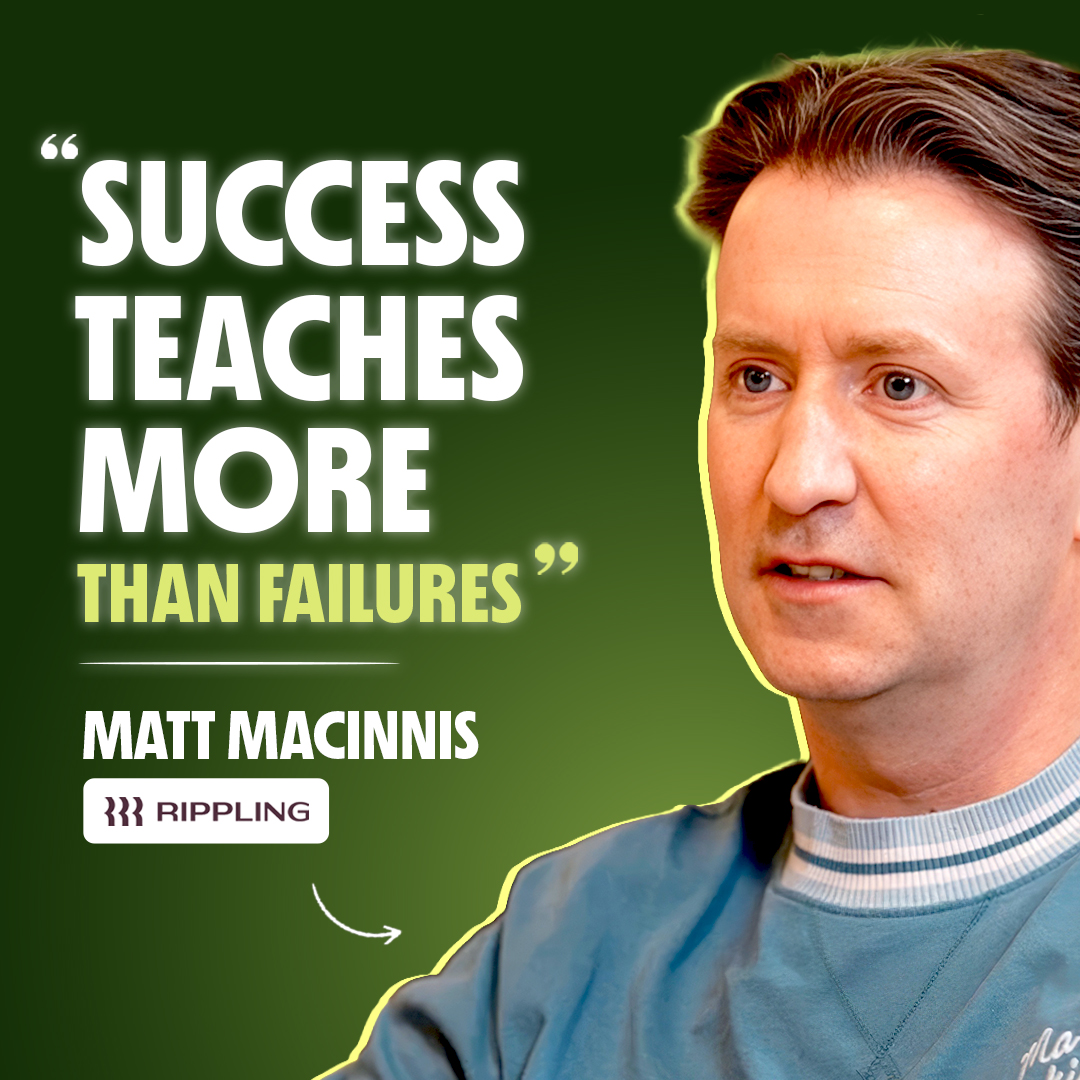
It’s a better place to learn and grow to be in a business that’s working versus one that’s not. And I’ve said this in public before. It’s like you learn from your mistakes, sure, but you learn way more from your successes.
You learn way more from success than you do from failure because success teaches you the things that do work as opposed to eliminating one of the 10,000 things on the list that don’t work. Okay, that doesn’t work. That didn’t work, and this didn’t work.
Okay, cool, that leaves me with 997 other things to try. It’s like if you as a prospective engineer, salesperson, marketer, whatever it is that you’re doing in your career have the opportunity to be a part of a winning team, go contribute to the winning team. You’ll learn a ton about yourself and be in an environment where you can probably more authentically express your strengths because the system wants them from you.
Nansi Mishra 34:52
Would you agree with me when I say that if the company fails, you learn about yourself and if the company succeeds, you learn about almost everything else, market, people, business, yourself?
Matt MacInnis 35:05
Yeah, I agree that you learn a lot more about the nature of things when the business is succeeding than you learn about the nature of things when you fail. I mean, yeah, failure just teaches you different things and they tend not to be necessarily the things that lead you to wild success. They might lead you to humility and comfort in life, which is great, and self-forgiveness and all kinds of stuff, yeah.
I mean, life is beautiful. Life is a journey. Life is unpredictable, and it’s easy to say from my perch but the sort of graceful acceptance of the outcomes that befall you as you make your way through it, that is one of the most important skills to acquire.
Nansi Mishra 35:53
Matt, you joined Ripling in 2019 when they had 50 or 70 people, right?
Matt MacInnis 35:59
Yeah.
Nansi Mishra 36:00
So how did you track the company back then? What processes did you track to understand the company and how did it change when they had then 100 people, then 500, and now 1,000?
Matt MacInnis 36:14
It’s a continuous gradient and I have done a poor job of snapshotting my impression of things over time. As I say this out loud, I’m like, man, I should, I’ll be on a podcast two years from now where they ask me what it was like way back in 2026 when you were pre-IPO and maybe I should write it down. The company was obviously wildly different when we were 50 people in many respects.
I mean, it’s not different in terms of tenor or tone or how we operate, but I do think that when you think about process development or having an operating system as a leader, as a founder, the trick is to do the minimum amount of process you can get away with, which is almost always more than zero but almost always less than a whole lot. And I think of processes as really important ingredients to reducing the volatility of your company, but the most straightforward way to approach this, particularly early in the company, is to just use checklists. I used very simple checklists, and I just used Notion.
I would just open up Notion. I’d have a page where I had a set of things that I wanted to scan every week. Are we okay on this front?
Where are we on hiring for design, hiring for product management? Keeping a checklist and then just having this sort of pseudo-discipline to review that checklist a few times a week to center myself. Always writing down my top three priorities and just always referencing that list.
I’m like a bit adult ADHD. Like I think-
Nansi Mishra 38:06
Like how often do you do it? Once a week, every day?
Matt MacInnis 38:09
Do what, like look at the list?
Nansi Mishra 38:11
Checking, yes.
Matt MacInnis 38:12
Multiple times a day for me, just to keep myself on track. It’s like every time I sit down, okay, so you’re in a meeting. You’re in an interview, you’re in an interview, you’re in an interview, you’re in a meeting.
It’s like, okay, there goes my morning, fuck. I’ve got like 90 minutes unscheduled. I’ve gotta like wolf down a salad, and then I’ve got two more candidates.
I’ve got an interview, and then I’m gonna go sit down with the heads, whatever, right? Those 90 minutes that you have that are unscheduled, they’re so precious. What are you gonna do with them?
One option is to sit there and think about what you’re going to do with them, which is meta work, work about work. It accomplishes nothing. It burns the minutes.
Wouldn’t it be easier if you just continuously kept your top three priorities written down on a Post-it note or a Notion note or whatever, such that when those 90 precious minutes arrive, you sit down, you open that up, you look at it, and right at the top, number one is source candidates for sales. Or right at the top, it says establish the first income statement for the company. Or right at the top, it’s like get the pitch deck turned over for the, whatever it is.
And you sit down on the 90 minutes, and you sit down and you look at that, and you’re like, I wrote that down for myself last night before bedtime. I know exactly what I have to do on this. And you just start cranking on it.
It’s so clarifying. And what I do with that list, that priority list, is I put it into every one-on-one doc I have with everybody I work with, so that when we sit down, they look at my priority list, and we can say, you know, nothing you’re doing overlaps with any of my priorities at the moment, so unless there’s something urgent I can help you with, I gotta jump. We don’t really need this time together today.
Or you look at that list, and you decide that you’re gonna spend your time together with that person entirely on priority number one. That’s a very productive use of your time. But creating alignment by sharing your priority list with people, and then revisiting it regularly when you have that magical 90 minutes of unscheduled time, it can be used in a lot of different ways if you just have a little system like that.
And the point here is like, my experience of this doesn’t really differ from when we were 40 people versus now being 5,000, is that these very simple, lightweight checklists that guide your behavior and provide scaffolding for your operating system can be really powerful ingredients to being effective.
Nansi Mishra 40:36
But when do you know, like, when to add the process and when to remove? Like, I feel adding is still easier than deleting.
Matt MacInnis 40:45
I think the question is, are you aware of when you’re doing real work and when you’re doing meta work? Like, being aware of when you’re doing work about work. And that’s like, if you’re a software engineer creating the ticket about the problem you discovered in the product instead of actually doing it, writing the code, solving the problem, removing the banner, whatever it is that you have to do in the product.
As a salesperson, is it about organizing the list of prospects you’re gonna reach out to? Or is it about the hard, grueling work of sitting there actually sending the messages or placing the phone calls to the prospects? There’s so many examples that you can come up with because we all have to do a degree of meta work in preparation for actual work.
But every time, every time you find yourself doing meta work, you should have a micro panic attack because you are burning precious time on something that yields no benefit to your business. It’s a necessary evil, but it should be minimized. And so you asked about, like, when is it too much process?
To me, the minute you find yourself following processes to do meta work, you have crossed a very dangerous line because now your process is meta, meta work.
Nansi Mishra 42:02
And since you have mentioned about AI, like what is Drippin’s take on AI? How it is reshuffling or, you know, remodeling itself?
Matt MacInnis 42:14
I think there’s like two schools of thought on how AI is going to impact the software industry. And I think both narratives are going to play out in different parts of the software landscape. One, so my sort of sensei on AI stuff is Andrej Karpathy.
He’s the guy who ran the AI team at Tesla for a long time. And if your listeners have never heard him talk or sort of dug into some of this, even just his tweets, like he’s like, he’s just awesome. And also in real life, he’s like a very down-to-earth guy.
But he sort of thinks about the landscape of software as like software 1.0 is like the straight up deterministic C++, you know, world of if-then statements. Software 2.0 is ML and, you know, pattern matching, but not LLM based. It’s just sort of like, you know, facial recognition technology, for example, is a good example of ML.
And so he calls that software 2.0. And then software 3.0 is this whole new landscape of LLMs and quote unquote, non-deterministic software. The term non-deterministic is really just all about the resolution at which you zoom into something. I mean, at the end of the day, it’s all just software, but so he breaks the world out that way.
And I think, so in this two schools of thought thing, one school of thought looks at the world bottom up from one to two to three and says, okay, we’re gonna have deterministic systems, databases, we’re gonna have layers on top of that, that may or may not use the ML stuff, but certainly the LLM stuff to either use deterministic tools or to use ML to look at broad sets of data. And then reason about that at the LLM altitude, but the LLM is fundamentally using deterministic software to produce some output for a human being. That’s one school of thought.
The other school of thought is sort of, I think represented by OpenAI and some of their software ambitions where no, we don’t need the deterministic stuff first, then the ML stuff, then the LLM stuff, really we can just tell the LLM what we want and let it self organize under the hood. It can on its own go and build deterministic stuff as needed, but the humans don’t really have to be able to inspect or interact with those components. That is another possible future for software in the era of LLMs. You said AI, I’m saying LLMs just to be a little more precise about what I mean. I don’t have religion about which of these two models plays out over time, maybe taken to its limit. All of it ends up in bucket number two and we are all living in the age of WALL-E from Disney and floating around on things and robots are bringing us lunch. I don’t actually know if I want that world, but okay.
We, Rippling, are squarely in camp number one. We have one of the most powerful underlying data systems on the planet right now. People think about us as being HCM, payroll, these sort of core HR capabilities, and then we have our spend suite, corporate cards, expenses, all that kind of stuff.
We have our IT stuff for device management and identity and access management. These are all really successful businesses for us, but these are all core nuclear services that are downright deterministic in the most deterministic sense. It’s like, what is payroll?
You dump a billion dollars in the top of a giant coin sorter and it spits money out to governments and to insurance companies and to pensions and then ultimately some of it’s left over for the employee to get in their net paycheck. It’s gotta be correct down to the penny. So you think about our system, it’s like its strength is that it organizes business data from a ton of different sources.
It keeps that data consistent and then it does all of these extremely high impact sensitive things like enrolling you in insurance or sending you a paycheck. So, okay, so you have all that stuff. Now you build a bunch of stuff on top of it and the AI can do amazing things to orchestrate those services.
And I think in the next five years, a lot of the value of AI is going to be most apparent and captured by the businesses that have the underlying data and tooling to do quote unquote deterministic things or perform tasks in the software world. You’re just gonna be able to orchestrate way, way, way more of it from an AI interface such that the human beings who are interacting with those systems are 10 times as powerful or as useful as they have been when instead of sitting there and doing all the manual grunt work that I can, I don’t wanna like, I’m zero interested in turning this podcast episode into like an ad for Rippling. You can ask me questions about how we think that’s gonna work out and I’m happy to share them if it’s interesting to your listeners.
Startups, startups don’t have, like early stage founders don’t have data. They don’t have tools that perform valuable tasks in the universe the way that Rippling does. So they almost have to live in domain too.
If you’re gonna start an AI company, well, I guess you’re gonna have to rely on that AI to build things from the top down. Otherwise you’re starting a traditional SaaS software business as your first move, which I would say at this stage is probably not the best move. I am skeptical as to the survivor, the survival rate of many of the AI companies that I see starting today because they’re gonna perpetually drink their data through a straw from other systems and those other systems are never, ever, ever gonna let other companies build big businesses on their shoulders if they themselves cannot profit from it.
And that profit that must be paid to the underlying systems is a massive tax that most startups cannot survive. Just in terms of like gross margins, it’s just so, so painful. I learned this lesson the hard way at Inkling where we sold textbooks.
It’s like, we got to keep 30% of the margin on the sale of a digital textbook. I can’t build a business with 30% gross margins. It just doesn’t make any sense not in the software world.
So the AI thing is gonna play out obviously, which is not new information for anybody. But I think these two domains of like the top down world versus the bottom up world, the near term profit is gonna mostly in order to the companies that already have the data and the infrastructure to perform services that the AI can orchestrate. That’s our goal and that’s like what we’re doing as a company and it’s why Rippling, you can call us a not AI company or a pre AI company, but in a few years, it’s gonna be pretty obvious that that was a silly distinction to draw.
And I know that’s the opinion of Marc Benioff at Salesforce. I know that’s the opinion of all of the executives at other much later stage, more successful businesses than Rippling as to how this stuff’s gonna play out. It’s gonna be super chaotic.
Nansi Mishra 48:55
But it’s going to play out really well for Rippling because it is not dependent on any third party data.
Matt MacInnis 49:02
We have gotten lucky by virtue of this compound startup model that we’ve pursued where we integrate IT, spend, HRAS, pay all of the core sort of GNA functions of a company into a single system and then put a really rich semantic layer on top of a very consistent data structure where all of these systems can all see each other’s data simultaneously and the permissions model is global across all of the applications. We are in a very unique position to succeed in the AI era. And there was a period there where I thought, oh man, I was worried.
Nansi Mishra 49:43
The timing was so right.
Matt MacInnis 49:44
Timing was freaking great for us. Yeah, it’s turned out to be very lucky. And again, it’s like we didn’t-
Nansi Mishra 49:53
What are the other companies that you see are going to benefit like Rippling?
Matt MacInnis 49:59
There are really few. There are really few. I mean, like there’s a bunch of older, boringer companies that will probably end up doing some interesting stuff in AI.
Like Salesforce is a big, boring, older company. They’re not that old, but they’re older. There are not very many younger than Rippling because we’ve been going full blast at this stuff.
You know, death march to holler back to your earlier language choice. We’ve been going hard at this for seven years, eight years. I don’t think anybody could build what we have built in eight years in a single year.
In 10 years. I do think that as a company, we’re sort of unique in our fierceness and how fast we move and how aggressively we’re able to capture new territory. I don’t think there’s any other company that could do what we have done.
And I can tell you that there is no other company behind us, coming from behind. So, I mean, it’s weird, but we have just done a good job of pulling up the drawbridge as sort of the last company to be able to build the SaaS foundations that we built as a platform for what AI is affording us. We’re nimble and young from a technology standpoint in a way that like Salesforce, Workday, ServiceNow, these sorts of companies are not.
But we are advanced enough that somebody trying to start from scratch now or five years ago would never catch up. So it’s a-
Nansi Mishra 51:41
So a new company starting in Rippling’s space, solving exactly the same problem.
Matt MacInnis 51:47
Toast. No chance.
Nansi Mishra 51:50
Because it doesn’t have data?
Matt MacInnis 51:52
Because it doesn’t have e-money licenses in the UK. Because it doesn’t have PEO licensure in the 18 states in the US or whatever the number is that require it. Because it doesn’t have the regulatory arbitrage that we have because you can’t rush regulators to get your licenses and all of the things you need to build the kinds of businesses that we’re in.
It doesn’t have the brand momentum. You can’t build a brand with people faster than those brains want to absorb them. You can build software.
But like payroll, you want to deal with garnishments. You want to deal with hourly-waged employees. You want to deal with the complexity of accounting integrations.
I sat through a business review today on accounting integrations. It’s fascinating stuff. It’s like, how do you integrate Rippling to Oracle ERP or to NetSuite?
You don’t build that overnight. You build that over the course of many, many, many, many quarters of continuous engineering effort to iron out all the wrinkles and all of the edge cases and all of the idiosyncrasies. AI is not going to help you accelerate that, at least not by very much.
You just got to do the hard work to build those systems. It’s layer upon layer upon layer upon layer of compounding advantage that you have when you build these systems from the bottom up. And so somebody coming in sideways and saying they’re going to short-circuit any one part of this is delusional.
There’s just no way you’re going to do it. People told us, by the way, we were delusional. We were never going to do it.
It’s just that we stuck with it for eight or nine years. I don’t remember the number now. What year is it?
2026?
Nansi Mishra 53:17
The year we started?
Matt MacInnis 53:18
Yeah, no, the year we’re in right now is 2026. So Rippling itself is coming up on like eight years of just doing this at warp speed. So you can carve off little bits and pieces of our business at the low end.
I think it’s going to be very hard to aggregate it into something big.
Nansi Mishra 53:36
In a short enough period of time.
Matt MacInnis 53:38
Yeah, in a short enough period of time to take advantage of AI, because like AI, we’re off to the races. It’s another area of intense, intense innovation and metabolism. I would not want to be my competitor on this one.
Nansi Mishra 53:53
I don’t see this coming, but just asking out of curiosity, if you have to start a startup in the zero to one journey, how would you do things differently using AI to move faster?
Matt MacInnis 54:05
The most important thing that I sort of would love to do from scratch is to build the tooling and the infrastructure knowing that AI is going to be the primary interface to the product over time. Like the first interface to computers were punch cards and you weren’t allowed anywhere near the computer. And then what became exciting in the 1970s and early 80s was command line interfaces where you could hook a computer up to a monitor, like a television.
And when you pressed a button on the keyboard, the characters appeared in real time on the TV in front of you. This was like mind blowing. And then you walk like 1970s, you walk into a radio shack and you see a Tandy or TRS-80 computer and it would do that, it was amazing.
So please, command line interfaces became this like real time innovation where you could interact with a computer and see a result right away. We then emerged obviously through like MS-DOS into Windows and Windows and the Macintosh interface, sorry, introduced the graphical user interface which then became an ever evolving standard from the mid 1980s until the 2020s. It was the way you interacted with, we get windowing and we get all kinds of innovations around GUIs, but GUIs became the standard.
And we are just now in like the mid 2020s evolving beyond the GUI to a new human computer interface paradigm which is the LLM. And it’s back to text but it’s nothing like a command line interface. It’s, you can talk to it, you can type to it like you’re talking to it and it’ll interpret what you’re saying and try to determine the best course of action.
And this is like, it’s really quite something when you zoom out and think like, man, we haven’t touched the paradigm for human computer interaction since the 1980s. This is a big moment. And so I don’t think we have a really great understanding of how that software design, how software design is gonna change in response to this.
It’s still so early in the game but starting a company today, this very simple statement, which is like I would question whether I should build a graphical user interface to my product at all or whether the primary interface should really be via AI and via the LLM is if you scrub the concept of a GUI or you subordinate the GUI to the LLM and only have graphical components inside the LLM interface, you will end up building very different systems. And I think that’s just like a super interesting like bit that you flip early in the development of a product and it can yield radically different outcomes down the road.
I just can’t predict which ones because if I could, I’d be rich.
Nansi Mishra 56:56
So Matt, I just wanna ask how is a PM’s role is changing with AI? Is this role becoming more important or it’s losing it?
Matt MacInnis 57:07
Oh my God, there was this hilarious video I saw today on Twitter of like this guy wandering aimlessly through a beach looking like he was deeply disturbed. And the caption was every engineer realizing that they have to become a product manager because it was like this guy was like just really deeply upset because like being an engineer is no longer about writing code. Like being an engineer is about driving cursor and steering the LLM toward problems and helping it understand things but it’s not about actually solving a lot of the sort of technical challenges.
The PM design and engineering jobs in their most coarse grained forms, not in their like really fine detailed forms but in their coarse grained forms as roles are all converging. It’s super interesting because I mean look, I myself yesterday was, I was sitting at my desk here in Bangalore and I was looking at a part of our product that I use regularly and I saw this nasty banner come up with this like text that I didn’t like and I clicked the call to action and that banner and it took me into a screen that I thought was really janky. And I just thought, okay, I’m the head of product.
I’m looking at this. I don’t think this is a necessary at all. Any of this is really necessary in our product unless it was built to a much better standard.
And so I went to cursor and I was like, hey cursor, here’s this screenshot. I just pasted in the screenshot. I said this banner is orange, it’s ugly.
How many, under what conditions is this displayed? And the screen that I get when I click the button in the banner, like are there any other code paths that would lead a user to this ugly ass screen? And I generally just for my own amusement use words like ugly ass and stuff in the interface with cursor because it handles it very gracefully.
So it looks at the screenshot and it sees the banner and it OCRs the text and it greps the code base for that string. It finds that part of the code. It searches for references to the screen that you get when you follow that link.
It finds no other references anywhere in the Rippling code base to that and concludes that the only path to seeing that screen is by clicking this one button. And I said, okay, just make that banner never show up and while you’re at it, make sure that the absence of the banner doesn’t mess up the rendering of this page. So it took about a minute or two.
It comes back and it says, here’s what I’m gonna do. Do you think this is a good idea? I was like, it seems like a reasonable approach.
I told it build a pull request and stick it into GitHub and I’ll have an engineer review it. I literally turned my chair 180 to an engineer that was sitting behind me. I said, hey, have a look at this.
He looks at the pull request. He’s like, yeah, it seems pretty reasonable. He commits it, boom, we’re done.
That banner is gone from the product. It’ll never show up for a user. I sent a link to the pull request to the product team that built that part of the product.
I said, hey guys, this thing was janky. I didn’t like it. I pulled it out of the product.
It’s gone, it’s dead. Build this again if you really think this is an important part of how the product should behave, you asked me about PMs. That was me, PMing. I made a decision about the product. I decided that I would personally make this change.
The only thing an engineer had to do was review my commit. And this is like nothing rocket science-y about this. Everybody who’s been close to AI knows that this is sort of the new thing, is that people can just go in and navigate.
You have to understand, when you mirror the Rippling code base to your laptop to work on it, it’s 10 gigs of source code. 10 gigs of source code built by thousands and thousands of engineers over the course of almost a decade. And I was able to navigate that code base and make that change in literally like three minutes.
That is insane. That is such a massive productivity boost. Product managers are gonna continue to need to exhibit good judgment about what a product should do, how to grow it, how to make it a better tool for the people or, I guess, the agents that use that product.
But they now also have to reach down and be the engineer and be the designer more often. The engineers have to reach up and be product managers more. It’s gonna create conflict and confusion about the boundaries of the job responsibilities, right, among all of these people.
But whatever, let’s just jump in with both feet and navigate this as we go. Every company’s gonna come to slightly different conclusions about it. But I think more people are gonna be product managers in businesses because they’re gonna be empowered to interact with the system productively and express opinions that can be translated into code.
Nansi Mishra 1:01:41
And how’s your equation with Parker?
Matt MacInnis 1:01:43
How’s my equation? My equation? Like our relationship or our operating model?
Yeah, I mean, you know what I said earlier about founders who can grunt at each other? Parker and I can grunt at each other. There’s a level of shared understanding and trust that allows us to communicate with very few words, to be really tough on each other directly when we need to, and then find ourselves drinking beers with our families together on Saturday night and be perfectly happy with the week.
And I think that’s a really important ingredient. Like at the end of the day, man, what is work about? We’re all gonna go to the grave.
We’re not gonna take any of this with us. It doesn’t matter. And so if you’re not having fun at work, if you’re not finding fulfillment, if you’re not enjoying the company of the people that you’re spending time with, what the hell are you doing?
Nansi Mishra 1:02:33
And it’s humanly not possible to give in that much effort if you’re not enjoying it.
Matt MacInnis 1:02:39
You can’t put the, it becomes a burden.
Nansi Mishra 1:02:40
If it’s a burden, you can’t carry it for so long.
Matt MacInnis 1:02:42
Absolutely, and it doesn’t always have to be fun, but I do think it always has to be fulfilling at the end of the week.
Nansi Mishra 1:02:48
There should be some satisfaction.
Matt MacInnis 1:02:49
For sure, yep. I sort of think of it as whittling your stick on the way to the grave, not to be too morose or dark about it, but it’s like you’re just whittling a stick. You’re just, the stick is eventually just gonna go into the compost bin, but you have to choose which stick you whittle and have it be the stick you care about and the stick that’s fun.
And so for me, being in Silicon Valley in the middle of what is effectively Florence during the Renaissance, where we are creating some of the craziest things that human beings have ever, ever created to be alive at this time, to be a part of that creative explosion is such a wild privilege and so weird. Like of all of the places and times you might have been born as a human being, to be in this one right now is incredibly special. And I think whether you’re in India participating in that creative explosion or whether you’re in San Francisco is not nearly as important as whether you throw yourself in and participate and you will have the satisfaction through life of having been a part of what is one of the craziest moments in human creative history.
Nansi Mishra 1:04:00
Beautiful.
Matt MacInnis 1:04:02
If you say so.
Nansi Mishra 1:04:05
So Matt, I think I’m done with all the questions that I had for this conversation. And I really thank you for all the patience that you showed.
Matt MacInnis 1:04:13
Sure, of course.
Nansi Mishra 1:04:15
Just one special section that’s left for this conversation is rapid fire.
Matt MacInnis 1:04:21
Rapid fire.
Nansi Mishra 1:04:21
Rapid fire.
Matt MacInnis 1:04:22
Let’s do it. They say that building a business, you should fire rapidly.
Nansi Mishra 1:04:27
So I’ll just say a question and then you have to answer as quickly as possible.
Matt MacInnis 1:04:31
Okay, I’ll try my best.
Nansi Mishra 1:04:33
So founder instinct or data, which do you trust more?
Matt MacInnis 1:04:37
Instinct, instinct, instinct, yeah, for sure. Easy answer.
Nansi Mishra 1:04:40
I guessed data for you.
Matt MacInnis 1:04:42
Really?
Nansi Mishra 1:04:42
Yeah.
Matt MacInnis 1:04:43
Data to me is-
Nansi Mishra 1:04:45
You have a very interesting personality, Matt. Really like you obsess over processes, but you’re also, you know, very over aggressive, cares deeply about all the small or big details.
Matt MacInnis 1:05:02
Yeah.
Nansi Mishra 1:05:03
It’s contradictory.
Matt MacInnis 1:05:04
Annoying, yeah.
You got it. The instinct versus data thing to me is like data informs where you ought to focus your attention. Like data that, if the data and the anecdotes disagree, the likelihood that the anecdotes are right is very, very high.
And so for a founder in particular, when you think about instincts versus data, at the end of the day, instincts are a much truer representation of who you are and all of the wisdom and knowledge you’ve acquired as a human being to that point in your life. It’s like data can subject to go left or right and right or wrong all over the place, but your instincts are the thing that you’re testing when you run the experiment of starting a company. And so it’s instincts all the way.
And then you might lose. It might not work out, but at least you’ve tested the right thing.
Nansi Mishra 1:05:59
And one thing founders consistently over optimize.
Matt MacInnis 1:06:04
Employee comfort. I think founders are, particularly younger founders who haven’t been through the grinder yet, tend to fear the loss of an employee. They tend to fear burning people out.
They tend to fear giving their A player too much work to do because they might lose their A player. And the problem is when you ask anybody who’s good, would you have me make it easier for you? Or would you have me give you more work to do so that it’s uncomfortable?
The highest performers, 100% of the time say, I would have you give me more work. I would have you load me up. I would have you push me to my limits.
That’s why I’m here. I’m like achieving and I feel good about it. And so I find founders tend to worry too much about the comfort of their employees for fear of losing them, as opposed to making their team members deeply uncomfortable with the burden that they’ve been given, which will maximize achievement and paradoxically maximize employee satisfaction and happiness, at least among the people you want to keep.
That wasn’t a short answer for you, but it was a rapid fire, it was a rapid response.
Nansi Mishra 1:07:16
I didn’t guess this answer. One thing they always under optimize.
Matt MacInnis 1:07:21
Under optimize, speed. I just don’t think we talk enough about the competitive advantage that’s created by raw speed. And maybe velocity is the better word here, but I think any startup is in a game of iterating toward the bigger outcome and you only learn by doing.
You don’t learn by thinking about doing. And so the name of the game is to do as fast as possible, even if it’s chaotic, even if you’re on the 17th iteration, you still have to approach the 18th as though it were your first. So I think founders tend to under optimize speed and it’s related to my earlier answer, which is like that because they’re worried that speed will look chaotic or will burn people out or make people uncomfortable.
But unfortunately, starting a startup, if it’s comfortable, it is dead.
Nansi Mishra 1:08:21
Quite deep. What are the things only the CEO should do forever? Like in Rippling’s case, Parker.
Matt MacInnis 1:08:28
Parker runs payroll for all 5,500. People don’t even believe us on this. They’re like, there’s no way that Parker personally runs payroll for 5,500 people.
The answer is you’re wrong. He really does. It’s super annoying.
It has its downsides. Your question was, what is one thing the CEO alone should do forever? The answer to that question is that the CEO alone should do something in the product.
Whatever that is for your business. At Rippling, the answer is the CEO alone should run payroll forever until the auditors, when they go public, tell him we can’t go public unless you change that. We talked about Airbnb later.
Brian Chesky alone sort of uses parts of the product, goes super deep on, he doesn’t, the story is he doesn’t have his own home. He only lives in Airbnbs.
Nansi Mishra 1:09:27
Is it true?
Matt MacInnis 1:09:28
I think it’s probably roughly true in the same way that it’s roughly true that Parker alone runs payroll. It’s so crazy that it doesn’t sound like it would be real, but it is. It is real.
The CEO alone should be some fanatical maniac about some part of the product that they just refuse to ever, ever, ever let go of. That makes total sense to me. Every business, every founder, should have that thing the CEO does that everyone else thinks is wild and crazy that that person does all the way to the finish line.
There’s a rationale to this, which is if you think about a company as a very complex, poly-dimensional mesh of nodes that are all connected to one another in some weird way, the CEO wants to get some vector through that crazy, unknowable mesh of different nodes and by reaching all the way to the bottom, in the case of Rippling, by running payroll for every employee every week all the way through, Parker just gets one vector and he yanks on some nodes that he doesn’t like and it has a ripple effect across the rest of the system in unknowable ways. And I think that’s the same thing with Brian Chesky, seeing all the way down to the very bottom of the Airbnb lived experience of customers gives him insight to the system in ways that one really can’t predict.
Founders should be maniacal about some arbitrary thing in the product and never, ever let go of it because it gives them a perspective on the system that they’ll lose the day they give it up.
Nansi Mishra 1:10:58
Beautiful obsession.
Matt MacInnis 1:11:01
Yes. I mean, if you’re not obsessive as a founder, you’re probably in the wrong job.
Nansi Mishra 1:11:08
The next one is, what’s one popular startup lesson that you actively distrust? VC bullshit, that’s what you call this.
Matt MacInnis 1:11:17
There’s a lot of examples of VC. I mean, my answer to this one is probably, I think the one that I think is most pernicious to human happiness is the one where they tell you to never give up. I think this one is pernicious because it is born of an incentive structure that was not created by any diabolical individual.
It’s not like this incentive structure was created by an evil committee of venture capitalists. That committee doesn’t exist. But if you look at how venture capital has played out over the course of the 1980s, 90s, 2000s, 2010s, and now 2020s, it’s very consistent that you put money into a business, you can’t get your money back.
It’s gone. That bet is placed. Now the wheel is spinning.
You don’t know where the number’s gonna come up. If you don’t like when the wheel starts to spin that, slow down, that it’s gonna point at a number that doesn’t earn you any returns. But you have the option to tell the dealer, fuck, spin the wheel some more.
Keep spinning the wheel. Keep doing it until I feel like it’s gonna stop on something that pays. Well, then as a venture capitalist, you’re gonna tell the dealer, whatever you call the person who spins the wheel in roulette, keep fucking spinning it.
And so you have a founder who takes your money. You can’t ever get your money back. And you want that founder to keep spinning the wheel until it looks like it’s gonna stop on a number you like.
But the problem is that life is short. Founders are only in their 20s for a total of eight years, because you can’t do it before 22, right? And they’re burning this precious time on something where the high order bits are all set wrong, where the marble is on a table with no holes in sight, where all the analogies I’ve used in this conversation are not stacked up to produce an outcome that’s gonna be exciting for anybody.
Why should the founder keep a bad cap table? Why should the founder keep toiling away at the ever-decreasing odds that something interesting is gonna happen here? The answer is because there’s a person they perceive to be their boss over their shoulder telling them that they need to keep trying, that there is a narrative in Silicon Valley that the glory comes to those who persist.
And all of the exceptions to the failure rule, like the ones that pivoted seven times and found success, are put up on billboards as examples of why you should keep trying. But if you look at the statistics, those outlier cases are all the more reason for you to quit, because you’re just not likely to find that outcome. It’s not the path that most companies take to success.
I think that that try-until-you-fail dynamic, again, born of the incentive structure that is set up for venture capitalists in Silicon Valley, has robbed a lot of people of a lot of very valuable working years and startup years where they might have been off with a clean cap table chasing something else.
Nansi Mishra 1:14:23
Dying is considered a better option than stopping when you felt that things were not working out.
Matt MacInnis 1:14:30
It’s like most companies, most companies, again, set aside the outliers, most companies that find wild success find it pretty soon, find it pretty early. They find it because they were in a good market. They find it because the founder had an earned secret that they could use to build a company that no one else could build.
If you start building and you’re two years in and you haven’t found traction, your odds are rapidly decaying. And you said die. I mean, sure, die the company.
But I think about it differently. It’s reset the cap table. Like just zero out the cap table and get a fresh start, retain your ownership, shed the baggage, and take another swing knowing what you now know.
I mean, it’s a pretty powerful move in favor of the founder. It’s not great for the early investors, but like, man, you’re seed investors. I’ve invested in like 65 companies under the assumption that every single one of them goes to zero.
Nansi Mishra 1:15:38
I really hate this advice. Have you got this advice in your first startup?
Matt MacInnis 1:15:43
To quit?
Nansi Mishra 1:15:44
To not quit.
Matt MacInnis 1:15:45
Oh, all day. You gotta keep going. Oh, 100%.
Yeah, that is definitely a product of my lived experience. No like negative vibes for the people who gave me that advice. I think they thought they were encouraging me.
But you live and you learn. Unfortunately, as you live, you get older and there are fewer opportunities to apply what you’ve learned.
Nansi Mishra 1:16:17
But I think for any VC, when they invest in any startup, any founder, it’s a long relationship, right? And in that process, you start liking that person and you start wishing really well for that person. And so for now, I’m not able to imagine that situation.
Matt MacInnis 1:16:38
Where you would tell someone keep going despite it not working out.
Nansi Mishra 1:16:41
Yeah, because it’s not just the outcome that you see. Maybe we’re still very early from a fund perspective. We’re still very young.
Matt MacInnis 1:16:50
I think it’s really important as both an investor and as a founder to have an open conversation about the incentive structures at play in any given relationship. For a seed investor who’s had a bunch of success, the incentive structure is actually pretty good in the sense that the founder and the investor can be mostly aligned most of the time. And I don’t know any really successful seed investors who worry about any of their investments going to zero.
It’s part of the equation and it’s the expected outcome. But when you start dealing with investors who are earlier in their careers, so a young whippersnapper joins a venture capital. I just use the term whippersnapper, which makes me feel old.
Like joins a venture capital firm and you’re their first bet or their second bet. Man, they got some personal baggage there because that investor really wants their first few bets to work out. They don’t wanna look dumb to the partnership that took a bet on them as a young partner in the firm.
And so saying that out loud to the investing partner as the entrepreneur is like, hey, I recognize that there’s probably higher stakes for you personally in the success of my business is a really healthy trust building exercise that I don’t think happens frequently enough. And then the other category is like when you start doing business with investors who are not in the go big or go home category, like home offices and like tier three funds that are there to generate their 1.5X and earn their fees. Like they become risk averse or loss averse.
And I just don’t, especially as an early stage company, don’t do business, don’t take money from funds that are in any way loss averse because that’s where they get into this sort of pernicious misalignment of incentives, you know, encouraging you to keep going because they don’t wanna mark you down in their portfolio. They might not be able to raise the next one. Their billionaire sole LP in their family fund might get pissed at you for your stupid investment that didn’t work out.
You know, these are the dynamics that are happening in the background that lead to these weird interfaces between the investors and the founder. I think they’re avoidable if you can have explicit conversations, open, transparent, incentive-focused conversations at the beginning of the relationship. Also born of a bunch of shitty interactions with.
Nansi Mishra 1:19:24
Sure, I think all the founders, before raising money from any investors, at least now, they talk to their founders. They don’t talk to investors. They talk to founders of that investors.
Like how’s the experience? And like founders are very smart.
Matt MacInnis 1:19:39
Yeah, there’s a lot.
Nansi Mishra 1:19:40
Because it’s a very long-term relationship and you have to choose the right type of partners for this partnership.
Matt MacInnis 1:19:48
Yeah, unlike a marriage, you can’t divorce an investor.
Nansi Mishra 1:19:54
Not like marriage, but it is also a very important relationship and minimum for 10 years, I would say.
Matt MacInnis 1:20:01
Yeah, that’s what you have to look at, right? Eventually the marriage ends. The marriage ends with glorious liquidity.
Nansi Mishra 1:20:09
Cool, I think I really enjoyed this conversation with you, Matt. Thank you so much for your time.
Matt MacInnis 1:20:15
Thank you for having me. Good luck with everything.
Nansi Mishra 1:20:18
Thank you.


Know when new episodes are released. Subscribe to our newsletter!
Explore Playlist

How Repeat Founders Build Startups Faster and Cheaper | 4x Founder Shreesha Ramdas (Lumber)
How One Indian Company Powers the World’s Hotels & Airlines | Bhanu Chopra, RateGain