



351 / December 26, 2025
How Ratan Tata’s Leadership Shaped One of India’s Oldest and Biggest Conglomerates | Harish Bhat
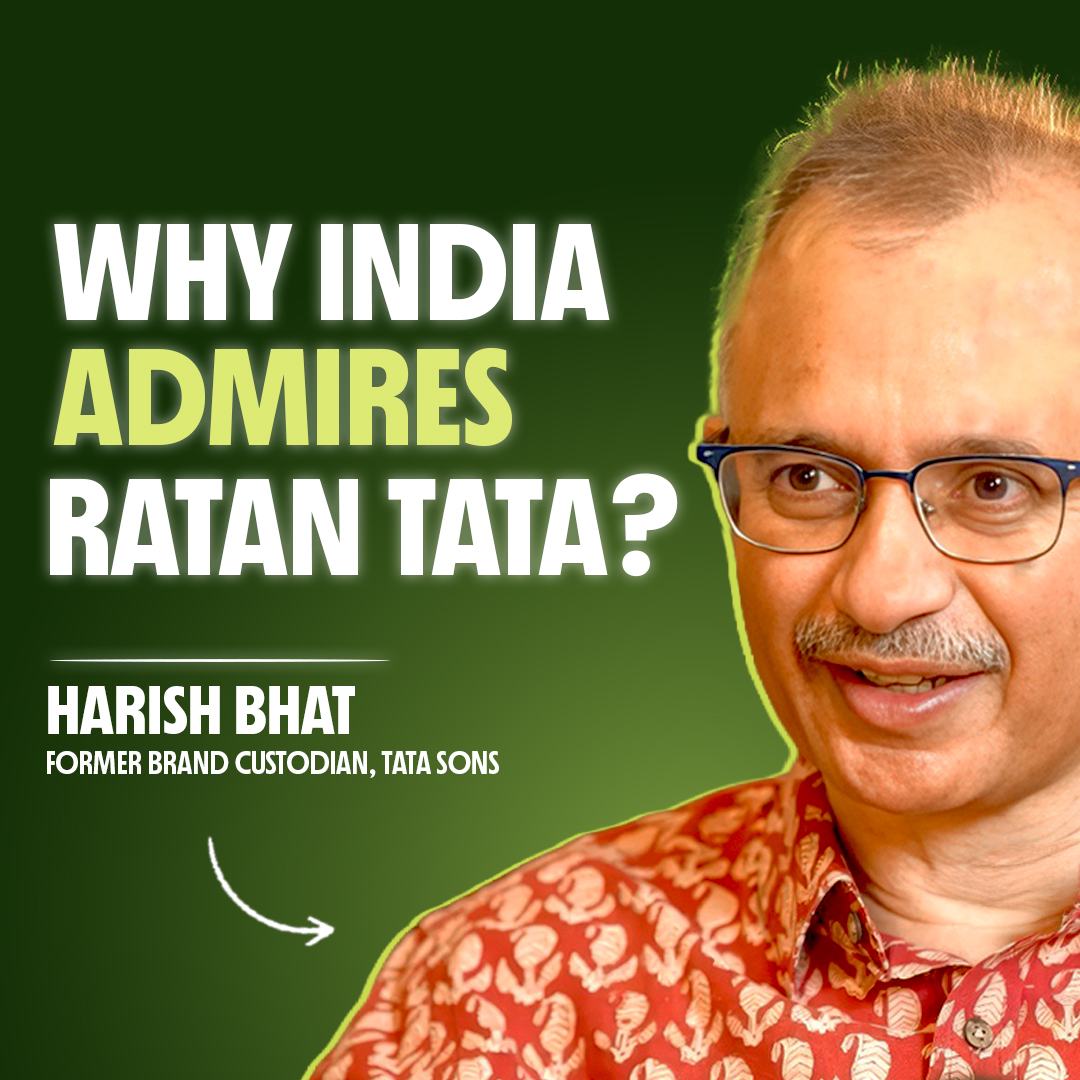
Harish Bhat spent 38 years with the Tata Group, working across businesses that reach millions of Indians every day, including Titan, Tanishq, and Tata Tea.
He joins Neon Show for a 3rd time and reflects on what it meant to build inside a 150+ year-old institution. The conversation begins in 1991, the year Ratan Tata took over as Chairman, a role he would hold for 21 years. Harish explains how Ratan Tata prepared Tata Sons at a time when the Indian economy was opening up and competition was changing rapidly.
We discuss landmark moments in the group’s history, including the Tetley acquisition in 2000, the first time an Indian company acquired a major global consumer brand. Harish shares how this decision transformed not only the Tata Group’s mindset but also the way ambitious Indian businesses think about their potential.
Harish speaks about Ratan Tata not as a distant icon, but as a leader he worked closely with. He shares stories of how decisions were made, how conflicts were handled, and why dignity, compassion, and keeping one’s word were always non-negotiable for Ratan Tata.
The conversation also draws from his book Doing the Right Thing, where he transfers these experiences into practical lessons on leadership shaped over decades.
Get the book: Doing the Right Thing
Watch all other episodes on The Neon Podcast – Neon
Or view it on our YouTube Channel at The Neon Show – YouTube
Nansi Mishra 1:10
Hi Harish, welcome to the Neon Show.
Harish Bhat 1:13
Thank you Nansi, thank you for having me here back again. They say third time is lucky.
Nansi Mishra 1:18
This is your third appearance on the Neon Show.
Harish Bhat 1:20
Absolutely, and I love being on the Neon Show. I think you get terrific viewership, people love all the interviews that you do, and here I am to talk to you this afternoon.
Nansi Mishra 1:32
It feels so great to share that all the last two podcasts that we did with you were watched by 20 million people.
Harish Bhat 1:41
Wow, I don’t believe that number, 20 million people. And that Nansi is I think because of the wonderful, insightful questions that both Sid and you have asked me.
Nansi Mishra 1:51
Thank you. And congratulations on your new book, Doing the Right Thing, and I am told that this book is already a national bestseller. So, maybe you can tell us why you wrote this book, and why are so many people reading this book?
Harish Bhat 2:08
So, you know, it’s interesting, the genesis of this book, Nansi, on the 9th of October last year, which is 2024, Mr Ratan Tata passed away. And I was in Bangalore in my home that night, when I heard the news. I was deeply saddened because he has been a huge influence on me throughout my career with the Tata group.
So, the next morning I took a flight to Bombay to pay my last respects to Ratan Tata. His body was at the NCPA in Mumbai. I went and paid my last respects.
There was a huge queue of people gathered there to pay their last respects to Mr Tata. On the roads, I could see slogans like Ratan Tata Amar Rahe and posters being put up on the roads. I haven’t seen that kind of display of emotion for a very, very long time.
You know, television channels were full of, you know, eulogies for Mr Tata and stories of his life. But more importantly, I found that so many people I spoke to, Nansi, felt a deep sense of personal loss when Ratan Tata passed away. Even people who did not know him, even people who have never interacted with him, said we were personally very impacted by his passing away.
So, I said, what is this happening? Why is it that millions of Indians have been impacted personally by the passing away of a leader, an industrialist like Mr Ratan Tata? Was it only because he was a very successful industrialist under whose chairmanship the Tata group grew from $6 billion in revenue to $100 billion in revenue?
Was it because of his philanthropy, the building of hospitals, or the fight against COVID-19, or all the other philanthropic initiatives that he invested in? Was it because of his personality, his gracefulness, the way he conducted himself? So, that was the starting point.
And as I started studying that subject and speaking to people who have worked very closely with Mr Ratan Tata, I found that one of the threads that ran throughout his life, one of the key drivers that motivated him was his desire to always try to do the right thing. Doing the right thing became a very, very important driver in his life. And he himself has said that.
He has said, you know, if I want to be remembered in a certain way, I would like to be remembered as a person who always tried to do the right thing. So, I said, if this is the case, let me dig a little deeper and find out what does doing the right thing really mean. What are the specific building blocks that go into doing the right thing?
Because if I can construct those building blocks, then there are also very valuable lessons for people like you and me, for everyone watching the show, to take back, to try to do the right thing in our own lives. Because here is a man, Ratan Tata, who was immensely successful in his life. And if he was immensely successful by doing the right thing, and it also enabled him to live a very fulfilling life, a contented life, then there must be something in it that all of us can also take home.
Nansi Mishra 5:55
Yeah. So, let’s just start with Ratan Tata sir’s early life, how he was connected with Tata family and where it all began.
Harish Bhat 6:04
So, Ratan Tata was born to Naval and Sooni Tata on the 28th of December 1937. His father Naval Tata was the adopted son of Sir Ratanji Tata, who himself was the younger son of Jamshedji Tata, the founder of the Tata group. So, in other words, Ratan Tata’s great-grandfather, you know, three generations removed, would have been Jamshedji Tata, the founder of the Tata group.
So, Ratan Tata was born into a family which was full of Tata tradition. We must remember that his grandmother, Lady Navajbai Tata, she would have perhaps interacted with Jamshedji Tata himself at that point in time. From a very young age, Ratan Tata was brought up by his grandmother Lady Navajbai Tata from the time he was 10 or 11 years of age.
He initially studied at the Campion School in Mumbai and thereafter at the Cathedral School in Mumbai. And then to do his college studies, he went to the Cornell University in the United States of America. His father wanted him to pursue engineering, but Ratan Tata was far more interested in architecture.
So, eventually he went ahead to study architecture at Cornell University. From all that I have read and heard, he loved the United States of America. He loved California, I am told, and wanted to settle down there. But in the early 1960s, his grandmother fell unwell.
Nansi Mishra 8:04
Yeah, I was about to ask, why did he come back?
Harish Bhat 8:06
That’s right. He came back to India because his grandmother fell unwell and he felt a need to be with her at that point in time. So, he was called back and he came back to India.
I think it was in 1961 or 1962. And when he came to India, he had a job offer from IBM at that time. But then J. R. D. Tata, who was the chairman of the Tata Group at that time, persuaded Ratan Tata to join the Tata Group.
So, in a summary, that’s how the early years of his life were. Schooling in Mumbai and then college life at Cornell and now back in Bombay where he has joined the Tata Group.
Nansi Mishra 8:47
Yeah. And 1991 was the year when J. R.D. Tata stepped down as chairman and that was the year when Ratan Tata sir joined as the new chairman of Tata Sons. And that was the year when Indian economy was also, you know, got liberalized and was open to the world.
How was that time for him? And because even the most successful businesses and including Tata Sons, it was a time when big shift was taking place. So, how he navigated that time and how he made Tata Sons future ready for the new time?
Harish Bhat 9:24
Very interesting question, Nansi. So, you are quite right. 1991 is when J. R. D. Tata handed over the reins of the Tata Group to Ratan Tata and Ratan Tata became the chairman of the Tata Group.
You are also right, that is the year in which Manmohan Singh as finance minister under the prime ministership of P. V. Narasimha Rao announced his famous budget.
If you remember with Victor Hugo’s words, you cannot stop an idea whose time has come and the Indian economy was suddenly liberalized. This was still the first year of Ratan Tata’s chairmanship but I think Ratan Tata grasped the impact of this budget on the Indian economy. He knew the Indian economy was going to be far more open in the years ahead.
He knew licensing was in its way out. He knew that this would be an era of heightened competition and he knew that many Tata companies would have to up their game to face the competition and become best in class in India and globally. So, a lot of his focus in those early years of his chairmanship was about making the Tata group future ready.
He did many things but I will describe three or four things that he did. I was a young manager in the group at that time. One of the first things that he did Nansi was he wanted the group to be inspired with the spirit of excellence.
So, he established what was called the JRDQV program which later became the Tata Business Excellence Model which required companies of the Tata group to go through what is called a Tata Business Excellence Model assessment where each company of the group is assessed on many parameters. Assessed on parameters of leadership, strategy, customer excellence, data excellence, human resources excellence, on the results that they achieve. There are six process categories and one result category on which every Tata group company is assessed.
Then each company has to work on the areas of improvement and ensure that those areas of improvement are addressed. So, this entire business excellence program that Ratan Tata put in place ensured that each company upped its game on excellence in the years thereafter. It was a very rigorous exercise.
I remember that both in Tata Tea and in Titan, the two companies that I was part of, the business that I was a member of was also subjected to the assessment of TBEM, the Tata Business Excellence Model. And I remember that there were many, many opportunities for improvement that we had to work on to make our businesses ready for the future. The other thing that Ratan Tata did was he established a unified Tata brand.
Until then, the Tata logo was used in different formats by different companies in the group, but he brought in a unified Tata brand. He put in place what is now called the BBP, the Brand Equity and Business Promotion Program. Companies had to sign on to be able to use the Tata brand.
And if they wished to use the Tata brand, they had to commit to the Tata Business Excellence Model and they also had to commit to the Tata Code of Conduct. And that unified brand, which is the way you see the Tata logo even today, established a very, very distinctive presence for Tata in the minds of consumers, in the minds of all stakeholders. He established business review committees.
And I remember as a young manager in Titan attending a couple of those business review committee meetings where you had senior directors from the Tata group looking at the longer-term plans of our companies and giving us their suggestions, giving us their inputs, so that those plans could be fine-tuned. In Tata Tea, I remember in those days, it was the late 1990s, perhaps for the first time, the company developed a five-year business plan as a result of this. And that five-year business plan was then subjected to critique and to suggestions and inputs by the senior directors of the Tata group.
And that again led to companies thinking longer-term, thinking of what processes they need to build, what structures they needed to build. And that resulted once again in companies becoming far more robust. And finally, of course, Ratan Tata also gave us a clarion call on globalization.
And by globalization, I don’t mean just going international. I don’t mean just global acquisitions. But Ratan Tata wanted every Tata company to benchmark itself with the best in the world and learn from the best in the world.
And that once again was a method of making Tata companies future-ready.
Nansi Mishra 14:38
So how and when Tata Sons became a global business?
Harish Bhat 14:42
So, you know, Tatas have always had some global businesses, even during JRD Tata’s time. For instance, TCS was a global business. But during Ratan Tata’s period, I think Tata Sons took some very, very firm steps towards becoming a truly global company in terms of owning global brands, in terms of owning global businesses.
You would have surely read about the acquisitions of Tetley, the acquisitions of JLR, the acquisitions of Corus, the acquisitions of Tata Daewoo in Korea, and many such acquisitions. So acquiring global brands or global businesses was one route to becoming global. But the other route to becoming global was to build companies in India which could compete with the best in the world, which were benchmarking themselves to global businesses.
For instance, you know, at that time, I was part of the Titan business. And I know in Titan, we were already market leaders in India. But we started benchmarking ourselves against Swatch, which is one of the largest global watch companies, and saying, why can’t we reach their levels of profitability?
Why can’t we reach their levels of innovation? Why can’t we reach their levels of branding and marketing excellence? So I think globalization was not just the acquisition of companies or going to more countries.
Of course, it was that. But it was also a global mindset, Nansi, saying that we may be competing in the Indian market or we may be competing in the global market, but we should be best in class with what the best global companies do. That mindset shift, I think, was something that Ratan Tata brought to the Tata Group.
And I’m very, very grateful that he did that because all of our businesses became more efficient, became more outward looking as a result of that shift.
Nansi Mishra 16:44
And Tetley is one of the most successful acquisitions, right? So can you talk about that?
Harish Bhat 16:51
Yeah, so Tetley was a unique acquisition, Nansi. And thank you for…
Nansi Mishra 16:55
Were you part of…
Harish Bhat 16:57
I was part of the due diligence team, which did the due diligence for the Tetley acquisition. You know, Tata Tea in India started as a small plantation company, then launched brands in India, which became very popular brands. Tata Tea, Tata Tea Agni, Chakra Gold Tea, Gemini Tea, Kanan Devan became very, very popular brands in India.
But there was a point in time when the then leadership of Tata Tea, led by Mr. Ratan Tata, by Mr. RK Krishnakumar, was asking what next for Tata Tea. How should the company expand? And one of the methods of expansion was to acquire a global brand.
But we must remember until then, no Indian company had acquired a global brand of any significance. This had not been done before. Notwithstanding that…
Nansi Mishra 17:51
Which year this was?
Harish Bhat 17:52
So the acquisition actually happened in 2000, but the process started many years before. Tata Tea did try once in the mid 1990s to acquire Tetley. Unfortunately at that time it did not succeed.
And I have narrated that story in one of my earlier books, Tata Log. Because they could not put the funding together. But Tetley was offered for sale again towards the end of the 1990s.
And this time Tata Tea went boldly forward. And under Mr. Ratan Tata’s leadership, Mr. RK Krishnakumar, who at that time was the Vice Chairman of Tata Tea, he steered this acquisition and put the required funding together. Put a wonderful financing mechanism together, which was also devised by Mr. Noshir Soonawala, who was a financial whiz kid and who used to work very closely with Mr. Ratan Tata in those days. And then I think through a series of deft moves, by the year 2000, Tata Tea acquired the Tetley brand and business across the globe. Now we must remember, Tetley is a very very popular brand in the United Kingdom, in Canada, in Australia, in the United States of America. And for an Indian company to acquire a global brand of that magnitude was unheard of at that point in time.
You know, not just did it add to Tata Tea’s business. One is the economics of the acquisition and what it did for Tata Tea in the years thereafter. That is the economic rationale which played out very well.
But in addition to that was the confidence that it gave Indian companies. That you can go out there and acquire a global brand if you wish to and you can run that global brand very profitably and very well. I think that confidence that it brought to Indian companies was unparalleled.
And that again I would give credit to Ratan Tata and the global acquisitions that he undertook. That he made many companies of the Tata group but also I think a large part of Indian industry look outwards. And he gave Indian industry the confidence that India and Indian corporate world has come of age.
Nansi Mishra 20:10
And in the same magnitude, the kind of magnitude J.R.D. Tata sir had with Air India, right?
Harish Bhat 20:18
I think it was a similarly pioneering move. Airlines when J.R.D. Tata founded Tata Airlines in 1932, it was pioneering because it had never been done in India before, civil aviation. He took the risk and he did it and he made it successful.
And Tata Airlines later became Air India. In a similar way, acquisition of large global brands had never been done before. But Ratan Tata showed the world and I think gave confidence to Indian industry that it could be done by Indian corporates.
Look at the acquisition of JLR for instance. Jaguar and Land Rover are globally famous brands. They are marquee names.
They sit at the luxury end of the automobile space. Yet the Tata group led by Ratan Tata not just acquired those brands but developed them and made them immensely successful. I think this was a matter of pride not just for the Tata group but a matter of pride for the entire nation.
Nansi Mishra 21:25
And maybe you can share something about Ratan Tata sir here that people who have worked closely with him often describes him as a very shy person and this is so unusual for a man who has led a company for over two decades, right? And grew revenue 50 times, profit 40 times. How is that possible?
Harish Bhat 21:52
So I think there are different sides to Mr. Ratan Tata. He was a visionary leader and we spoke about globalization just now but we could also speak about his launching the first indigenous Indian car, the Tata Indica. We could speak about the Nano which was also something that he envisaged.
We could speak about many of the high technology businesses that he brought into the Tata group. So on the one hand he was a visionary leader very bold in his decision making and during the 20 years that he was the chairman of the Tata group the revenues of the group grew from 6 billion US dollars to 100 billion US dollars. So you can imagine the rapid growth that the group experienced during his tenure.
But on the other hand he was also, I believe, a very private person. You know, I would say he was very graceful in his interactions. He met people.
He chose his words very thoughtfully and very carefully. He spoke little but when he spoke he spoke after giving every word that he said due consideration. But he was also a very private person who liked his own space.
He liked to spend time with his dogs at home. He would take his dogs out for a walk. To tell you the truth I have never reported directly to Mr. Ratan Tata. I have met him on several occasions during my long tenure in the group. But what I have heard from everyone who has worked with him was that, yes, he was a very private person who valued his private space greatly.
Nansi Mishra 23:36
And in the book also you mentioned that and everyone obviously knew about this how respectful he was for his colleagues, for everyone around him. So there is one story that you have mentioned in the book where he made the second phone call to S.
Harish Bhat 23:53
Muthuraman. Oh yes, beautiful story.
Nansi Mishra 23:56
Who was managing director of Tata Steel. So maybe we can talk about that story.
Harish Bhat 24:00
So Mr. Muthuraman was managing director of Tata Steel and he has narrated this story. So what happened was that Mr. Muthuraman as managing director of Tata Steel was reporting to Mr. Ratan Tata who was the chairman of Tata Steel and also chairman of the Tata Group. So there was one particular business deal, Nansi on which Mr. Ratan Tata and Mr. Muthuraman differed in their views whether to do that deal or not. And now by a certain date Mr. Muthuraman had to convey to the other party whether Tata Steel would do the deal or whether they will not do the deal. So that day came close and Mr. Muthuraman knew in his mind that he would have to consult Mr. Ratan Tata and take his concurrence before reverting to the other party. That particular day Mr. Ratan Tata was travelling to Delhi. So he could not meet him in person. However, Mr. Ratan Tata had told Mr. Muthuraman don’t worry, I am coming back to Bombay by 7 this evening. After I land up in Bombay as I am driving away from the airport to my house I will call you.
And then we will discuss this and come to a resolution. So Mr. Muthuraman went to his office and he waited there. He knew that today was the crunch time the decision would have to be taken.
And he receives a call from Mr. Ratan Tata who is in his car on the way home. So they discussed the deal again. Mr. Ratan Tata expresses his point of view. Mr. Muthuraman expresses his point of view. Again the points of view are different from each other. Mr. Ratan Tata does not agree with him. So Mr. Muthuraman once again tries to convince Mr. Tata saying these are the reasons why this deal should happen. And at the end of that segment of the conversation Mr. Ratan Tata reverts to Mr. Muthuraman saying listen if you want to do this deal in this way you please go ahead but leave me out of it. Mr. Muthuraman could sense a little bit of irritation in Mr. Tata’s voice because he must have felt you know his managing director was going trying to push his point time and again. At that exact point Nansi the phone goes dead and Mr. Muthuraman is left wondering he thinks has Mr. Ratan Tata slammed the phone down on you. You know this happens often if a person is irritated he slams the phone down on you. I am sure both of us have faced that from different people colleagues and all that.
So Mr. Muthuraman is left wondering what am I to do. Have I upset the chairman of the Tata group by trying to push my point too far and his CFO was with him Kaushik so Kaushik says Sir what should we do now but Mr. Muthuraman doesn’t know and he is still feeling upset that he may have upset the chairman of the group. Within a few minutes his phone rings again and once again it is Ratan Tata on the phone.
So Ratan Tata speaks to Muthuraman and says listen Muthu that is how Muthuraman was called listen Muthu I am not calling you to talk about the deal that you can decide as you want but I am just calling to tell you that I did not slam the phone down on you. My car was going over a bump and when the car went over the bump the connection broke and that is why the call went that is why the call broke off. So please don’t misunderstand that I have slammed the phone down on you I have not done that.
And Mr. Muthuraman says that second call from Mr. Ratan Tata was not about the deal at all. It was a call of respect towards his colleague. He knew that I was feeling very uncomfortable that thinking that he might have banged down the call.
So he was calling me back to say no that did not happen and Mr. Muthuraman told me on the phone Harish this was like Ratan Tata putting his hands over my shoulders all the way from the car. And he says you know that is the kind of man he was a man who was very sensitive to his colleagues and respected his colleagues and at the end of that conversation Nansi this was 2025 when I was writing the book so many years after this incident had happened even then Mr. Muthuraman broke down in tears. He broke down in tears while narrating this story to me.
That is the impact that Ratan Tata had on colleagues who were working with him. He, the respect towards his colleagues was topmost in his mind. He would always tell people let us never do anything which impacts the dignity of the other person.
Always respect the dignity of the other person on the other side of the table. I still remember one particular incident which involved me. There was a matter which I had to explain to Mr. Ratan Tata. It was a matter that was causing concern and I was called to his office to explain the matter. You can imagine going to the group chairman’s office going to the office of an icon like Mr. Ratan Tata I had all my papers with me all the data that was required to explain whatever had to be explained. So I went into his office.
I did not know would I be fired or would I be told that I have done something wrong. So I think there were nerves and butterflies in my stomach. So I went into Mr. Ratan Tata’s office. There was one other person in his office. He invited me to sit down offered me a cup of tea then asked me to explain the situation and when I explained the situation he heard me out very patiently did not interrupt me and at the end of that five minute segment he then thought for a couple of minutes and then he reverted to me and he gave me his views on what he thought should be done and he said Harish I think we should take the right actions here and it was a very very courteous conversation he was very respectful and I went out of his office with a clear sense of direction on what I had to do but more importantly Nansi I went out of his office with my dignity intact. So that’s the kind of person he was and that’s why I think he inspired so much love so much admiration, so much respect from all of us that’s why you know our country not just respects him but admires him, loves him that’s why our country broke down when he passed away. He was not just a corporate leader, of course he was a corporate leader, but I think he was a very fine human being and he kept his humanity at the center. He might have been the chairman of the largest industrial group in the country, but I think in his mind he was first and foremost a human being who had to do the right thing for all the human beings who are working with him.
Nansi Mishra 31:32
So he has done great things for the business, but he is known for the smallest of small things he would do for people around him and animals.
Harish Bhat 31:43
That is correct. So you are absolutely right. He was known for his gestures towards both people and towards animals.
And of course, the Tata Group headquarters in Mumbai is quite unique in having a kennel for stray dogs, but that is another story altogether.
Nansi Mishra 32:07
How wonderful. Maybe we can share that story also.
Harish Bhat 32:10
Yes. So that’s an interesting story. You know, stray dogs have been, ever since I have known the corporate headquarters of the Tata Group, stray dogs have been part of the building.
They’ve always been roaming around reception. It’s always been a welcome home for them. But the story I am now going to narrate was a story that was written on LinkedIn by Mr. N. Chandrasekaran, who is the chairman of Tata Sons. And Chandra narrates the story. He says, this was when he was planning to renovate Bombay House in 2017.
And many people had told him they were not very sure what Mr. Ratan Tata would think about the renovation of Bombay House, because Bombay House was perceived as a temple in the Tata Group. But it was a hundred-year-old building and it needed to be brought up to modern standards of safety, modern standards of communication, etc. So eventually, Mr. Chandrasekaran went to Mr. Ratan Tata and discussed the renovation of this building. And he waited to listen to what Mr. Ratan Tata would say. And apparently, Mr. Ratan Tata turned to him and asked him one question, where will the dogs go? The concern in his mind was with the renovation of Bombay House, where will those stray dogs go?
And Mr. Chandrasekaran had to respond to him. And he told him that they would be constructing a kennel for the dogs in the renovated Bombay House. And then Mr. Ratan Tata was happy. And apparently, when Bombay House was reopened after the renovation, one of the first places that Mr. Ratan Tata visited was the kennel. And he was very happy with the facilities that had been provided to the dogs there. Now, you know, this question, where will the dogs go, is not just about the dogs.
It is a question which reflects the care and compassion that was on top of Mr. Ratan Tata’s mind in any such situation. I think care and compassion was a defining part of his personality. It mattered a lot to him.
And therefore, you know, in every situation, including situations of crisis, his care and compassion always came to the surface.
Nansi Mishra 34:27
I think these two words come to your mind when you think about him or when you talk about him.
Harish Bhat 34:33
Is that so? Do they come to your mind as well?
Nansi Mishra 34:35
Yes, care and compassion.
Harish Bhat 34:36
That is true, Nansi. And at so many points in time, it has come to the surface. For instance, when he created the Taj Public Service Welfare Fund after the 26-11 terror attacks at the Taj and ensured that this fund took care not just of the families of the Taj employees who had lost their lives, but of every family in Bombay who had lost someone in those terror attacks or every injured person in Mumbai.
I think he was going, he went out of his way to ensure that, you know, the Tata group could give back to Mumbai, a city which has sustained and nurtured the group for so many years. And that was driven by care and compassion. His, when he decided not to go to London to receive an award from Prince Charles at that time, because one of his dogs was unwell.
That was a mark of care and compassion. So you will read many, many more stories in this book. But care and compassion were, I think, central to his personality.
And even the, you know, even the entire initiative to build cancer hospitals across the country, starting with the Tata hospital in Kolkata at Rajarhat and then the number of cancer hospitals which have been opened under Mr Ratan Tata’s leadership, whether it’s in Assam, whether it is in the Northeast, in other parts of the country, that was driven by, I think, an extreme sensitivity to the fact that cancer is a scrouge and if it comes into a family, it can disrupt lives altogether.
And what can possibly the Tata group and the Tata Trust do in that fight against cancer? So I think care and compassion were at the heart of Mr Ratan Tata’s personality and that stayed with him throughout his life.
Nansi Mishra 36:43
And we can also talk about how committed he was for his people, for the company and how he would go out of his way to make his commitments.
Harish Bhat 36:55
That is true, Nansi. Once he made a commitment, you know, I have interviewed more than 20 people in the writing of this book and the researching of this book. And all of them have told me that once he made a commitment, once Mr Ratan Tata made a commitment, he would go out of his way to fulfill that commitment.
And not just people within the group, people outside the group as well. And let me narrate two stories to you there. One story that I want to narrate is of a very senior person within the Tata group and his name is Mr R Gopalakrishnan.
I have actually co-authored my previous book with him. Mr Gopalakrishnan was a director of Tata Sons and he was reporting to Mr Ratan Tata at that time. And he had an appointment with Mr Ratan Tata to meet him on the 27th of November 2008 at 10 o’clock in the morning.
This was the morning after the terror attacks on Mumbai. The terror attacks were on the 26th of November. They started on the night of 26th of November and Mr Gopalakrishnan had an appointment to meet Mr Ratan Tata at 10 o’clock on the morning of the 27th.
Now after the terror attacks happened, Mr Ratan Tata rushed to the Taj and almost that entire night he was on the pavement outside the Taj. He wasn’t permitted to go into the hotel building but he decided to stand there to provide moral support to the people within the hotel who were facing such ruthless attacks from the terrorists. Now Mr Gopalakrishnan had also heard about the terror attacks but this was a meeting with the chairman of the group.
So he said I will go to his office at 10 o’clock. So he reached Mr Ratan Tata’s office at 10 minutes to 10 and Mr Tata was there. So Mr Gopalakrishnan sees him.
He sees that his eyes are a little drooping because obviously he has stood the night outside the Taj hotel. So he goes in and at the start of the meeting he says Mr Tata you could have postponed this meeting. We all know what happened last night.
Why didn’t you postpone this meeting? To which Ratan Tata turns to Mr Gopalakrishnan and says Gopal I had given you a commitment that I would meet you today morning. That was the I think extremes to which he pushed himself to meet every commitment that he had given people.
Of course Mr Gopalakrishnan after a brief conversation then requested him you know can we do the detailed meeting later and Mr Tata agreed to that. But the point I am trying to make here is that he made a commitment and he lived up to the commitment and one of the reasons I wrote this book Nansi is to say what are those essential lessons we can learn from Mr Ratan Tata which enable us to do the right thing in our own lives.
Nansi Mishra 39:50
Like everyone admires him, wants to be like him maybe a fraction of him but how do we do that?
Harish Bhat 39:59
So you know I have covered that towards the end of this book I have said that there are four things.
Nansi Mishra 40:04
This book will help them.
Harish Bhat 40:06
I think so and towards the end of this book Nansi I have actually distilled four lessons that I think can help us to be a little bit like Mr Ratan Tata and to do the right thing in our own lives. I have said the first thing is to lead a life of integrity. Integrity has two components to it.
One is honesty you know not cheating people, financial integrity etc. The other part of integrity is being true to your own values. Whatever values matter most to you in Mr Ratan Tata’s case being very fair mattered a lot to him, being caring and compassionate mattered a lot to him, you know fulfilling every commitment mattered a lot to him.
Similarly each of us will have values that we prioritize. Those may not be the same values that matter to Mr Ratan Tata but are we true to the values that we prioritize and are we honest? That is integrity and Ratan Tata lived a life of integrity and I think if each of us live a life of integrity as well then you will be able to do the right thing because you will be true to your values.
The second thing that I have said there is you know for Ratan Tata he immersed himself in his role. He considered himself as the custodian of the Tata group and he did what he thought was right for the Tata group. More importantly he did what he thought was right for India.
Now everyone listening to this show, each of us is a professional in our own right. Some of us may be in a particular role for a few years, some of us may be in a role for a much longer period of time but during the time we are in a role how do we immerse ourselves completely in that role and how do we do everything that the role requires of us without thinking only about the short term or the medium term. That I think is another lesson we can pick up from him.
The third thing Nansi that I have said is that you know he was in his corner office as chairman of Tata sons but when it came to people related issues he actually put humanity ahead of his chairmanship. He was a human being first and chairman next and that I think is very very important. Sometimes when we reach senior positions we don’t necessarily look at all the actions we are taking through the lens of humanity and Mr Ratan Tata did that and I think it’s important for each of us to reflect on this that to be a human being is far more important than to be you know a vice president or to be a CXO or whatever else.
And the final and the fourth lesson that I’ve also drawn out from this is something that Ratan Tata said which has always stayed in my mind. He said, I want to go to bed every night knowing that I have not succumbed. What he was saying was that he would sleep well at night if he knew that he had not succumbed to anything wrong during the day and I think life is like that.
We are all faced with temptations every single day. The world is full of temptations and distractions. How do we ensure that we don’t succumb to those temptations and distractions and do what we believe is truly the right thing to be done?
It’s not easy. We are all human beings so this is something which is challenging to do but these are lessons that we can learn from Mr. Ratan Tata. You know you yourself invest in many companies and you have seen many leaders of these companies as well.
I think when a leader is truly inspiring and creates an environment where people can flourish, when a leader provides purpose to his or her teams, people will want to be part of that organization for a long long time. I have been part of the Tata group for 38 years now and I know so many thousands of my colleagues who have worked for their entire lifetimes in the Tata group and why? Because the purpose of the Tata group, the leadership of the Tata group inspires us and motivates us to do that work.
Inspiring people, giving them a sense of purpose is true not just of successful corporate organizations, it’s true of any organization, any institution. I think it’s true of corporate organizations, it’s true of governments, it’s true of religious organizations, it’s true of any institution in the world.
Nansi Mishra 44:50
I’ll share one example. So we recently closed our fund three which was 25 million dollars fund and we raised most of the amount from Indians who are living in US, Europe, Middle East, Singapore and this time we did a close party because for the last one and half years we did some thousand in-person meetings to close this because we didn’t want to raise this fund from India because fund is registered in US. So we wanted to take money in US only and deploy US only and we thought that let’s do a celebration where we call all our founders and investors and they can meet each other at one place and that’s how we would end this year and begin the new year with the new fund announcement that will be 50 million dollars and these are the people who we have just met maybe six months back, three months back and they are showing how much they care for us that they are flying from Singapore, US to be with us. So Siddhartha and me we were discussing that what else we can do and we thought what if we give handwritten notes to all the guests who are coming and those are not random messages, maybe we really tell them what value they added to Neon.
So I was just telling Siddhartha that one person who joins Neon maybe he’s founder or maybe she’s investor and they invest the money then they connect us with another person and that another person also invests or helps us with big or small thing and then this next person connects us with five more people. In that entire loop this first person has no idea how much value he or she has brought to Neon. So I and Siddhartha we sat along with our team and we decided that we’ll write special message for each of them and the moment they arrive to the venue we’ll hand over these notes to them.
So before they enter to the place they should know why they are there, what contribution they bring to the table to Neon, to our people.
Harish Bhat 47:14
That is a very nice gesture.
Nansi Mishra 47:16
And they feel that even if they don’t know other people in the room they know why they are there, why they belong to this place and everyone the moment we said hi to them they were like what have you written?
Harish Bhat 47:30
So that is humanity at work Nansi. That is humanity at work because it would have been easy to send another typewritten email to people but you did a handwritten note. It would have been easy to just say thank you but you didn’t say just thank you, you actually quantified the contribution that each person had made.
You said this is what you did, this is how you put us to the next person, the next person. So the magnitude of the contribution which that person himself may not have imagined, you were able to put down. And then third, before the meeting you sent it to them as a mark of welcome to your closing party.
Nansi Mishra 48:09
So you are coming to another home, this is your place.
Harish Bhat 48:13
So that shows that you went out of your way and many of those founders, I don’t know whether they will remember all the food they ate at your party, maybe yes, but they will definitely keep this note for a very very long time. This is not something that every fund is going to do everywhere. This is a very very emotional gesture and I think emotional gestures like this speak to people’s hearts.
They don’t speak to people’s minds. Often you know when we are caught in the world of high finance, we are only talking to people’s minds and intellects. But I think it’s important to talk to both the head and the heart at the same time.
Nansi Mishra 48:50
And let’s go back to the other welfare, so many welfare contributions Mr. Ratan Tata made.
Harish Bhat 48:57
So Mr. Ratan Tata was I think at heart a philanthropist, but very importantly he wanted to do what was right for the country. And he was also seized with the sense of being fair, ensuring that we were fair and inclusive to all segments of the society. So I’ll just pull out two or three of his contributions, Nansi, because there are many.
The first one that I’d like to pull out is the fight against cancer. And Mr. Ratan Tata launched a full-fledged cancer care program in the Tata Trust, which included a cancer awareness program, which included investment in new cancer hospitals, many of them in conjunction with state governments of the different states in India, and which included, you know, what shall I say, even making people aware of how they had to diagnose cancer at an early stage and be able to fight it when the time was still not too late.
So that entire cancer care program flowered out under Mr. Ratan Tata’s leadership. Many of these stories go to show that at the back of his mind all the time, Nansi, was the question, how can we make this a fairer society? How can we ensure that we do things ethically?
How can we give back a little more to our country? Those were the kind of thoughts in mind at all points in time. And I’m sure, you know, people watching the Neon show, many people would aspire to be in your position.
Many people are entrepreneurs working with startups that they have created. But for each of them, I would say, Nansi, that a book like this that you read about what Mr. Ratan Tata has done, but more importantly, the lessons you can take into your own life, you will always be left with two or three lessons that are going to help you on your journey. Because at the end of the day, I think Mr. Ratan Tata is not just an industrialist, not just a philanthropist. But in many ways, he is a role model that each of us can aspire towards at least learning a little bit, if not learning everything.
Nansi Mishra 51:27
I think anyone watching this episode would, you know, agree with you totally.
Harish Bhat 51:33
Yes.
Nansi Mishra 51:33
And what a beautiful message we have on the book. So it’ll make so much sense for me to keep it on my table. So even if I’m done reading this book, and I don’t have time to go through the book again, just keeping that book right in front of me, and if I just read the title, it’ll just…
Harish Bhat 51:52
So the front cover says doing the right thing learnings from Ratan Tata. And the back cover has just one quotation, Nansi, it says at all times, ask yourself if you’re doing the right thing, Ratan Tata. And that’s a powerful quotation.
This quotation alone can provoke us to think a 10 times about what we do.
Nansi Mishra 52:11
The best, you know, book to keep on your table. That will remind you.
Harish Bhat 52:15
I agree completely.
Nansi Mishra 52:18
Why are you doing what you’re doing? And are you doing it the right way?
Harish Bhat 52:22
That’s correct. And I think once in a while, we should reflect on that. Because all of us are human beings.
Sometimes we may inadvertently take wrong paths in our life. But when we ask ourselves that question and sit back and reflect, you will get an answer in your conscience. You don’t need to discuss that answer with anyone else.
But I think your conscience will speak to you and say, yes, it’s the right thing or no, it’s the wrong thing.
Nansi Mishra 52:48
And even if you realize that it was not the right thing, you can go back and change.
Harish Bhat 52:53
There’s nothing set in stone. You can go back and change.
Nansi Mishra 52:57
You can say sorry to your colleagues.
Harish Bhat 52:59
Absolutely. And I think all of us have the right to make a few errors in our lives. But it’s important we learn from those errors and do the right thing the next time we are in a similar circumstance.
Absolutely right.
Nansi Mishra 53:13
Very interesting. So I think this is the one last question I have for you, Harish. You have finished writing eight books.
This is your eight book. What goes into writing a book? Like how did you approach this whole book writing process?
We’ll just take this book’s example, like how many interviews you conducted.
Harish Bhat 53:32
So, you know, Nansi, after I had returned from Bombay, after paying my last respects to Mr. Ratan Tata, I kept thinking about him and I keep thinking about what has driven him in his life. And thereafter, last November, I was invited to deliver a lecture by XLRI Jamshedpur. And this was the JRD Tata Memorial Lecture.
And after thinking carefully, I chose to speak on the subject of doing the right thing. How Mr. Ratan Tata can inspire us. So I put a small speech together.
That was the first step towards writing this book. And I think some of the basic framework of the book was built in that speech. And then when the professors at XLRI Jamshedpur told me that they liked the speech very much, there were lessons in that speech.
They wanted to print it in one of their in-house magazines. Then I came back and said, this looks like a good framework for the book itself. By then I had interviewed three or four people.
Nansi Mishra 54:45
And that were not just those students or professors, everyone would get to hear.
Harish Bhat 54:52
So then I interviewed maybe another 15 to 20 people who have worked very closely with Mr. Ratan Tata. Some of them very brief conversations, but with many of them extended conversations of two or three hours each, sometimes even more. And through those interviews, I gathered their points of view on Mr. Ratan Tata, as well as some of these stories which stood back in their mind and which impacted them the most of their interactions with Mr. Ratan Tata. But once I had all those stories with me, I then had to look at the common threads running through those stories. What are the common themes that these stories are throwing up? And those common themes then became the themes of doing the right thing. The writing of the book itself is a very intensive process. You require space, you require focus. It’s virtually like a tapasya or a penance when you write a book. I have to lock myself into my study and those four hours do nothing except do the writing. And you have to write in a way that the book flows like music out of you. Only then the book becomes a joy to read.
And the stories have to be both emotional as well as talking to your logical mind at the same time. And that to me is the crux of good writing. And I’m still coming back to what I told you at the beginning of our conversation.
Why did so many Indians feel a sense of personal loss when Ratan Tata passed away? I think one of the key reasons is that he always tried to do the right thing without exception throughout his life. And when you see a person who always tries to do the right thing, you know it is the kind of person you want to aspire to be. And you know it has not been easy for him. There have been challenging to do that. There have been challenging periods in his life and you really respect him for it.
And then you see the care and compassion that he brought to people or he brought to animals and you admire him for it. You love him for it. I think it is those emotions which made so many of us cry and feel a deep sense of loss when he passed away. You know people like him come but rarely. And I think the best tribute that we can pay to him is each of us in our respective roles, whatever we are doing, whether we are entrepreneurs, whether we are managers, whether like you, you’re investing in funds, doctors, lawyers, in each of our roles, we ask ourselves, what is that little bit more we can do for our country? What is that little bit more we can do for India?
Because we are proud Indians and Ratan Tata put the country first always. And I think if each of us put our country first, India will become so much more prosperous and so much more a better place.
Nansi Mishra 58:01
Can’t agree more. Yes.
Harish Bhat 58:03
I think that is one lesson that is very very clear to me from the story of his life.
Nansi Mishra 58:07
Yeah. Thank you so much.
Harish Bhat 58:09
Thank you. Thank you very much.
Nansi Mishra 58:10
For coming all the way to be with us today and narrating all these stories so beautifully with so much patience.
Harish Bhat 58:17
My pleasure Nansi and thank you for hosting me once again on the Neon Show. It’s been an absolute privilege to be on the show in this conversation with you. And I do hope that this adds value to your viewers.
Nansi Mishra 58:29
Thank You
Harish Bhat 58:29
Thank you very much.


Know when new episodes are released. Subscribe to our newsletter!
Explore Playlist
ChatGPT Killed My $50M ARR Business Overnight | Swapnil Jain Observe Al